

Key Takeaways
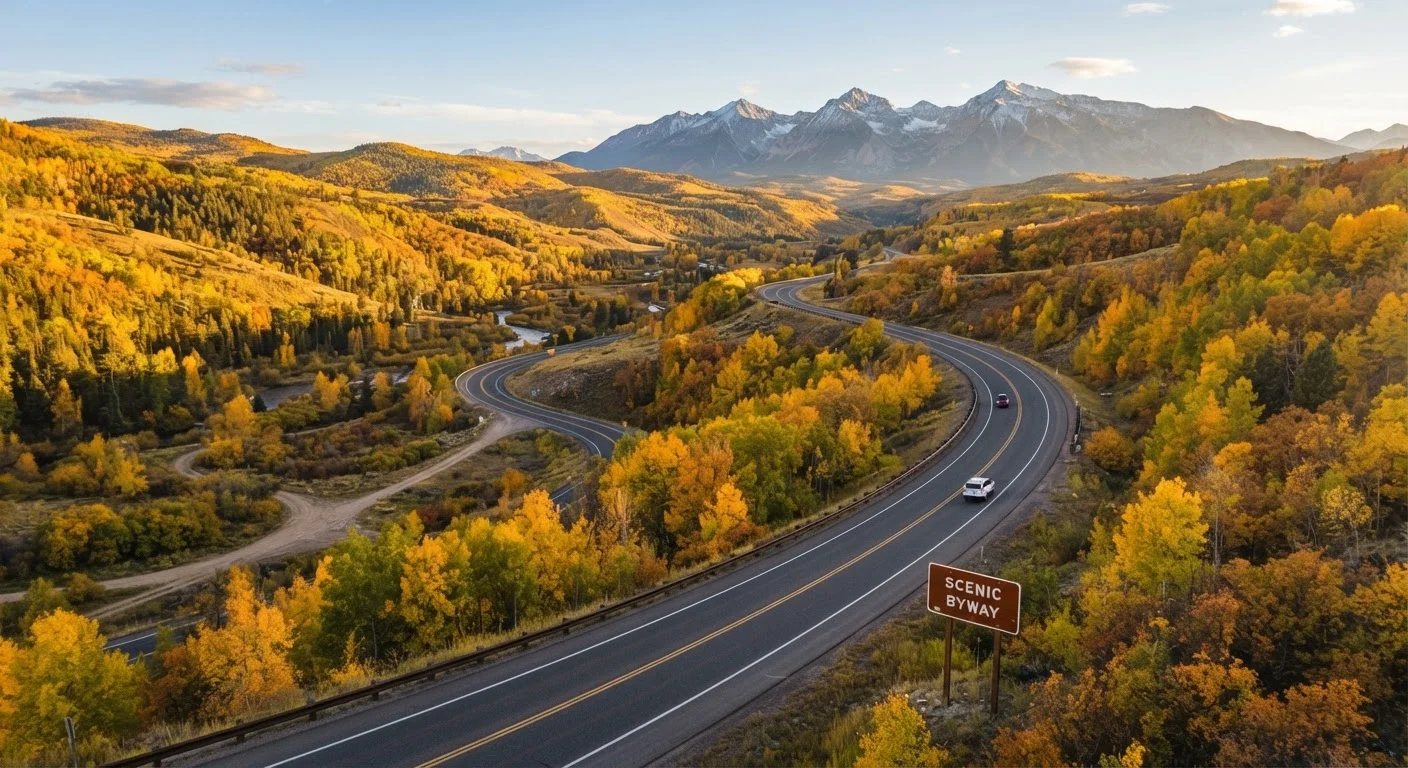
Scenic Byway
A scenic byway is a road officially designated by a government agency — federal, state, or regional — as having special visual, cultural, historical, natural, or recreational qualities worth preserving and promoting. The designation typically comes with signage, planning protections, and sometimes traveler amenities like pull-offs, interpretive signs, and visitor guides. Not every pretty road qualifies — there's a formal nomination and review process behind the label.
At the federal level, the America's Byways program — administered by the Federal Highway Administration — grants one or more of six 'intrinsic qualities' (scenic, natural, historic, cultural, archaeological, or recreational) to qualifying corridors. State-level designations follow their own criteria and may or may not align with federal standards.
Where the Term Comes From
The phrase "scenic byway" sounds self-explanatory — a byway that's scenic. But on a US road map, it carries a more specific meaning shaped by decades of federal and state policy. The modern framework traces back to the Intermodal Surface Transportation Efficiency Act of 1991, which directed the Federal Highway Administration to develop a national program recognizing roads of exceptional character. That program, now known as America's Byways, remains the gold standard for federal designation.
To earn federal recognition, a route must demonstrate at least one of six defined intrinsic qualities: scenic, natural, historic, cultural, archaeological, or recreational. Roads are nominated by states or tribal governments, reviewed by experts, and formally designated by the Secretary of Transportation. The process is deliberate — which is why the label carries weight.
Parallel to the federal program, all 50 states run their own scenic byway systems with their own criteria. A road marked as a scenic byway on a state tourism map may reflect a rigorous state program — or a relatively informal designation process. That variation is worth understanding before you plan a route around the label alone.
What the Designation Actually Does
Scenic byway status isn't purely honorary. Federal designation opens access to dedicated funding streams — historically through federal transportation bills — that states can use for corridor improvements, interpretive signage, pull-off construction, and visitor amenities. It also creates planning obligations: transportation projects proposed along a federally designated corridor must be assessed to ensure they don't compromise the road's intrinsic qualities.
In practical terms, this is why some byways feel more intentionally curated than others. You'll notice consistent brown-and-white signage, well-placed overlooks, and interpretive panels explaining the landscape or history you're passing through. That infrastructure doesn't appear by accident — it's often the downstream result of byway status and the funding it unlocks.
State vs. Federal Designations Differ
Not all scenic byway labels are created equal. Federal America's Byways designation involves a formal multi-step review by the Federal Highway Administration, while state designations can range from equally rigorous processes to relatively straightforward nominations. When researching a specific route, look up which program governs it to understand what the label actually reflects.
State-level protections vary widely. Some states mirror federal review requirements; others treat the designation as primarily promotional. If land preservation along a particular corridor matters to you, it's worth looking into which program governs the specific road.
Why It Matters When You're Planning a Trip
For road trippers, the practical value of knowing a route is a designated byway comes in a few forms. First, it signals that the road has been evaluated by people whose job is to identify what makes a corridor worth slowing down for. Second, designated byways tend to have better traveler infrastructure: rest areas, interpretive stops, and connections to nearby parks or historic sites.
One of the most striking examples is the Great River Road, which follows the Mississippi through ten states and carries America's Byways recognition. Driving it without knowing its designated status means missing the interpretive network and wayfinding system built specifically to enhance the experience.
Use Byway Directories When Route Planning
The Federal Highway Administration's America's Byways directory is searchable by state and by intrinsic quality — so you can filter for, say, historic routes in the Southwest or scenic corridors in New England. Most state DOTs publish their own byway maps as well, often with downloadable guides and suggested itineraries.
When planning your first US road trip, cross-referencing your route against the America's Byways directory can reveal designated corridors you didn't know existed — including some that rival famous drives in beauty but see a fraction of the traffic.
It's also worth noting that some genuinely spectacular roads carry no official designation at all. Designation signals quality; its absence doesn't guarantee mediocrity. Use the label as one useful filter among several, not the only one.
Reading the Map with Fresh Eyes
The next time you see "scenic byway" printed on a map or GPS screen, you're equipped to read it more precisely. Is it a federal America's Byways designation, or a state program? Does it overlap with national parks or major natural areas? What intrinsic qualities earned it the label?
Answering those questions shifts how you experience the drive. A road recognized for its historic qualities invites different attention than one designated for scenic or archaeological value. The designation is, in a sense, a reading guide for the landscape you're about to pass through.
Whether you're headed along the East or West Coast or exploring a Southern coastal route, checking byway designations before you go adds a layer of context that transforms a drive from point A to point B into something more purposeful. That's ultimately what the label is designed to do.
150+
Federally designated America's Byways routes
The Federal Highway Administration's America's Byways program has recognized more than 150 distinct road corridors across the United States as of its most recent published listings.
6
Intrinsic qualities evaluated for federal designation
Federal reviewers assess routes against six defined qualities — scenic, natural, historic, cultural, archaeological, and recreational — and a route must demonstrate strength in at least one to qualify.
10
States traversed by the Great River Road byway
The Great River Road, one of America's longest designated byways, passes through ten states as it follows the Mississippi River from its Minnesota headwaters to the Gulf of Mexico.