
Driving Through America's South: The Storytelling Landscape of the Gulf Coast Route

Key Takeaways
Why the Gulf Coast Route Deserves Your Attention
While travelers flock to California's Pacific Coast Highway or debate the myths of Route 66, the Gulf Coast sits quietly to the south, telling its stories to anyone willing to take the slower road. This is a drive shaped by centuries of collision — French and Spanish colonial ambition, the devastating weight of American slavery, Reconstruction, and the resilient cultures that grew through it all.
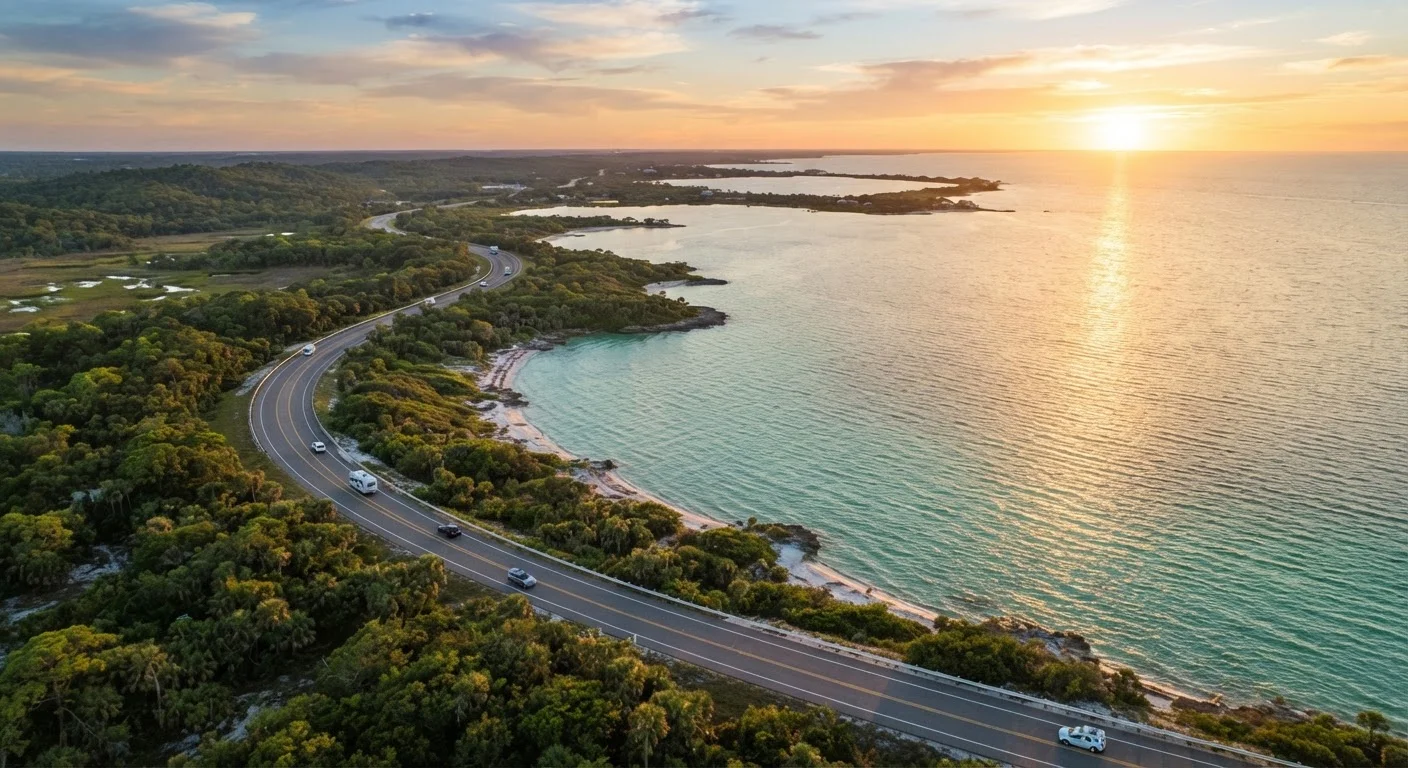
It is also, frankly, one of the most physically beautiful drives in the country. The light here is different — thick and golden, bouncing off water that reads somewhere between green and blue depending on the hour. The air smells of salt and pine. And the food, almost everywhere you stop, is extraordinary.
If you've been planning your first US road trip, the Gulf Coast is an underrated choice: manageable in scale, rich in variety, and less crowded than the routes that dominate travel conversation.
The Route at a Glance: New Orleans to Pensacola
The core drive runs approximately 400 miles from New Orleans, Louisiana, east through Mississippi and Alabama, ending in Pensacola, Florida — or continuing further into the panhandle depending on your schedule. The fastest path follows I-10, but the point of this trip is US-90 and US-98: the old coastal highway and its continuation, which hug the shoreline through small towns, maritime forests, and long stretches of open bay.
~400 mi
New Orleans to Pensacola core distance
Driving the coastal US-90/US-98 corridor rather than I-10 adds time but reveals the route's character.
3–5 days
Recommended minimum trip length
Shorter drives are possible but sacrifice the slower-paced stops that define the Gulf Coast experience.
1848
Year Biloxi Lighthouse was built
One of the oldest lighthouses in the American South, it remains a navigational landmark and public heritage site.
Plan for three to five days at minimum if you want to actually inhabit the places along the way rather than photograph them from the car window. The route pairs naturally with a Mississippi River journey if you want to build a larger Southern loop.
Key Stops and What Makes Each One Worth It
New Orleans, Louisiana — Your starting point needs no overselling, but don't just stay in the French Quarter. The Garden District's architecture, the Tremé neighborhood's musical heritage, and the city's complex Civil War and Reconstruction history deserve real time.
Bay St. Louis, Mississippi — This small coastal town, badly damaged by Hurricane Katrina in 2005, has rebuilt into one of the Gulf's most charming art and food communities. The main street runs close to the water and is walkable in an afternoon.
Biloxi and Gulfport, Mississippi — The Biloxi Lighthouse, one of the oldest in the South, has stood since 1848. The surrounding area carries a layered history including Indigenous Biloxi peoples, French settlement, and significant Civil Rights-era events.
Mobile, Alabama — Often overlooked, Mobile claims one of the oldest Mardi Gras celebrations in North America — predating New Orleans. The historic district and USS Alabama Battleship Memorial Park are both genuinely compelling stops.
On US-90 through Mississippi, build in at least one unscheduled hour per day — some of the most memorable stops on this route are unmarked pulloffs or small businesses with no online presence.
Over-scheduling a Gulf Coast drive tends to push travelers onto the interstate to make time, bypassing the slower roads where the trip's real texture lives.
When visiting historic sites along this route — particularly plantations and Civil War battlefields — seek out interpretive programs that foreground the perspectives of enslaved people and freedmen, not just architectural history.
A growing number of sites along the Gulf Coast corridor have expanded their programming to present more complete historical narratives, and those programs transform what might otherwise be a passive visit into a genuinely informative experience.
Pensacola, Florida — The panhandle's anchoring city sits on a deepwater bay and holds Fort Pickens, part of the Gulf Islands National Seashore. The sugar-white sand beaches here are among the most visually striking on the entire route.
Food, Culture, and the Stories Baked Into the Landscape
Gulf Coast food is not a single cuisine — it's a layered argument between French, Spanish, African, Native American, and Acadian (Cajun) cooking traditions. In New Orleans, that argument produces gumbo, étouffée, and beignets. In coastal Mississippi and Alabama, it shifts toward Gulf seafood preparations — boiled shrimp, fried oysters, crab claws — that reflect the working waterfront culture still alive along the shore.
The landscape itself is a storytelling medium. The antebellum plantations visible along some stretches of this route are not merely architectural curiosities — they are physical records of the enslaved labor that built the Southern economy, and many now offer interpretive programming that centers those histories honestly. Understanding what you're driving through deepens what you see.
Scenic byway designations along portions of US-90 exist partly to protect the visual character of this corridor, but the cultural depth runs well below what any road sign can capture.
Practical Planning: Timing, Pacing, and What to Watch For
Hurricane season officially runs June 1 through November 30, with peak activity typically in August and September. Traveling outside this window — particularly in spring (March through May) — generally offers pleasant temperatures and lower humidity. Summers are hot and humid throughout the region; plan accordingly if you're traveling then.
Lodging ranges from historic inns in New Orleans and Mobile to simple waterfront motels along the Mississippi coast. Book ahead for New Orleans regardless of season; smaller towns along the route are generally more forgiving on availability.
Drivers considering this trip solo will find it well-suited to independent travel — see our thoughts on what changes when you drive alone for practical framing on pacing and safety. Cell coverage is generally solid through the main towns but can be intermittent on stretches of US-98 through more rural sections of the Florida panhandle. Download offline maps before you go.
Most importantly: resist the pull of the interstate. The Gulf Coast's best discoveries — the roadside seafood shacks, the bayou overlooks, the unexpected historical markers — live on the old two-lane highway, not the fast road running parallel to it.
Travel conditions, road access, and local services can change. Verify current entry requirements, weather conditions, and site hours through official state tourism boards and local sources before your trip.