

Key Takeaways
Our Verdict
City breaks and countryside retreats each offer genuinely rewarding European experiences — just very different ones. Cities pack in history, food scenes, and cultural energy; rural escapes trade that density for calm, nature, and local depth. The smartest travelers ask what they need from this particular trip rather than defaulting to one style every time.
| Best for | Recommended |
|---|---|
| First-time European visitors or those with limited time | City Break |
| Travelers seeking rest, restoration, or slower cultural immersion | Countryside Retreat |
| Couples or families wanting flexible pacing and scenic variety | Combined City-Country Itinerary |
| Repeat visitors who've already done the major European capitals | Countryside Retreat |
What You're Really Choosing Between
Deciding between a European city break and a countryside retreat isn't about which destination is more impressive — it's about what kind of traveler you are right now, on this particular trip. A weekend in Barcelona delivers Gaudí architecture, tapas bars, and sensory overload in the best possible sense. A week in rural Umbria gives you silence, hill towns, and the feeling that time has briefly stopped.
Both are valid. Both are genuinely wonderful. But they ask very different things of you, and offer very different returns. Understanding those differences honestly is the best starting point for any European trip plan.
Think about your last few trips. Did you come home energized by everything you packed in — or quietly wishing you'd stayed somewhere longer and moved less? That instinct is worth listening to. For deeper thinking on pacing, see our piece on slow travel vs. whirlwind itineraries.
The Case for a European City Break
City breaks earn their reputation because they're efficient. In three to five days, a traveler can move through museums, neighborhoods, restaurants, and historic sites with a momentum that feels almost cinematic. Rome, Lisbon, Prague, Amsterdam — these cities are engineered, in a sense, for short visits. Public transit is usually excellent, the sights are concentrated, and the food scene alone can fill an itinerary.
City breaks also tend to be logistically simpler. Flights connect directly to major European hubs, accommodation options range from budget hostels to boutique hotels, and you rarely need a rental car. For Americans traveling to Europe for the first time, a city-anchored trip removes a lot of friction.
| City Break | Countryside Retreat | |
|---|---|---|
| Ideal trip length | 3–5 days | 5–10 days |
| Pace | Fast, activity-dense | Slow, open-ended |
| Transport needed | Public transit usually sufficient | Rental car typically required |
| Crowd levels | High at peak season | Generally low to moderate |
| Cultural immersion | Broad but surface-level | Deeper, more local |
| Best for | First-timers, short trips | Repeat visitors, rest-seekers |
The trade-off is real, though. Popular European cities — especially in summer — are genuinely crowded. The Colosseum queue, the Louvre's packed halls, the Trevi Fountain at noon: these experiences are still worthwhile, but they come with noise and waiting. Understanding what to expect at major heritage sites before you arrive makes a measurable difference.
The Case for a Countryside Retreat
A countryside retreat operates on a completely different premise: instead of seeing as much as possible, you inhabit a place. Rural Provence, the Cotswolds, Tuscany's Val d'Orcia, the Portuguese Alentejo — these regions reward travelers who slow down enough to notice them properly.
The sensory experience shifts entirely. Meals take longer because they're meant to. Mornings are genuinely quiet. You might spend an afternoon driving a winding road without a specific destination, which turns out to be the highlight of the trip. For travelers experiencing fatigue from their everyday routines, that kind of unhurried rhythm can feel restorative in ways a city simply can't deliver.
Plan Your Countryside Base Carefully
Rather than moving accommodations every night, choose one well-located rural base — a farmhouse, small inn, or village rental — and make day trips from there. This approach dramatically reduces packing-and-unpacking fatigue while giving you a genuine sense of belonging somewhere. Many of Europe's most memorable countryside regions are compact enough to explore thoroughly from a single base within a 30-to-45-minute drive.
Countryside travel in Europe also often reveals a more textured, less tourist-facing version of local culture. Village markets, family-run agriturismos in Italy, or a small regional winery in the Douro Valley offer encounters that no city highlight reel can replicate. If exploring the contrast between Portugal's popular coast and its quieter interior interests you, our piece on coastal vs. inland Portugal is worth reading before you book.
The practical challenges are real: you'll likely need a rental car, fewer accommodations are available, and rural areas don't always lend themselves to last-minute planning. But for travelers who've already ticked off the major capitals, the countryside often becomes the experience they talk about most.
Combining Both: A Smarter Middle Ground
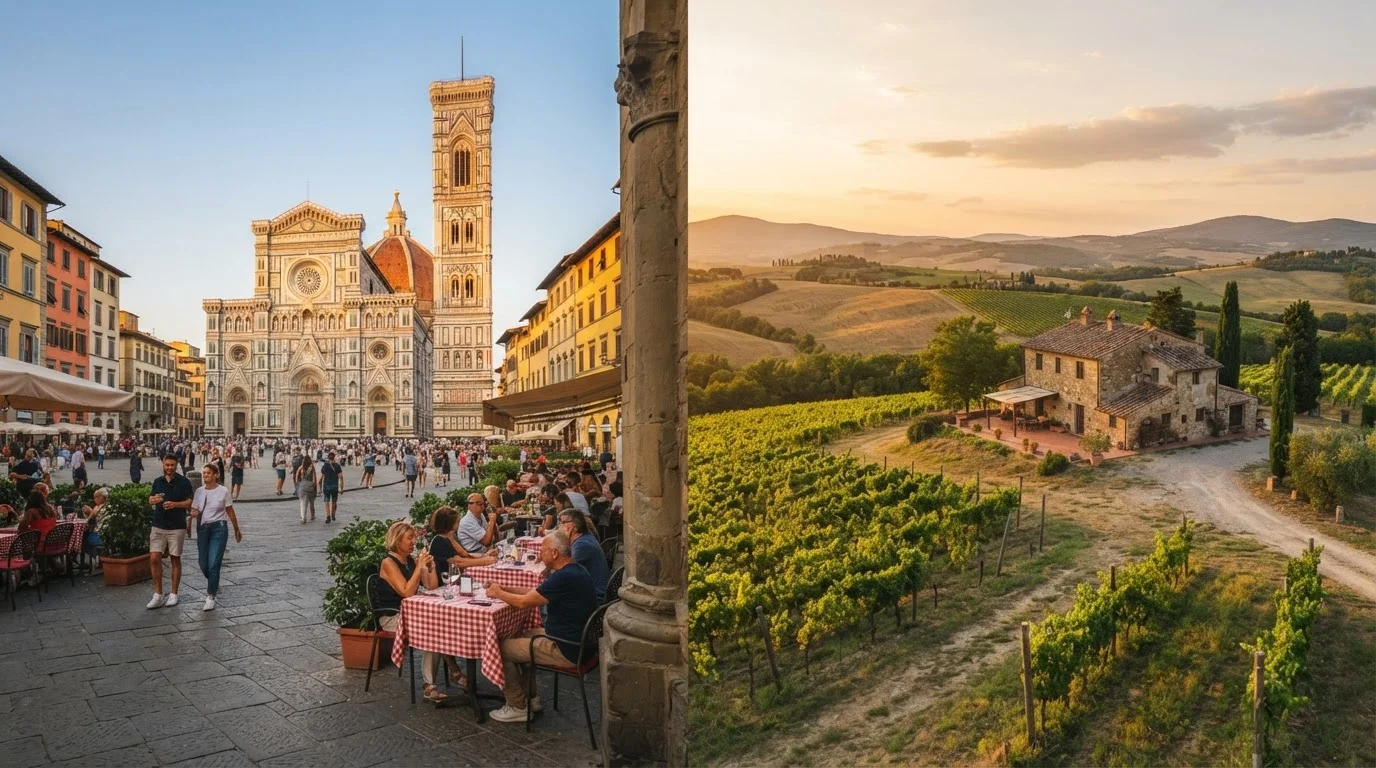
Many European trips don't have to choose. A week that opens with two days in Florence before moving into the Chianti hills gives you city energy followed by countryside decompression — and each part makes the other feel more vivid by contrast. Similarly, arriving into Lisbon before heading east into the Alentejo plains uses the city as an orientation point before the slower portion begins.
The key is sequencing thoughtfully. City-first, countryside-second tends to work better than the reverse — arriving back into a busy airport after days of rural calm can feel jarring. Building this kind of hybrid itinerary well takes some care; our guide on building an itinerary that won't burn you out covers exactly how to balance activity with breathing room. And for travelers weighing how long to stay in each place, slow travel vs. country-hopping lays out the real trade-offs clearly.