

Key Takeaways
Option A
Coastal Portugal
The sun-drenched, internationally beloved Portugal everyone pictures.
Best for: Travelers who want beaches, buzzy cities, Atlantic seafood, and well-developed tourist infrastructure.
Option B
Inland Portugal
The quieter, slower, deeply authentic Portugal most visitors never see.
Best for: Travelers seeking ancient villages, cork forests, Douro Valley wine country, and a genuine local pace of life.
If you want beaches, nightlife, and easy city-hopping
Coastal Portugal
Lisbon, Porto, and the Algarve offer established transport links, vibrant food scenes, and Atlantic coastline that genuinely earns its reputation.
If you want to avoid tourist crowds entirely
Inland Portugal
Regions like Alentejo and Trás-os-Montes see a fraction of visitor numbers, meaning you get historic towns and local restaurants almost to yourself.
If this is your first trip to Portugal
Coastal Portugal
The coastal corridor — Lisbon to Porto with an Algarve extension — is forgiving for first-timers and still genuinely rewarding.
If you're a repeat visitor or slow traveler
Inland Portugal
The interior reveals the Portugal that most photo feeds miss: medieval castle towns, sheep-dotted plains, and centuries-old winemaking traditions.
If culinary exploration drives your itinerary
Inland Portugal
Alentejo's black pork, açorda bread soups, and local wines represent a distinct food culture rarely found on tourist menus near the coast.
What Each Region Actually Looks Like
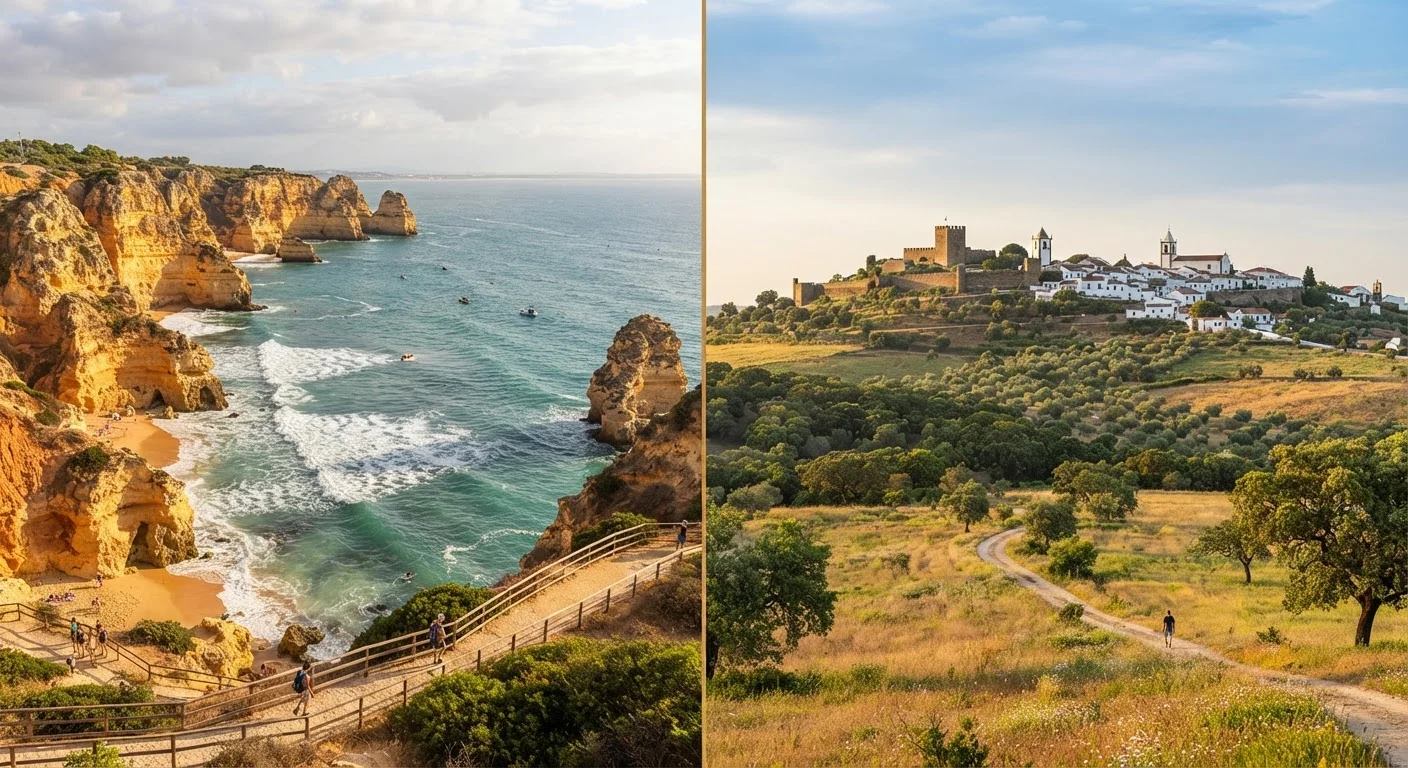
Coastal Portugal is the version the internet sells you: terracotta rooftops above Lisbon's seven hills, golden Algarve sea cliffs, tiled azulejo facades catching Atlantic light. It is, genuinely, beautiful — and there's a reason travelers have been arriving in waves for decades. The coastline runs more than 1,100 miles, shifting from the wilder surf-battered shores of the Alentejo coast to the calmer, family-friendly coves of the southern Algarve.
Inland Portugal tells a different visual story entirely. The Alentejo region — a vast plateau covering roughly a third of the country — rolls out in plains of cork oak, olive groves, and wheat fields that shimmer gold in summer. Further north, the Douro Valley carves dramatic terraced vineyards into steep schist hillsides, while Trás-os-Montes in the northeast is rugged, forested, and almost startlingly remote. Historic walled towns like Évora, Marvão, and Bragança feel less like tourist attractions and more like living museums where locals still go about daily life undisturbed.
| Criterion | Coastal Portugal | Inland Portugal |
|---|---|---|
| Landscape | Cliffs, beaches, urban riverfront | Plains, cork forests, terraced valleys |
| Crowd levels | High in peak season | Low to very low year-round |
| Getting around | Train, bus, metro | Rental car strongly recommended |
| English widely spoken | Yes, in most tourist areas | Less so; basic Portuguese helpful |
| Food character | Seafood, pastries, city dining | Pork, bread soups, rural taverns |
| Accommodation range | Hotels, hostels, resorts | Rural quintas, agritourism, small inns |
| Best season to visit | Spring, summer, autumn | Spring and autumn (summers very hot) |
Infrastructure, Logistics, and Getting Around
One of the most practical differences between the two Portugals is ease of movement. The coastal corridor — connecting Lisbon, Porto, and the Algarve by train and expressway — is well-served, relatively affordable by Western European standards, and navigable without a car. Lisbon's metro is efficient. Algarve resort towns have regular bus connections. English is widely spoken in hotels, restaurants, and shops along the coast.
Inland is a different calculation. Public transport exists but is sparse; many village-to-village connections involve infrequent buses or none at all. A rental car transforms what's possible. That said, roads in the interior are generally quiet and well-maintained, and driving through cork forest or along Douro Valley switchbacks is itself a highlight. If the idea of slow, road-trip-style travel appeals to you, the interior rewards it enormously — much as we explore in our piece on slow travel versus country-hopping.
Visa and Entry Requirements
Portugal is part of the Schengen Area. Entry requirements, visa rules, and any travel advisories change over time and vary by nationality. Always verify current requirements through your government's official travel advisory website and Portugal's official immigration authority before booking. Do not rely solely on travel articles for entry documentation guidance.
Crowds, Cost, and Seasonal Rhythm
High season on the Algarve (roughly June through August) brings significant crowds and corresponding price spikes for accommodation, particularly in popular resort towns. Lisbon, too, has become noticeably busier in recent years, with visitor numbers putting pressure on neighborhoods like Alfama and Bairro Alto. This doesn't make the coast worth avoiding — but it does mean planning matters.
The interior operates on a different seasonal clock. Alentejo summers are scorching — inland temperatures regularly exceed what you'd experience on the coast — so spring (April–June) and autumn (September–October) are the sweet spots. During those shoulder months, you can often find guesthouses and rural quintas (country estates) at prices that feel almost anachronistic by European standards. This trade-off between accessibility and authenticity is a core theme in how travelers choose between city breaks and countryside retreats across Europe.
Food, Wine, and Cultural Identity
Portuguese food is already one of Europe's most underrated culinary traditions — but coastal and inland kitchens diverge considerably. The coast leans on the extraordinary seafood the Atlantic provides: grilled sardines, percebes (barnacles), bacalhau (salt cod) prepared dozens of ways, and fresh fish brought in daily at local markets. In Lisbon and Porto, pastéis de nata and craft coffee culture sit comfortably alongside centuries of tradition.
Inland, the larder shifts. Alentejo cuisine is built on pork — particularly the acorn-fed Iberian black pig — and slow-cooked dishes like carne de porco à Alentejana (pork with clams, a beloved Portuguese paradox). Bread soups, migas, and game are common. Alentejo is also Portugal's most dynamic wine region, producing bold, sun-concentrated reds and increasingly interesting whites. The Douro Valley, naturally, is port wine country — but it now produces some of Portugal's finest still wines too. Tasting either region's wine in context, rather than at an export retailer, is a genuinely different experience.
~30%
Of Portugal covered by Alentejo region
Despite covering roughly a third of the country's landmass, Alentejo is one of Portugal's least densely populated regions, contributing to its open, unhurried character.
1,100+ miles
Length of Portugal's Atlantic coastline
Portugal's extensive coastline — one of the longest in Western Europe — varies dramatically in character from north to south, from wild surf to sheltered coves.