

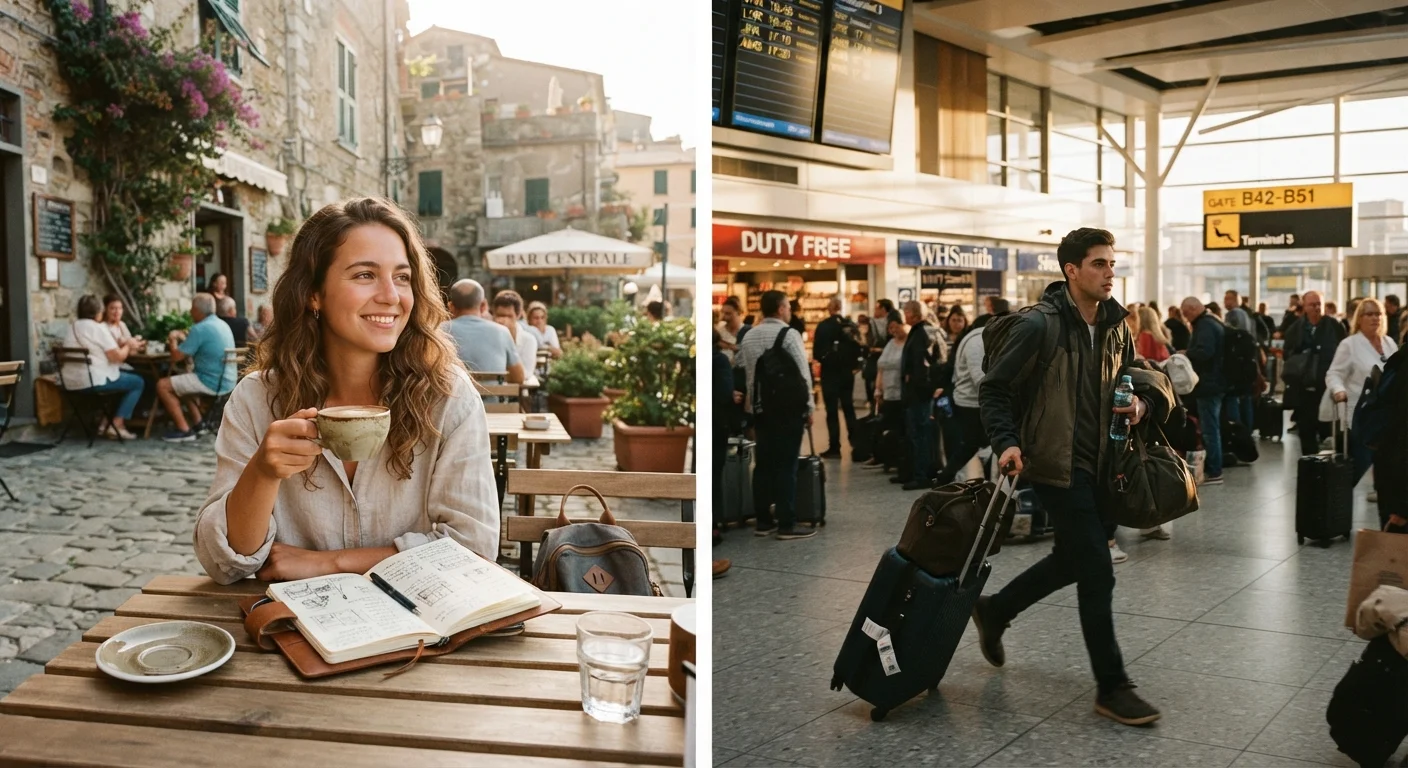
Key Takeaways
Option A
Slow Travel
The deep-dive, stay-longer approach to experiencing a place.
Best for: Travelers who want cultural immersion, lower daily costs, and a more relaxed pace without constant transit.
Option B
Country-Hopping
The see-more, move-fast strategy for covering ground quickly.
Best for: Travelers with limited vacation time who want to sample multiple destinations in a single trip.
If you have two weeks or fewer and want to experience multiple regions
Country-Hopping
A tight itinerary with strategic routing lets you sample several destinations without wasting days on transit if planned carefully.
If you're traveling for a month or more and want to keep costs manageable
Slow Travel
Weekly and monthly accommodation rates, local grocery shopping, and fewer transport purchases dramatically reduce your daily burn rate.
If cultural depth and genuine local connection matter more than variety
Slow Travel
Staying long enough to find your corner café, recognize neighbors, and navigate a place like a temporary resident is simply not possible in two or three days.
If you're a first-time international traveler wanting to scout future destinations
Country-Hopping
Brief stops across several countries help you identify which places deserve a longer return visit, making future trips more intentional.
If minimizing travel stress and decision fatigue is a priority
Slow Travel
Fewer logistics to juggle, one set of local routines to learn, and no recurring packing-and-transit cycles means a genuinely lower-stress trip.
The Real Cost Breakdown: Transit, Accommodation, and Daily Life
The biggest financial difference between these two styles lives in transport. Country-hopping means paying for movement constantly — flights between capitals, intercity trains, airport transfers, and baggage fees. Even budget carriers add up when you're crossing three or four borders in two weeks. By contrast, a slow traveler might spend the entire transport budget on a single long-haul flight and one or two regional trains.
Accommodation follows a similar logic. Hotels and short-term rentals priced per night are standard for country-hoppers, and nightly rates are almost always higher than the per-night equivalent of a weekly or monthly rental. A studio apartment in Lisbon might cost significantly less per night booked for three weeks than the same neighborhood's hotel rate. For a thorough look at where trip spending actually concentrates, see our breakdown of real travel budget categories.
Daily living costs shift too. A slow traveler can visit a local market, stock a small kitchen, and cook several meals a week — a habit that meaningfully reduces food spending. A country-hopper eating out every meal because there's no kitchen and no time to shop pays restaurant prices at every stop.
| Criterion | Slow Travel | Country-Hopping |
|---|---|---|
| Transport costs | Low — mostly one major journey | High — repeated flights or trains |
| Accommodation rate | Lower per night (weekly deals) | Higher per night (nightly rates) |
| Food spending | Lower — cooking possible | Higher — mostly eating out |
| Decision fatigue | Low after initial setup | High — constant new logistics |
| Cultural depth | High — routines and community | Low — surface-level exposure |
| Destinations covered | One or two | Many |
| Minimum days to feel worthwhile | 10–14 days per place | 7–10 days total feasible |
| Packing complexity | Low — unpack and settle | High — frequent repacking |
The Hidden Costs You Don't See on a Spreadsheet
Money isn't the only currency being spent. Country-hopping burns time and mental energy in ways that rarely appear in budget calculators. Every new destination means re-learning transit systems, deciphering new currency or payment norms, navigating unfamiliar neighborhoods, and making dozens of micro-decisions — all while running on disrupted sleep from overnight buses or early flights.
Slow travel has its own hidden costs, though. Staying somewhere long enough to feel settled sometimes reveals that a destination isn't quite what you hoped — and you're committed. There's also the opportunity cost of depth over breadth: spending six weeks in one country means six weeks not spent somewhere else.
A Note on Entry Requirements and Visa Rules
Country-hoppers crossing multiple borders within a single trip need to pay close attention to visa requirements, permitted stay durations, and any regional travel zone rules that apply to their passport. Schengen Area limits, for example, restrict how long non-EU visitors can stay across participating countries in any 180-day period. Always verify current rules directly with official government sources and destination embassies well before your departure date — these regulations change, and travel information in articles like this one cannot substitute for official guidance.
If you're weighing how much movement is too much, our guide on finding the travel pace that suits you digs into the stress and experience trade-offs from a different angle. And if itinerary structure is the concern, building an itinerary that won't burn you out offers practical spacing strategies worth reading before you book.
Which Style Actually Suits Your Trip?
Trip length is probably the most honest deciding factor. If you have ten days, slow travel in a single region often feels like the better fit — you get to exhale, explore side streets, and stop performing tourism. But if you have three weeks and genuinely want to see coastal Portugal alongside a stint in southern Spain, thoughtful country-hopping with strategic routing can work well. For destination-specific inspiration, our look at coastal versus inland Portugal shows how even a single country rewards a more layered approach.
Travel style and temperament matter just as much as budget. Some people find slow travel quietly revelatory; others find it restless-making after day five. Country-hopping suits natural planners who enjoy the logistics game — but if packing and unpacking every few days sounds exhausting, that signal is worth trusting.
There's also a middle path worth naming: anchor travel, where you base yourself in one city and take day or overnight trips to surrounding areas. It blends the accommodation savings of slow travel with some of the variety of country-hopping — and it sidesteps the worst of both styles' trade-offs. Whatever approach you choose, verify current entry requirements, local conditions, and travel advisories with official government sources before booking.