

Key Takeaways
Tyre Pressure
Tyre pressure refers to the amount of air inside a tyre, measured in pounds per square inch (PSI). Every vehicle has a manufacturer-specified pressure range that balances ride comfort, tyre wear, fuel efficiency, and safe handling. When pressure falls outside that range — too high or too low — the tyre cannot perform as designed.
Tyre pressure is typically measured in PSI in the US, though some gauges also display bar or kPa. Always use cold-inflation readings — taken before the vehicle has been driven more than a mile — because driving heat temporarily raises pressure by several PSI.
Why Tyre Pressure Is So Easy to Neglect
Unlike a warning light you cannot ignore or a noise that follows you down the highway, incorrect tyre pressure is invisible. A tyre can be 10 PSI under-inflated and still look — to the untrained eye — completely normal. That invisibility is precisely why tyre pressure tops the list of maintenance tasks drivers consistently skip.
It does not help that many drivers believe their vehicle's Tyre Pressure Monitoring System (TPMS) is doing the job for them. TPMS, required on US vehicles since 2008, only triggers an alert when pressure drops roughly 25% below the recommended level. By that point, meaningful damage to the tyre — and your fuel economy — is already underway. Relying solely on TPMS is a bit like waiting for your fuel warning light before thinking about stopping for gas.
As part of the habits that quietly extend your vehicle's lifespan, monthly pressure checks take fewer than five minutes and cost nothing beyond owning a basic gauge.
~1 PSI
Monthly natural pressure loss per tyre
Rubber is permeable; tyres lose roughly 1 PSI per month under normal conditions, independent of any puncture or leak.
1 PSI per 10°F
Pressure drop per temperature change
The US Department of Transportation notes that tyre pressure changes approximately 1 PSI for every 10°F shift in ambient temperature.
25%
Under-inflation threshold before TPMS alerts
Federal TPMS standards require a warning only when pressure drops 25% or more below the vehicle placard specification — well into unsafe territory.
What Correct Tyre Pressure Actually Does
Manufacturer-specified tyre pressure is not arbitrary. Engineers test extensively to find a pressure range where the tyre's contact patch — the portion touching the road — is optimal. At the right pressure, the full designed width of the tread contacts the road evenly, giving you predictable braking, cornering stability, and wear across the tyre's life.
Under-inflation causes the tyre to sag and bulge at the sides. The centre of the tread lifts away from the road while the shoulders carry excess load. This generates heat, accelerates edge wear, and over time can cause internal structural damage or blowout. It also increases rolling resistance, meaning your engine works harder — and burns more fuel — for the same speed.
Over-inflation produces the opposite effect: the centre of the tread becomes the primary contact point, wearing prematurely, while the inflated tyre becomes stiffer and more vulnerable to impact damage from potholes and road debris.
The compounding nature of these effects is why skipping small repairs often leads to bigger bills. A tyre running low for months does not just wear faster — it can fail prematurely, require early replacement, and in serious cases contribute to loss of vehicle control.
Buy a Dedicated Gauge for Accuracy
A quality digital or dial-style tyre pressure gauge costs only a few dollars at any auto parts store and fits in your glove box. Station air hose gauges are often inaccurate due to heavy use and exposure. Owning your own gauge means you can check pressure any time — not just when you happen to be near a pump.
How to Check and Correct Your Tyre Pressure
The correct pressure for your vehicle is not the number moulded onto the tyre sidewall. That figure is the tyre's maximum structural limit, not the recommended driving pressure. Your vehicle's recommended PSI is printed on a sticker inside the driver's door jamb or, in some models, inside the fuel filler flap. It is also listed in the owner's manual.
To check pressure accurately:
- Check cold. Measure before driving or within the first mile. Driving raises tyre temperature and pressure, giving you a falsely high reading.
- Remove the valve cap from the tyre's valve stem — the small rubber or metal nozzle protruding from the wheel rim.
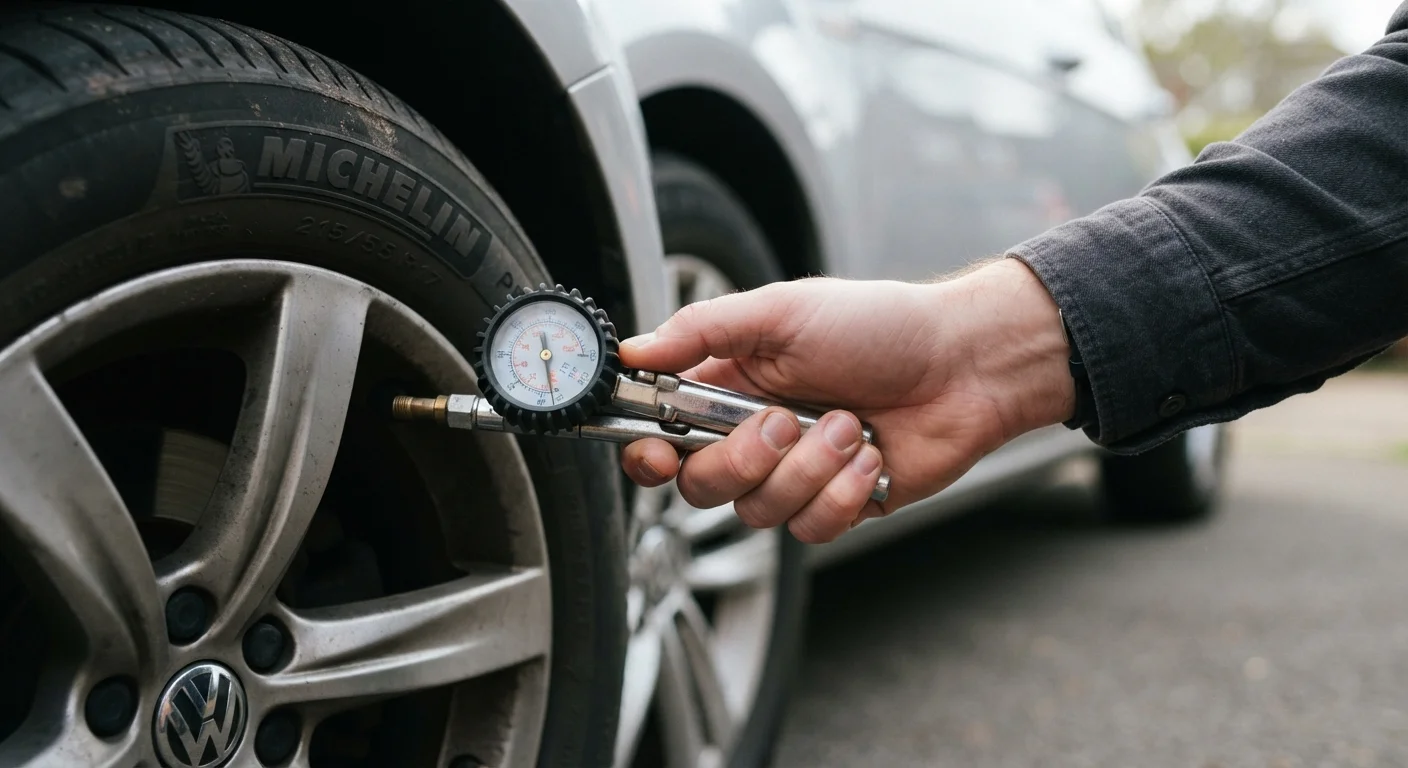
- Press your gauge firmly onto the valve. A quality digital or dial gauge will give you a reading within seconds. Note the PSI.
- Compare to your door jamb sticker. If pressure is low, add air; if too high, release small amounts by pressing the pin in the centre of the valve stem.
- Replace the valve cap. Caps keep dust and moisture out of the valve mechanism.
Note that front and rear tyres sometimes have different recommended pressures, particularly on performance vehicles or trucks — always check the sticker rather than assuming all four are the same.
Building Pressure Checks Into Your Routine
The most practical approach is linking tyre pressure checks to something you already do regularly. Many drivers tie it to the first of each month, a regular fuel stop, or an oil change interval. The key is consistency rather than perfection — checking every five or six weeks is far more valuable than never checking at all.
Temperature swings deserve special attention. For every 10°F drop in ambient temperature, tyres typically lose approximately 1 PSI. A tyre correctly inflated in September can be noticeably under-inflated by December without any air escaping. Building in a check at the start of winter — and again in spring — addresses this seasonal drift.
If you find yourself frequently adding air to the same tyre, that is a signal worth investigating. A slow leak from a nail, damaged valve stem, or cracked wheel may be the cause. Older vehicles in particular can develop valve stem deterioration that causes gradual, hard-to-detect leaks.
Tyre pressure is one of the few maintenance tasks entirely within a driver's control, requires no special skill, and pays measurable dividends in tyre longevity, fuel economy, and safety. It is, in short, the maintenance task most worth not skipping. For a broader look at what keeping your car properly maintained involves, see keeping on top of scheduled servicing.
Spare Tyre Pressure Is Often Overlooked
Many drivers check their four main tyres but forget the spare entirely. A spare tyre that is flat when you need it is of no use. Check and inflate your spare to the pressure listed in your owner's manual — typically higher than your road tyres if it is a compact 'donut' spare — at least every few months.