

Key Takeaways
What a Scheduled Service Actually Covers
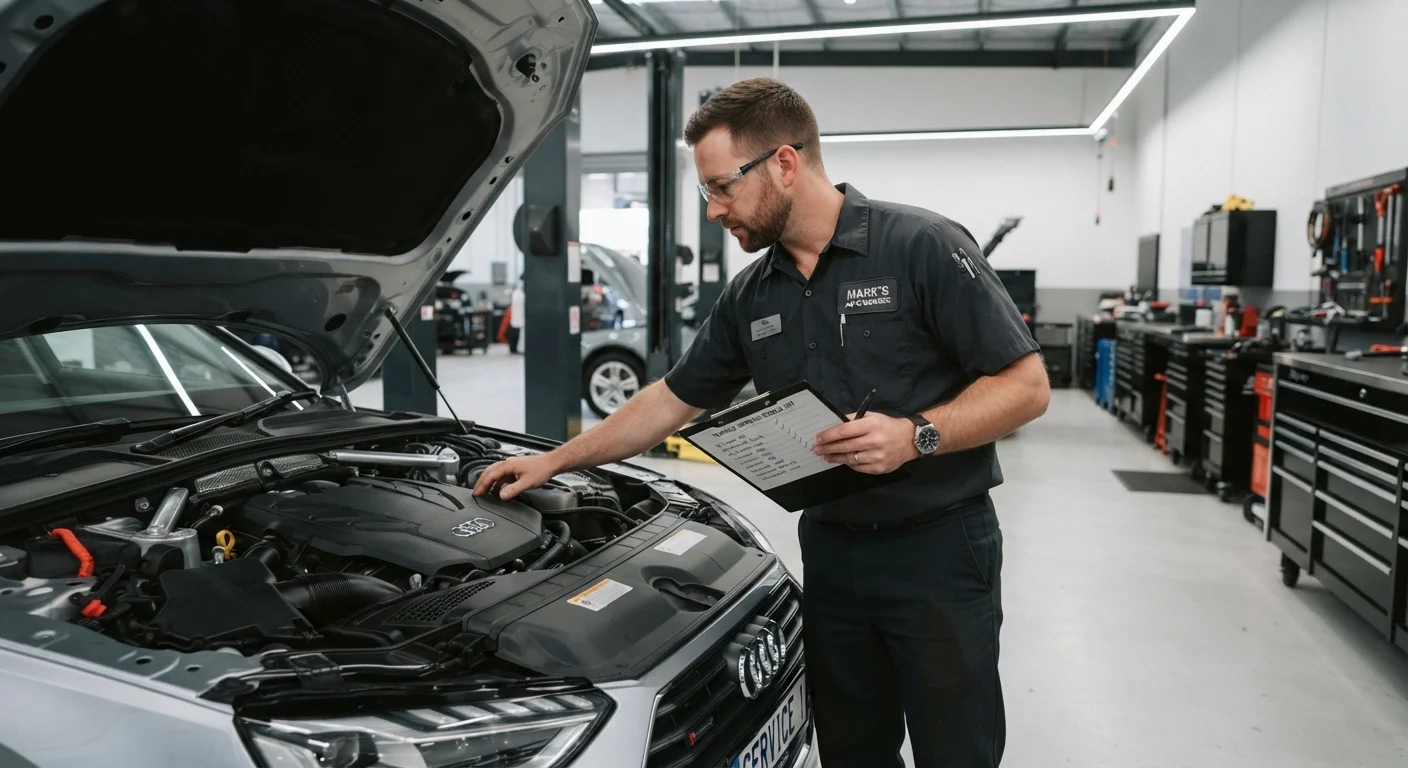
Many drivers think of a scheduled service as little more than an oil change with a stamp in the booklet. In reality, a full log book service is a systematic inspection of dozens of interconnected systems. What gets checked at any given interval depends on your vehicle's make, model, and accumulated mileage — but most standard services include:
- Engine oil and filter replacement — fresh oil removes contaminants and restores lubrication; a clogged filter can starve engine components of oil flow
- Fluid level checks and top-ups — coolant, brake fluid, transmission fluid, and power steering fluid all degrade or deplete over time
- Air and cabin filter inspection or replacement — a blocked air filter reduces engine efficiency; a dirty cabin filter affects air quality inside the vehicle
- Tyre condition and pressure — tread depth, even wear, and correct inflation are safety-critical checks
- Brake system inspection — pad thickness, rotor condition, and brake fluid quality are assessed
- Battery condition test — voltage output and charge retention give an early warning of impending failure
- Lights, wipers, and horn — basic functional checks that are easy to overlook between services
At higher mileage intervals — typically around 30,000, 60,000, and 90,000 miles — more involved work is scheduled, such as spark plug replacement, timing belt or chain inspection, and transmission fluid changes. For a detailed breakdown of what happens at each milestone, see what each service milestone involves.
Why Service Intervals Exist — and Why They're Not Negotiable
Manufacturer service intervals are not marketing tools or conservative guesses — they are engineering specifications based on how quickly specific fluids degrade, how much heat and friction accumulates in key components, and how long filters can capture contaminants before restricting flow. Treating them as flexible suggestions carries real consequences.
“Preventive maintenance is the cheapest form of repair. The cost of ignoring a service interval is almost always paid later — at a much higher price.”
— Cars & Driving Editorial Team, Automotive maintenance writers and advisors
Motor oil, for example, breaks down chemically under heat and pressure, losing its ability to prevent metal-on-metal contact. To understand exactly what happens to oil between changes, see our article on how motor oil degrades over time. Brake fluid is hygroscopic — meaning it absorbs moisture from the air — which lowers its boiling point and reduces braking performance over time, even if the pedal still feels firm.
40%
Engine wear increase from degraded oil
Engineering studies on motor oil degradation suggest that running significantly beyond recommended oil change intervals can increase internal engine wear rates substantially, depending on driving conditions and oil type.
2–3×
Cost multiplier for deferred repairs
Industry service data consistently indicates that small mechanical issues left unaddressed through missed services tend to escalate into failures costing two to three times more to fix than if caught early.
Delaying services also risks voiding manufacturer warranty coverage. Most new vehicle warranties require documented, on-schedule servicing at approved intervals. A gap in that record — even a short one — can give an insurer or manufacturer grounds to decline a warranty claim on a related component failure.
Practical Habits That Keep You on Schedule
Staying on top of scheduled servicing is less about remembering dates and more about building a few reliable habits into how you manage your vehicle.
Set a dual reminder — by date and by mileage — for every scheduled service.
Manufacturer intervals are expressed as whichever comes first: a time limit (e.g. 12 months) or a mileage threshold (e.g. 7,500 miles). Tracking only one risks missing the other. Low-mileage drivers often hit the time limit before the mileage marker.
Keep your owner's manual and service log book accessible in the vehicle at all times.
The owner's manual contains the definitive service schedule for your specific vehicle. Mechanics and dealers also need the service log book to verify previous work — having it on hand prevents disputes and validates warranty claims.
Don't ignore warning lights in the period between scheduled services.
Service intervals address predictable wear, but sensors can detect acute problems — low oil pressure, coolant temperature, or brake system faults — that arise between scheduled visits. Ignoring them because a service is 'not due yet' can turn a minor fix into a major failure.
Ask for an itemised inspection report after every service.
A written summary of what was inspected, what was replaced, and what was flagged as a future concern gives you a clear picture of your vehicle's condition. It also creates an objective record if a dispute arises over whether a problem existed before a service visit.
One of the most underrated tools available to any car owner is a simple, consistent maintenance log. Recording service dates, the work performed, and the mileage at each visit creates a paper trail that pays dividends at resale time and makes it far easier to spot patterns — like a component that keeps failing prematurely. Our guide on keeping a car maintenance log explains exactly how to set one up without overcomplicating it.
It's also worth pairing your scheduled services with seasonal readiness checks. Before summer heat or winter cold sets in, certain systems need attention beyond what a standard service interval covers. See what to check before each season for a practical checklist. And don't overlook the small things between services — tyre pressure is one of the most skipped yet most consequential checks any driver can do in under five minutes.