

Key Takeaways
Pet Food Ingredients List
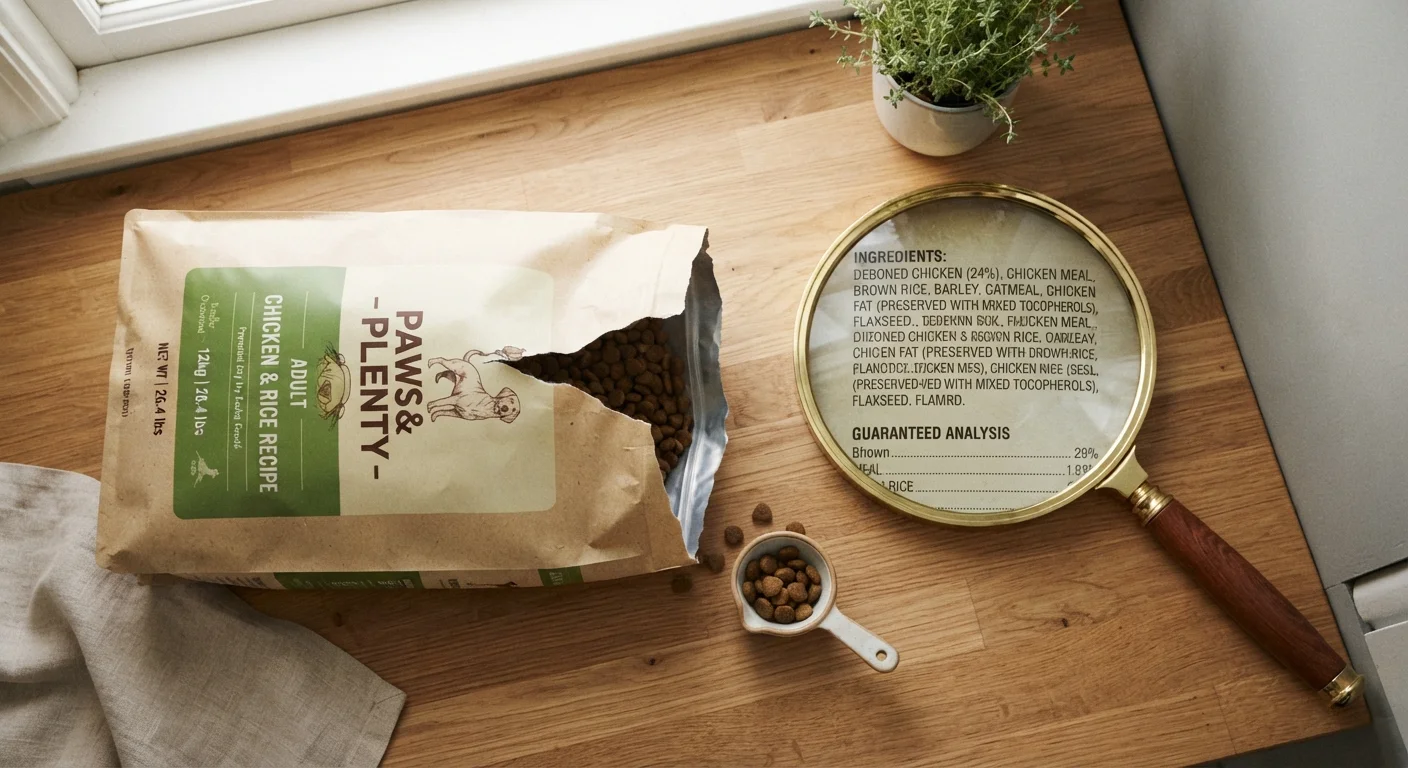
The ingredients list on a pet food label is a regulated, standardized disclosure of every substance used to make that food, listed in descending order by pre-cooking weight. It tells you what raw materials went in before processing — but not necessarily how much of each nutrient survived cooking. Regulators in the U.S., specifically AAFCO (the Association of American Feed Control Officials), set definitions for ingredient names so that terms mean something specific, not just something appealing.
AAFCO ingredient definitions distinguish between named meat meals (e.g., 'chicken meal'), generic by-products, and whole muscle meats — each category has regulated inclusion standards that affect nutrient density estimates.
The Rules Behind the Label
Pet food sold in the U.S. is regulated at both the federal level (by the FDA) and the state level, with most states adopting AAFCO model regulations as their standard. AAFCO doesn't directly approve products, but it establishes the ingredient definitions, nutrient profiles, and labeling rules that manufacturers must follow. That framework is why the phrase 'chicken meal' means something consistent from brand to brand.
The ingredients list is required to use standardized ingredient names — manufacturers can't invent flattering terms. What they can do is select which ingredients to use, how to process them, and how to frame them in marketing copy surrounding the label. Understanding the regulated portion helps you cut through the marketing layer.
For a broader look at all the panels on a pet food package — including feeding guidelines and the guaranteed analysis — see our guide on what pet food labels actually tell you.
AAFCO Defines Terms, But Doesn't Approve Products
A common misconception is that AAFCO 'certifies' or 'approves' individual pet foods. It does not. AAFCO publishes the model regulations, ingredient definitions, and nutrient profiles that state feed control officials use to regulate products sold in their states. The responsibility for compliance rests with the manufacturer, not a central approval body.
Pre-Cooking Weight and Why It Misleads
The single most important thing to understand about ingredients lists is that every item is ranked by its weight before processing. Whole chicken, for example, is approximately 70% water. After cooking, that same chicken loses most of its mass. A 'chicken meal,' by contrast, is already a dried, concentrated protein — it may appear third or fourth on the list but contribute more actual protein than the whole chicken listed first.
This doesn't make whole meat a bad ingredient — it's a legitimate and digestible protein source. But it does mean that ingredient rank alone is an incomplete guide to protein contribution. The guaranteed analysis panel, which shows minimum crude protein and fat percentages alongside maximum fiber and moisture, gives a more accurate picture of what's actually in the bowl.
~70%
Moisture content in whole raw chicken
This high water content explains why whole meats often rank first on ingredients lists even when they contribute less post-processing protein than a dried meal ingredient.
50+
Nutrient minimums in AAFCO dog food profiles
AAFCO's nutrient profiles for adult dog maintenance specify minimums and some maximums for more than 50 individual nutrients, providing the regulatory framework manufacturers must meet to make completeness claims.
2
AAFCO substantiation methods for adequacy claims
A pet food can claim nutritional completeness either by formulation against published AAFCO profiles or by passing a controlled animal feeding trial — each carries different levels of real-world validation.
Ingredient Splitting and What It Hides
Ingredient splitting is the practice of listing the same base material under multiple names to reduce its apparent dominance in the formula. For example, a food might list 'ground yellow corn,' 'corn gluten meal,' and 'corn bran' as separate entries. Individually, each sits lower on the list — but combined, corn may be the largest ingredient by weight.
This tactic is legal and not inherently deceptive in a regulatory sense, but it's worth recognizing. When you see several entries that clearly derive from the same source, mentally group them and consider their collective contribution. The same principle applies to multiple sugar or fat sources.
Diet composition also plays a direct role in your pet's long-term health. If you want to understand how excess calories from any source contribute to weight issues, our article on pet obesity and its health implications offers useful context.
Terms That Sound Alarming (But Have Regulated Meanings)
By-products: The word sounds like waste, but AAFCO defines 'meat by-products' as clean parts of slaughtered animals other than muscle meat — including lungs, kidneys, brain, and liver. Organ meats are among the most nutrient-dense parts of an animal and are consumed widely in human diets globally. Named by-products (e.g., 'chicken by-products') are preferable to generic terms like 'poultry by-products,' which don't specify species.
Meal: A 'meal' ingredient (e.g., 'salmon meal') is rendered and dried, meaning moisture has been removed to concentrate nutrients. Named meals are generally considered a reliable protein source. 'Meat and bone meal' or 'animal meal' without species identification are less specific and considered lower transparency.
Digest: 'Chicken digest' refers to material hydrolyzed from clean animal tissue. It's used primarily as a palatability enhancer in small quantities and is not a primary protein source despite sounding substantial.
For a broader comparison of feeding approaches and how ingredient sourcing fits into each, see dry food, wet food, or raw diet comparisons.
Use the Guaranteed Analysis, Not Just the List
When comparing two foods, look at the guaranteed analysis panel rather than ranking ingredients by position. Calculate protein and fat on a dry matter basis by dividing the listed percentage by (100 minus the moisture percentage), then multiplying by 100. This removes moisture differences and lets you compare foods with different water content on equal footing.
The Most Important Line on the Package
The AAFCO nutritional adequacy statement — often found in small print near the bottom of the label — is arguably more meaningful than the entire ingredients list. It tells you whether the food was formulated to meet AAFCO nutrient profiles for a specific life stage, or whether it passed actual animal feeding trials.
'Formulated to meet' means the recipe was calculated to hit nutrient targets on paper. 'Animal feeding tests' means the food was fed to real animals under AAFCO protocols and assessed for health outcomes — generally considered a higher standard. A label that says 'for intermittent or supplemental feeding only' means the food is not complete and balanced and should not be a primary diet.
No label can substitute for professional guidance tailored to your individual animal. Always consult your veterinarian when evaluating major dietary decisions, especially for pets with health conditions, seniors, or growing animals. The Pet Care Basics hub also offers practical guidance across everyday care decisions.
This article is for general informational and educational purposes only and is not a substitute for professional veterinary advice. Consult a licensed veterinarian before making significant changes to your pet's diet.