

Key Takeaways
Pet Food Label
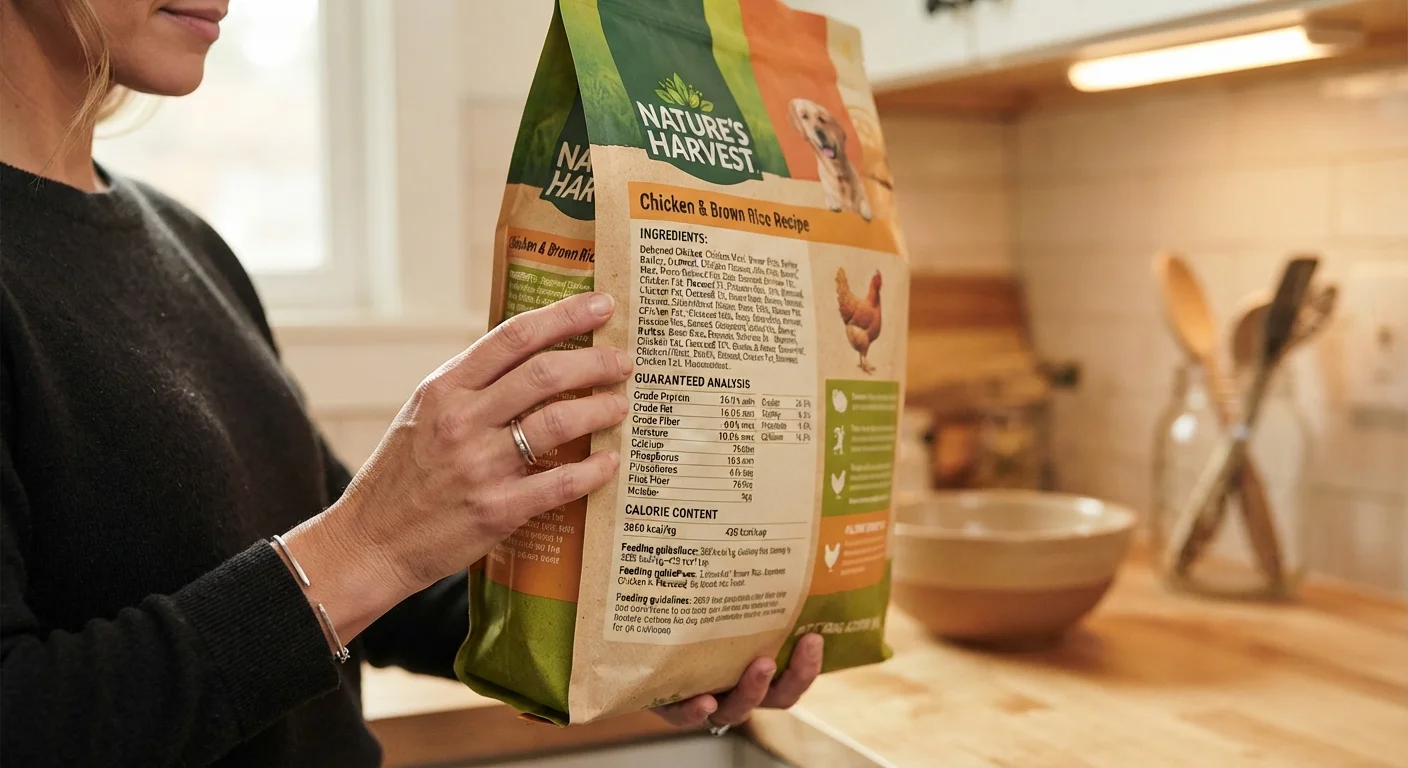
A pet food label is the regulated collection of information printed on pet food packaging, including the product name, ingredient list, guaranteed analysis, nutritional adequacy statement, and feeding guidelines. In the United States, pet food labeling is governed by the Association of American Feed Control Officials (AAFCO) and individual state regulations. Each section of the label carries a specific, defined meaning that differs from common marketing language.
AAFCO establishes model regulations for pet food labeling that most U.S. states adopt; the FDA also oversees safety and adulteration standards under the Federal Food, Drug, and Cosmetic Act.
The Ingredient List: What the Order Really Means
Ingredients on a pet food label are listed in descending order by weight before processing. This matters more than most owners realize. A whole ingredient like 'chicken' contains roughly 70% water, so while it may appear first on the list, it contributes less concentrated protein than 'chicken meal' — a dried, rendered ingredient that appears lower but delivers more protein per pound.
This doesn't make whole-meat first ingredients bad. It does mean the first ingredient alone tells an incomplete story. Scan several items down the list. If the first few protein sources are followed quickly by multiple grains or starches listed separately (e.g., ground corn, corn gluten meal, corn bran), those ingredients collectively may outweigh the protein source despite appearing lower.
For more context on how ingredients interact with different feeding approaches, see our comparison of dry, wet, and raw feeding.
Look Beyond the First Ingredient
When scanning an ingredient list, group similar items together mentally. If a food lists three or four different grain or starch sources separately, their combined weight likely exceeds the first-listed protein source. Reading the full list — not just the top line — gives you a more accurate picture of what your pet is actually eating.
The Guaranteed Analysis: Useful but Limited
The guaranteed analysis panel lists four required values: minimum crude protein, minimum crude fat, maximum crude fiber, and maximum moisture. Some manufacturers voluntarily add others, such as omega fatty acids or taurine.
These are regulatory floors and ceilings, not exact figures. A food with '26% minimum crude protein' may contain more — or just barely meet that threshold. The panel also says nothing about digestibility, which determines how much of that protein a pet actually absorbs and uses.
Another important limitation: crude protein measures all nitrogen-containing compounds, including some that aren't nutritionally valuable. This is why the source of protein — named meats or meals vs. vague 'animal by-products' — provides context the numbers alone cannot.
4
Required values in every guaranteed analysis
AAFCO model regulations require all U.S. pet food labels to list minimum crude protein, minimum crude fat, maximum crude fiber, and maximum moisture — regardless of additional voluntary disclosures.
~70%
Moisture content in whole fresh meat ingredients
Whole meats like chicken or beef are roughly 70% water before processing, which affects how much actual protein they contribute to a finished kibble compared to rendered meal ingredients.
2
Ways an AAFCO adequacy claim can be established
Per AAFCO guidelines, a 'complete and balanced' claim may be supported either by formulation against nutrient profiles or by actual animal feeding trials — two methods with meaningfully different levels of real-world validation.
The AAFCO Nutritional Adequacy Statement
This is arguably the most important line on the label, and it's often overlooked. The nutritional adequacy statement tells you two critical things: whether the food is 'complete and balanced' (meaning it meets AAFCO nutrient profiles), and which life stage it's formulated for — typically 'adult maintenance,' 'growth' (puppies and kittens), 'all life stages,' or 'gestation/lactation.'
A food labeled 'for supplemental feeding only' or 'intended as a treat' is not nutritionally complete on its own. Feeding it as a primary diet risks nutrient deficiencies over time.
Also note how the adequacy claim was established: either through feeding trials (where animals were actually fed the food under AAFCO protocols) or by formulation (where the recipe was calculated to meet nutrient profiles without live trials). Both are accepted, but feeding-trial claims reflect real-world performance.
Understanding what your pet actually needs nutritionally connects directly to preventing long-term issues. Our resource on pet obesity and its health implications explores how feeding habits contribute to one of the most common and underdiagnosed conditions in companion animals.
Feeding Guidelines and Marketing Language
Feeding guidelines — usually a chart based on body weight — are formulated for the average, healthy, moderately active pet. They are a starting point, not a prescription. A sedentary indoor cat needs fewer calories than the label suggests; a working dog needs more. Monitor body condition rather than strictly following the chart, and adjust gradually.
Treat marketing terms with healthy skepticism. Phrases like 'premium,' 'holistic,' 'human-grade,' and 'ancestral diet' are largely unregulated in pet food labeling. They communicate brand positioning, not verified nutritional standards. The regulated language — AAFCO statements, guaranteed analysis, and specific ingredient names — is where actual accountability lives.
For related context on how ingredient claims on packaging compare to what's actually inside the food, our in-depth look at decoding pet nutrition labels offers additional analysis. And if you're weighing which everyday human foods are genuinely risky for your pet versus overblown concerns, see the truth about pets and human food.
This article is for general informational purposes only and is not a substitute for personalized veterinary nutrition advice. Consult your veterinarian for guidance tailored to your pet's specific health needs and life stage.