

Key Takeaways
Creates a visually uniform, polished outdoor space
A well-maintained traditional lawn provides consistent texture and color that many homeowners and neighborhoods consider attractive. It can also increase the perceived tidiness of a property.
Provides durable, functional surface for family use
Dense turf grass handles foot traffic well, making it practical for children's play, outdoor entertaining, and sports. It recovers from wear more reliably than many alternative groundcovers.
Reduces-input approaches lower chemical and water use
Scaling back fertilizers, herbicides, and irrigation frequency can meaningfully reduce a household's environmental footprint without abandoning the lawn aesthetic entirely.
Native and naturalistic lawns support local ecosystems
Native groundcovers and grasses provide habitat and food sources for pollinators, birds, and beneficial insects that traditional turf does not. This ecological benefit compounds over time.
Low-maintenance options free up significant time
Replacing high-input turf with lower-maintenance plantings can reclaim several hours of yard work each week during peak growing season, reducing physical and financial demands.
High water demand strains resources in dry climates
Traditional turf lawns require regular irrigation to stay green during dry periods, which can significantly increase household water bills and put pressure on local water supplies.
Synthetic inputs carry real environmental risks
Fertilizers and herbicides can leach into groundwater or run off into nearby streams, contributing to nutrient pollution and harming aquatic ecosystems and soil biology.
Ongoing maintenance demands consistent time investment
Mowing, edging, fertilizing, aerating, and treating weeds or pests can occupy several hours per week during the growing season, representing a significant ongoing commitment.
Native groundcovers have a challenging establishment phase
Native and naturalistic plantings often look sparse or weedy in their first season while root systems develop. This transition period requires patience and some tolerance for an unfinished appearance.
Reduced-input lawns may not meet neighborhood expectations
In communities with HOA rules or strong social norms around lawn appearance, a less manicured or mixed-planting yard can attract complaints or require variance requests.
No single approach works across all climates and soils
Grass varieties and groundcovers that thrive in one region may struggle or fail in another. Choosing the wrong species for your soil type and climate is a common and costly mistake.
Our Verdict
Traditional turf lawns offer undeniable curb appeal and functional outdoor space, but they carry real costs in water, labor, and chemical inputs. Reduced-input and naturalistic alternatives ease those burdens at the cost of some uniformity. The most sustainable choice is the one that realistically fits your climate, your schedule, and your willingness to adapt over time.
Homeowners willing to assess their yard's actual conditions — sun, soil, rainfall, and household use — and align their care approach accordingly, rather than defaulting to a single standard.
What Lawn Care Philosophy Are You Actually Following?
Most homeowners inherit a lawn care routine rather than choose one. The fertilizer schedule, the weekly mowing height, the sprinkler timer — these often come from habit, neighborhood norms, or whatever the previous owner set up. But behind every lawn is a philosophy, even an unexamined one, about what a yard is supposed to do and how much effort it deserves.
There are broadly three camps: the high-input traditional lawn, the reduced-input managed lawn, and the naturalistic or native approach. Each makes different demands on your time, budget, and local environment. Understanding those tradeoffs is the first step toward making a deliberate choice.
For a broader view of how outdoor maintenance shifts throughout the year, the Seasonal Garden Maintenance reference offers a useful task-by-task framework.
The Traditional High-Input Lawn
The classic American lawn — dense, uniformly green, weed-free — is an engineered outcome. Achieving it typically involves regular fertilization, herbicide applications, irrigation during dry periods, and precise mowing. The results can be visually striking and practically useful for families who use their yard actively.
Creates a visually uniform, polished outdoor space
A well-maintained traditional lawn provides consistent texture and color that many homeowners and neighborhoods consider attractive. It can also increase the perceived tidiness of a property.
Provides durable, functional surface for family use
Dense turf grass handles foot traffic well, making it practical for children's play, outdoor entertaining, and sports. It recovers from wear more reliably than many alternative groundcovers.
Reduces-input approaches lower chemical and water use
Scaling back fertilizers, herbicides, and irrigation frequency can meaningfully reduce a household's environmental footprint without abandoning the lawn aesthetic entirely.
Native and naturalistic lawns support local ecosystems
Native groundcovers and grasses provide habitat and food sources for pollinators, birds, and beneficial insects that traditional turf does not. This ecological benefit compounds over time.
Low-maintenance options free up significant time
Replacing high-input turf with lower-maintenance plantings can reclaim several hours of yard work each week during peak growing season, reducing physical and financial demands.
However, the resource demands are substantial. Turf grass is among the most irrigated crops in the United States, and synthetic fertilizers contribute to nutrient runoff that can affect nearby waterways. Pesticide and herbicide use raises concerns for soil health, pollinators, and household pets. Maintaining that carpet-like appearance also demands consistent time — usually several hours per week during the growing season.
If you do maintain an irrigated lawn, it's worth reviewing how your system is set up. Poorly calibrated sprinklers are a leading cause of overwatering. The overwatering guide explains how excess moisture damages roots and invites disease even in otherwise healthy turf.
The Reduced-Input Managed Lawn
A middle path that many homeowners land on — sometimes intentionally, sometimes by scaling back — involves maintaining a recognizable lawn while cutting inputs. This might mean mowing less frequently, allowing the grass to grow slightly taller (which shades out some weeds naturally), skipping synthetic fertilizers in favor of compost topdressing, or spot-treating weeds instead of blanket herbicide applications.
High water demand strains resources in dry climates
Traditional turf lawns require regular irrigation to stay green during dry periods, which can significantly increase household water bills and put pressure on local water supplies.
Synthetic inputs carry real environmental risks
Fertilizers and herbicides can leach into groundwater or run off into nearby streams, contributing to nutrient pollution and harming aquatic ecosystems and soil biology.
Ongoing maintenance demands consistent time investment
Mowing, edging, fertilizing, aerating, and treating weeds or pests can occupy several hours per week during the growing season, representing a significant ongoing commitment.
Native groundcovers have a challenging establishment phase
Native and naturalistic plantings often look sparse or weedy in their first season while root systems develop. This transition period requires patience and some tolerance for an unfinished appearance.
Reduced-input lawns may not meet neighborhood expectations
In communities with HOA rules or strong social norms around lawn appearance, a less manicured or mixed-planting yard can attract complaints or require variance requests.
No single approach works across all climates and soils
Grass varieties and groundcovers that thrive in one region may struggle or fail in another. Choosing the wrong species for your soil type and climate is a common and costly mistake.
This approach won't satisfy those who want the uniform perfection of a high-input lawn, and it requires enough knowledge to make strategic decisions rather than just following a fixed schedule. But it often produces a lawn that's still tidy and usable, while reducing chemical exposure and water use meaningfully.
Mulching clippings back into the lawn — rather than bagging them — is one of the simplest reduced-input steps. It returns nitrogen to the soil and reduces the need for supplemental fertilizer. The garden mulching guide covers how organic materials feed soil over time, a principle that applies to lawn nutrition as much as garden beds.
Naturalistic and Native Groundcover Approaches
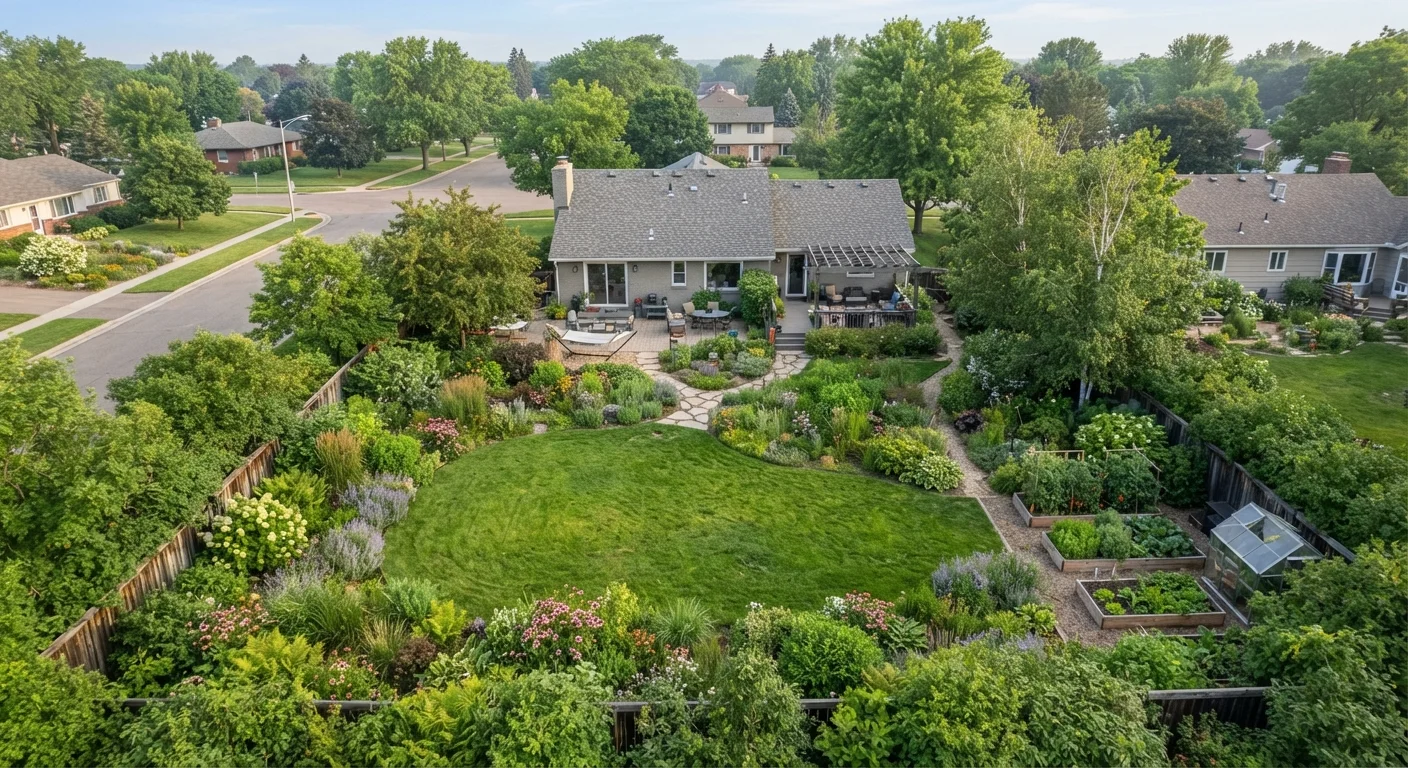
Some homeowners move away from traditional turf altogether, replacing portions of their lawn with native grasses, clover, low-growing sedges, or mixed groundcovers. These plantings typically require far less water once established, need little or no fertilizer, and actively support pollinators and soil biology.
~30%
Household water used on lawns and gardens
According to the U.S. Environmental Protection Agency, outdoor water use accounts for roughly 30% of household water consumption on average, with a significant portion going to lawn irrigation.
40–60%
Irrigation water wasted due to inefficiency
The EPA estimates that nearly half of all residential irrigation water is lost to evaporation, wind drift, or runoff caused by overwatering and inefficient systems.
50+ million
Acres of turf grass managed in the US
Estimates from NASA and university research suggest that managed lawns cover more than 50 million acres across the United States, making turfgrass one of the country's most irrigated crops.
The tradeoff is aesthetic adjustment. Mixed groundcovers don't offer the uniform texture of turf, and some municipalities have rules about lawn height or appearance — worth verifying with your local ordinances before making major changes. Establishment periods can also be challenging; native plants often look sparse in their first season before their root systems develop.
For homeowners considering this shift, the native plants vs. exotic ornamentals guide provides a useful framework for evaluating which species make sense in your specific region. And if irrigation is part of your transition plan, a thoughtfully designed system can reduce waste significantly — see the garden irrigation setup guide for practical options.
Check Local Ordinances Before Transitioning
Some municipalities and homeowners associations have specific rules about lawn height, plant types, or the percentage of a front yard that can be converted to non-turf plantings. Before removing turf or installing a naturalistic garden, check with your local planning or zoning office. Many areas have updated their codes in recent years to accommodate water-wise landscaping, but requirements vary widely.