
Urban Driving vs Rural Driving: Why the Same Speed Feels Different in Each Setting

Key Takeaways
Our Verdict
Urban and rural driving are not variations of the same task — they are fundamentally different risk environments that require deliberate mental shifting. City driving demands constant short-range vigilance; rural driving demands sustained attention at higher speeds with fewer external cues to keep alertness sharp. Recognising which environment you're in, and actively adjusting your approach, is one of the most practical safety habits a driver can build.
| Best for | Recommended |
|---|---|
| Drivers navigating dense city streets with heavy foot traffic | Urban driving mindset: slow, scanning, expect the unexpected at close range |
| Drivers covering long rural distances on undivided two-lane roads | Rural driving mindset: sustained alertness, wider scan, conservative speed margins |
| Drivers who frequently switch between city and country routes | Conscious environment reset: actively recalibrate speed perception and hazard focus at each transition |
Why the Same Speed Feels Completely Different
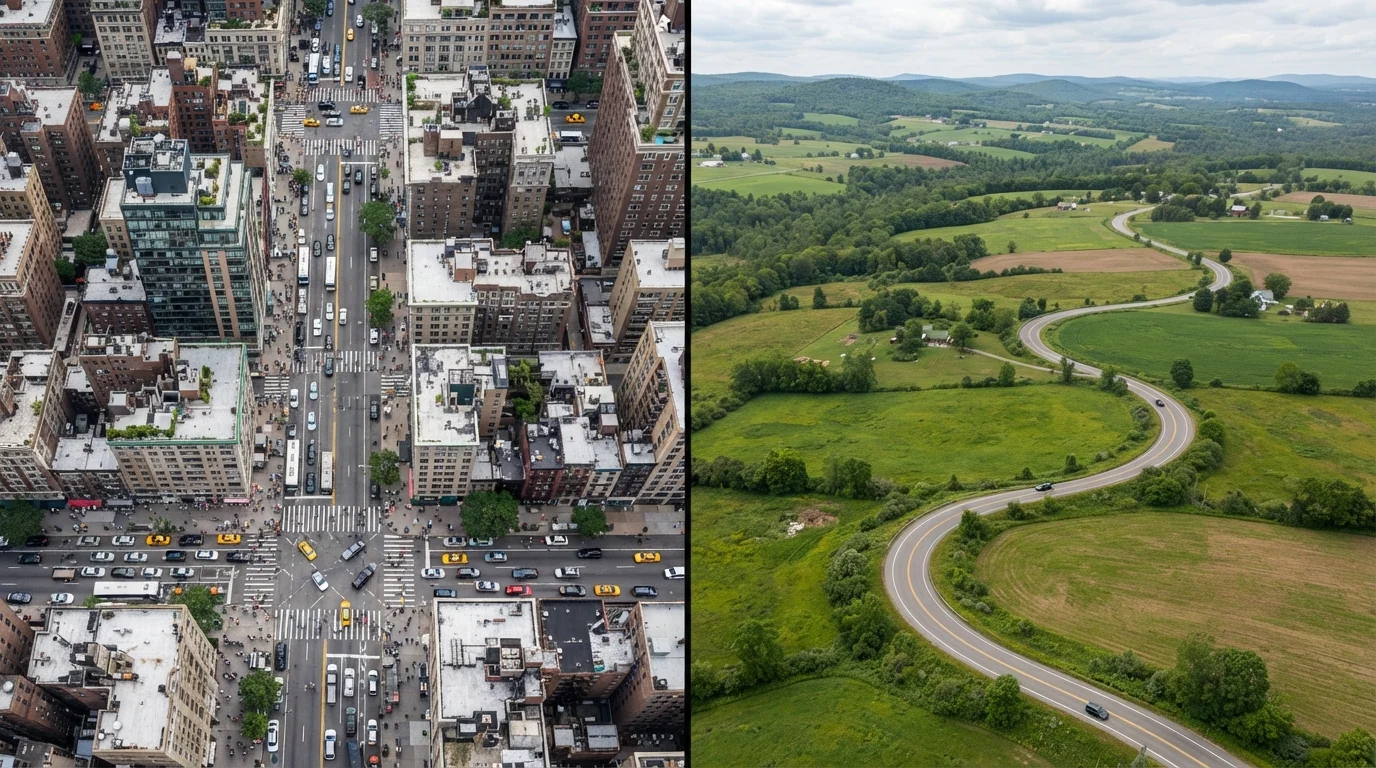
Drive at 35 mph through a downtown neighborhood and every sensory input is working against complacency — storefronts blur past, crosswalk signals flash, cyclists filter through gaps. Drive at 35 mph on an empty rural road and the sensation is almost the opposite: open space, little visual movement, and a feeling that you're barely moving at all.
This isn't an illusion in the trivial sense. It's a well-documented perceptual effect rooted in how the brain uses surrounding visual references — called optic flow — to estimate speed. When dense objects rush past your peripheral vision, the brain registers speed accurately or even overestimates it. When the scene is sparse, speed feels lower than it is. Research in traffic psychology consistently links this phenomenon to rural speeding: drivers genuinely feel slower than their speedometer confirms.
Understanding this gap between felt speed and actual speed is the foundation for safer driving in both environments. See our guide to stopping distances at different speeds for a concrete look at what extra mph actually cost you in an emergency stop.
Urban Driving: High Frequency, Short-Range Hazards
City streets compress everything — lane widths, following distances, reaction windows, and the sheer number of road users sharing the same space. The primary challenge isn't speed; it's hazard frequency. A driver on a busy urban arterial road might encounter a door opening, a pedestrian stepping off a curb, a delivery vehicle double-parked, and a cyclist changing lanes — all within a single block.
Urban hazards tend to emerge at close range and from unexpected angles. Driveways, alleys, bus stops, and school zones all generate unpredictable movement. Because speeds are lower, individual collisions are less likely to be fatal — but injury rates from urban crashes remain significant, particularly for pedestrians and cyclists who are highly vulnerable.
The mental demand in urban driving is attentional breadth: scanning constantly in all directions, processing multiple information streams simultaneously, and making rapid decisions about gaps, right-of-way, and positioning. Complacency — the assumption that a familiar route holds no surprises — is among the most dangerous mindsets a city driver can carry.
Reset Your Perception at Every Transition
When moving from a rural road into a town or village, check your speedometer rather than relying on how fast you feel. Optic flow illusions can leave you 10–15 mph faster than you perceive. A quick glance at the gauge and a conscious acknowledgment of the new environment takes only seconds and can make a genuine difference.
How experienced drivers scan for hazards is worth reviewing for anyone who relies on familiar urban routes — familiarity breeds reduced scanning, which is exactly when incidents happen.
Rural Driving: Lower Frequency, Higher-Consequence Hazards
Rural roads carry a different risk profile entirely. Speeds are higher, roads are narrower, shoulders are often absent or unpaved, and infrastructure — lighting, guardrails, emergency services — is limited. When something goes wrong at 55 mph on an undivided two-lane road, the margin for error is thin.
Hazards on rural roads appear less often but carry greater consequences when they do. Animals crossing, farm equipment entering the roadway, unmarked intersections, sudden tight curves, and gravel or debris surfaces all require a driver who is actively scanning well ahead — not reacting to what has already appeared. Head-on collisions, run-off-road crashes, and animal strikes are disproportionately common in rural settings.
| Urban Driving | Rural Driving | |
|---|---|---|
| Typical speed range | 15–45 mph | 45–65+ mph |
| Primary hazard type | Pedestrians, cyclists, intersections | Animals, curves, oncoming traffic |
| Hazard frequency | Very high — multiple per block | Low — but unpredictable |
| Collision severity risk | Lower (speed-limited) | Higher (speed and isolation) |
| Speed perception accuracy | Generally accurate (dense visual cues) | Often underestimated (sparse cues) |
| Fatigue risk | Lower — constant stimulation | Higher — monotony reduces alertness |
| Key driver mindset | Broad scan, expect close-range hazards | Long-range scan, maintain active alertness |
Fatigue compounds every rural risk. Long, monotonous stretches reduce alertness in ways that urban stop-and-go traffic does not. Drivers who transition directly from highway or rural roads into city driving sometimes find their reflexes calibrated for speed — a mismatch that takes several minutes of conscious adjustment to correct.
For a broader look at how attentional habits must shift between environments, see our piece on defensive versus reactive driving mindsets.
Making the Transition Safely
The risk moment many drivers underestimate is the transition itself — moving from a rural road into a town, or from city traffic onto an open highway. Speed perception hasn't yet recalibrated, and the hazard environment has changed without a clear signal to shift mental gears.
A practical approach: when entering a new environment, check your speedometer actively rather than relying on how fast you feel. Give yourself a brief mental reset — acknowledge the environment change and consciously ask what new hazard types now apply. This isn't elaborate; it takes seconds. But for drivers who frequently switch between urban and rural routes, making it a deliberate habit rather than an unconscious one is meaningful.
Understanding how posted speed limits and advisory speeds differ also helps in both settings — the legal limit is a ceiling, not a target, and conditions often require driving well below it.
This article is for general educational purposes. Always apply your own judgment to current road conditions and follow applicable traffic laws in your state.