
Speed Limits, Advisory Speeds, and Variable Limits: What Each One Legally Means

| Sign color for posted limits | White with black text (rectangular) (MUTCD — Manual on Uniform Traffic Control Devices) |
| Sign color for advisory speeds | Yellow with black text (diamond or plaque) (MUTCD — Manual on Uniform Traffic Control Devices) |
| Legally enforceable | Posted limits and variable limits — yes; advisory speeds — no (Varies by state statute) |
| Highest US interstate speed limit | 85 mph (Texas State Highway 130 toll segment) (IIHS Speed Limit Laws, current as of 2024) |
| Work zone fine multiplier | Typically 2× standard fine in most states (State traffic codes vary; confirm with your state DMV) |
| VSL systems in use | Operational in states including WA, VA, MN, UT, and others (FHWA Variable Speed Limit Programs) |
Three Types of Speed Control — and Why the Difference Matters
Most drivers treat any number on a roadside sign as an instruction to go that fast. In reality, the US uses at least three distinct categories of speed regulation, and each carries a different legal weight. Confusing them isn't just a trivia problem — it can mean the difference between a legal defense and a traffic citation, or between a safe negotiation of a curve and a serious crash.
| Sign color for posted limits | White with black text (rectangular) (MUTCD — Manual on Uniform Traffic Control Devices) |
| Sign color for advisory speeds | Yellow with black text (diamond or plaque) (MUTCD — Manual on Uniform Traffic Control Devices) |
| Legally enforceable | Posted limits and variable limits — yes; advisory speeds — no (Varies by state statute) |
| Highest US interstate speed limit | 85 mph (Texas State Highway 130 toll segment) (IIHS Speed Limit Laws, current as of 2024) |
| Work zone fine multiplier | Typically 2× standard fine in most states (State traffic codes vary; confirm with your state DMV) |
| VSL systems in use | Operational in states including WA, VA, MN, UT, and others (FHWA Variable Speed Limit Programs) |
The three primary categories are: statutory (posted) speed limits, advisory speeds, and variable speed limits. Each appears on a different sign, means something different in law, and demands a different response from you as a driver.
Posted Speed Limits: The Legal Ceiling
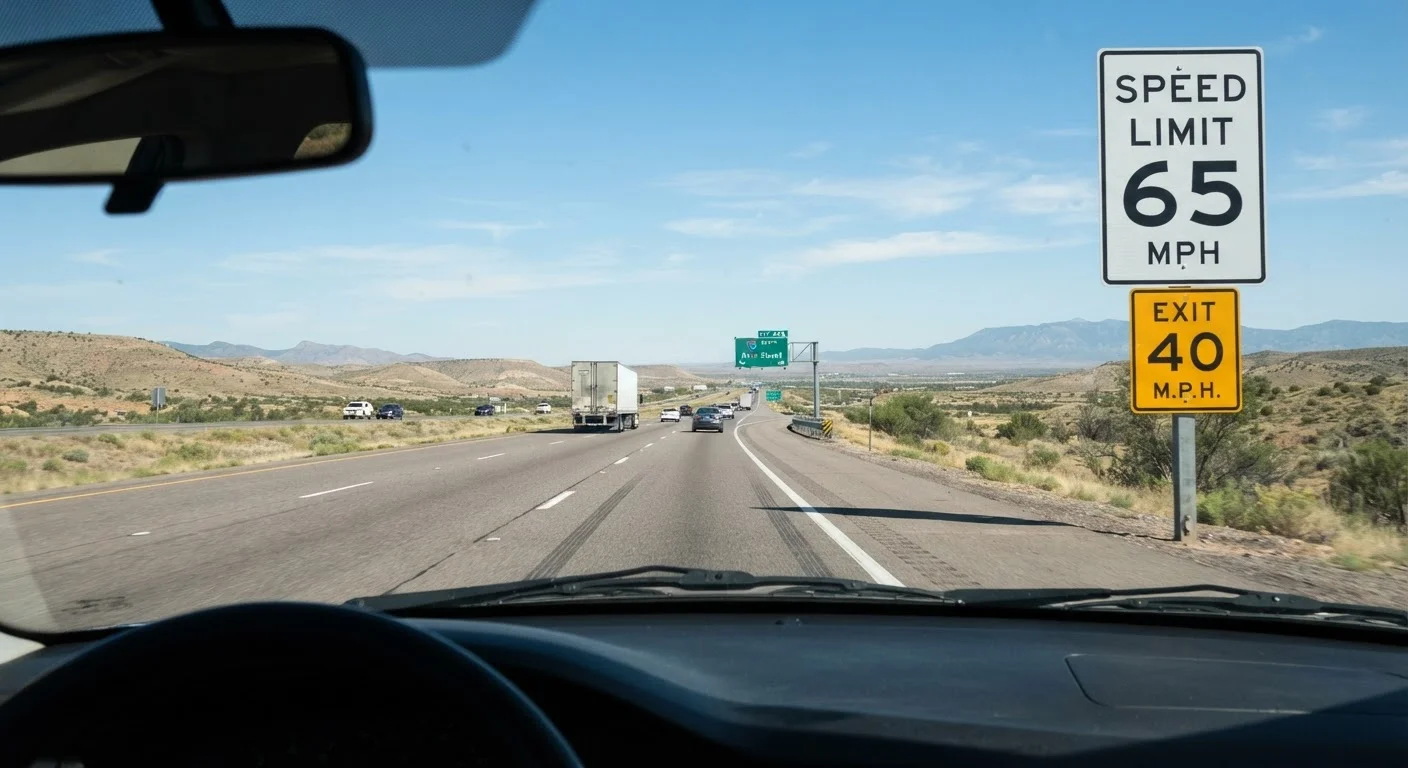
A posted speed limit — the white rectangular sign with black numerals — establishes the maximum lawful speed for that section of road under normal conditions. Exceeding it is a traffic violation, regardless of road conditions, traffic flow, or how fast other vehicles are traveling. These limits are set by state or local governments and vary significantly by road type and jurisdiction.
Two legal doctrines shape how posted limits work in practice:
- Absolute limit states: In most states, driving even 1 mph over the posted number is a per se violation — no further proof of danger is required to issue a citation.
- Basic speed law: All states also have a basic speed law requiring drivers to travel at a speed that is reasonable and prudent given actual conditions. This means that even if you are at or below the posted limit, you can still be cited if conditions — rain, fog, heavy traffic — make that speed unsafe.
Common posted limit categories in the US include 25 mph in residential zones, 35–45 mph on urban arterials, 55 mph on undivided rural highways, and 65–80 mph on interstate freeways (the exact maximum varies by state). For a deeper look at how speed interacts with stopping distance, see our explanation of stopping distance at different speeds.
Advisory Speeds: A Recommendation, Not a Command
Yellow diamond-shaped signs — or smaller yellow plaques posted beneath warning signs — display advisory speeds. These are not legally enforceable speed limits. Instead, they communicate the speed at which engineers determined a feature of the road (a curve, an interchange ramp, a hill crest) can be safely navigated under normal conditions by a typical vehicle.
Posted Speed Limit
The maximum lawful speed established by law for a specific road segment, displayed on a white rectangular sign. Exceeding it is a traffic violation under most state statutes.
Advisory Speed
A recommended speed for a specific road feature (such as a curve or ramp), displayed on a yellow sign. It is not legally enforceable as a speed limit but is relevant evidence in a collision or citation involving the basic speed law.
Variable Speed Limit (VSL)
An electronically displayed speed limit that changes based on real-time traffic, weather, or incident conditions. VSLs are legally binding and enforceable in the same way as static posted limits.
Basic Speed Law
A universal US driving principle requiring drivers to travel at a speed that is reasonable and prudent for actual conditions, regardless of the posted limit. A driver can be cited under this law even when traveling at or below the posted number.
Work Zone Speed Limit
A temporarily posted limit in active construction or maintenance zones. Most states impose doubled fines for violations and enforce the limit whether or not workers are present.
Exceeding an advisory speed is not automatically a violation. However, if you exceed it and lose control or are involved in a collision, the advisory speed becomes highly relevant evidence that you were driving faster than conditions permitted — which connects directly to the basic speed law mentioned above.
Think of advisory speeds as engineering data made visible. A 25 mph advisory on a freeway ramp loop doesn't mean 26 mph will send you off the road — it means the curve was designed with that figure as the comfortable baseline. Adverse conditions (rain, ice, a loaded vehicle) lower that practical threshold further. For a broader look at how road environment shapes speed perception, our article on urban versus rural driving is a useful companion.
Variable Speed Limits: Adaptive and Legally Binding
Variable speed limits (VSLs) — also called dynamic speed limits — are electronically displayed limits that change in response to real-time conditions: traffic density, weather, incidents, or time of day. They appear on overhead gantry signs or roadside electronic message boards, typically on urban freeways, work zones, and high-volume corridors.
A critical point many drivers miss: variable speed limits carry the same legal force as posted static limits. When a gantry displays 45 mph, that is the enforceable maximum for that section at that moment. States including Washington, Virginia, Minnesota, and Utah have operating VSL systems on major corridors, and citations can be issued based on the displayed figure at the time of the offense.
VSLs serve a traffic-management function beyond individual safety — by reducing speed differentials between vehicles during congestion, they reduce the accordion effect that causes phantom traffic jams. Obeying them benefits not just your own safety but the flow of traffic around you.
Work zone speed limits — which are also typically posted on temporary signage — are a related category worth noting. In most states, fines for speeding in active work zones are doubled, and some states add points-multiplier penalties. These limits apply whether or not workers are visibly present, and they are fully enforceable.
If you want a broader grounding in how road signs communicate legal obligations, our reference on commonly misread road signs covers the full sign vocabulary in plain language.