

| Total sign types in the MUTCD | Hundreds, across regulatory, warning, and guide categories (Manual on Uniform Traffic Control Devices (MUTCD), FHWA) |
| Shape: Octagon | Always means STOP — no exceptions (MUTCD, Federal Highway Administration) |
| Shape: Inverted triangle | Always means YIELD (MUTCD, Federal Highway Administration) |
| Color: Yellow | Warning — road condition or hazard ahead (MUTCD color coding standards) |
| Color: Orange | Work zone / construction ahead (MUTCD color coding standards) |
| Color: White with red | Regulatory — a rule you must follow (MUTCD color coding standards) |
| Color: Green | Guide information — directions and distances (MUTCD color coding standards) |
| Color: Blue | Services information (gas, food, lodging, hospital) (MUTCD color coding standards) |
Why Experienced Drivers Misread Signs
Most of us learned road signs under exam pressure and then filed them away. Years of daily driving build strong habit — and habits can quietly substitute for active reading. You see an octagon shape and brake, but do you actually read the sign, or just recognize the silhouette? That shortcut works until a sign appears in an unfamiliar context or an infrequent sign type appears on a new route.
This reference covers the signs most commonly misunderstood, overlooked, or confused — with plain explanations of exactly what each one requires you to do. For a broader look at anticipating road hazards, see our guide to reading the road.
| Total sign types in the MUTCD | Hundreds, across regulatory, warning, and guide categories (Manual on Uniform Traffic Control Devices (MUTCD), FHWA) |
| Shape: Octagon | Always means STOP — no exceptions (MUTCD, Federal Highway Administration) |
| Shape: Inverted triangle | Always means YIELD (MUTCD, Federal Highway Administration) |
| Color: Yellow | Warning — road condition or hazard ahead (MUTCD color coding standards) |
| Color: Orange | Work zone / construction ahead (MUTCD color coding standards) |
| Color: White with red | Regulatory — a rule you must follow (MUTCD color coding standards) |
| Color: Green | Guide information — directions and distances (MUTCD color coding standards) |
| Color: Blue | Services information (gas, food, lodging, hospital) (MUTCD color coding standards) |
Regulatory Signs: Rules, Not Suggestions
Regulatory signs carry legal weight — they communicate requirements enforced by law. Their shape and color are standardized across the country by the MUTCD so you can identify the category before you read the words.
Sign Knowledge Doesn't Expire — But Gaps Do Form
Most US drivers learned road signs during their initial licensing exam and haven't revisited them since. Research in traffic safety consistently finds that experienced drivers are no less likely than newer ones to misread certain sign categories — particularly warning and guidance signs that appear infrequently. Treating this as a quick refresh is a reasonable habit for any driver.
Signs Drivers Frequently Confuse
- STOP vs. YIELD: A STOP sign requires a complete stop at the marked line before checking for cross traffic. A YIELD sign requires you to slow down and give the right of way to conflicting traffic — a full stop is only required if traffic is actually present. Many drivers treat yield signs as a suggestion to slow slightly.
- Do Not Enter vs. Wrong Way: A "Do Not Enter" sign (white square with a red horizontal bar) means you cannot enter that road from your current approach. A "Wrong Way" sign is positioned further along the same road to warn drivers who have already made the error. Seeing a Wrong Way sign means stop and turn around immediately.
- No Turn on Red: Unless this sign is posted, US drivers are generally permitted to turn right on a red signal after a full stop — but only where no sign prohibits it. This sign is easy to miss when mounted at eye level alongside other signals.
- Divided Highway signs: A "Divided Highway Begins" sign warns that the road ahead splits into two separate one-way roadways with a median between them. Drivers sometimes mistake this for a lane-reduction warning. The paired "Divided Highway Ends" sign means two-way traffic resumes — requiring greater caution.
For right-of-way rules that sit alongside these signs, our plain-English right-of-way reference covers the rules at junctions and roundabouts in detail.
Warning Signs, Work Zones, and What to Do
Warning signs (yellow, diamond-shaped) describe a condition ahead — they don't tell you what legal action to take, but they do require a judgment call. Common ones that drivers underestimate:
- Slippery When Wet: The car-skidding icon is often ignored in dry weather, but it identifies a section of road with a documented traction problem — worth remembering if conditions change.
- Advisory Speed Plates: A small yellow plate below a warning sign displaying a speed (e.g., "25 MPH") is not a posted speed limit — it's the speed engineers calculated as safe for that curve or condition. It is a strong advisory, not a legal maximum, but it's based on tested geometry.
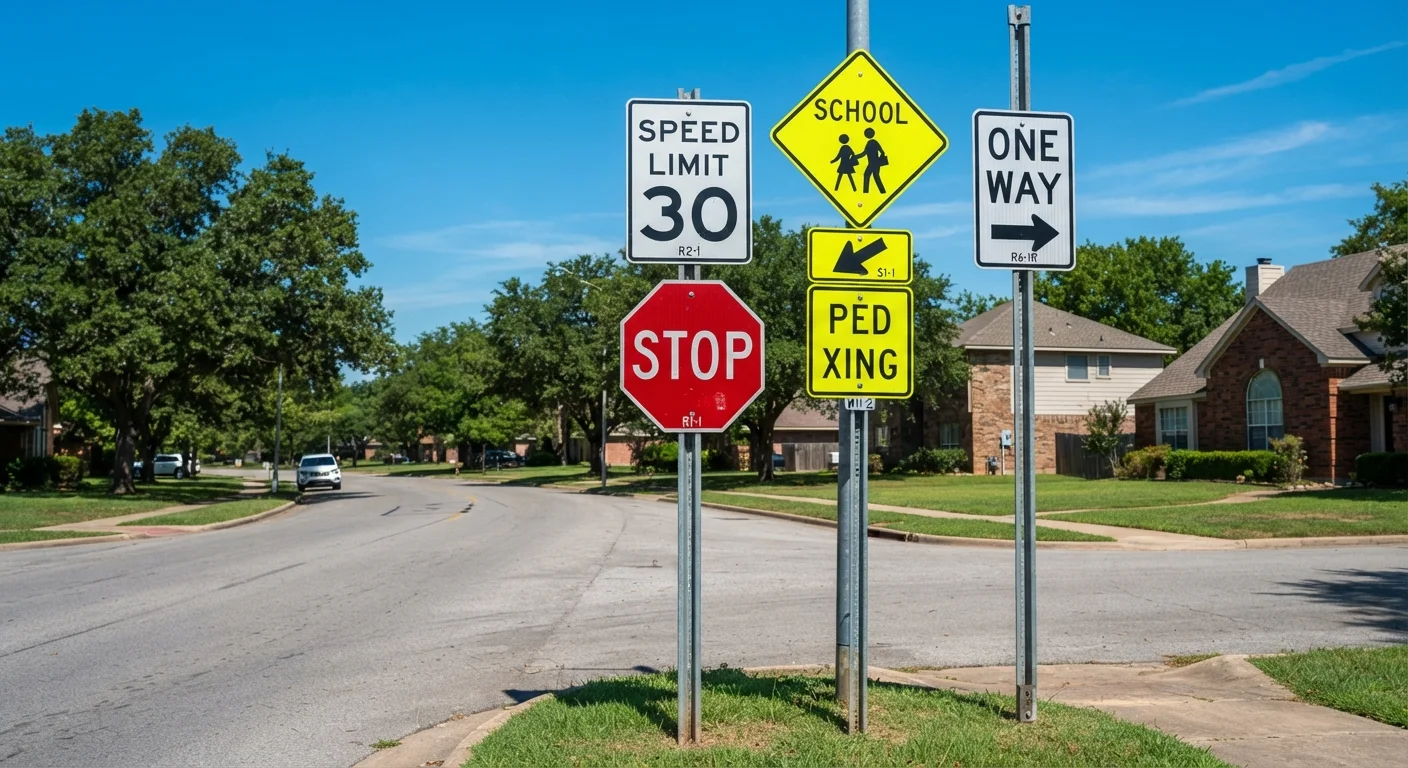
- Pedestrian and School Zone signs: The yellow pentagon shape is exclusive to school zones in the US. The similar-looking pedestrian crossing sign is diamond-shaped. Both require reduced speed and heightened attention, but the school zone sign may carry enhanced penalties and specific time-based rules.
- Orange work zone signs: Speed limits posted on orange signs inside a work zone are legally enforceable and often carry doubled fines. Treat every orange speed sign exactly as you would a permanent black-on-white regulatory sign.
If you're preparing for a longer drive on unfamiliar roads, our pre-trip walkround checklist is a good starting point — and highway driving guidance covers the sign environments that change most at higher speeds.