

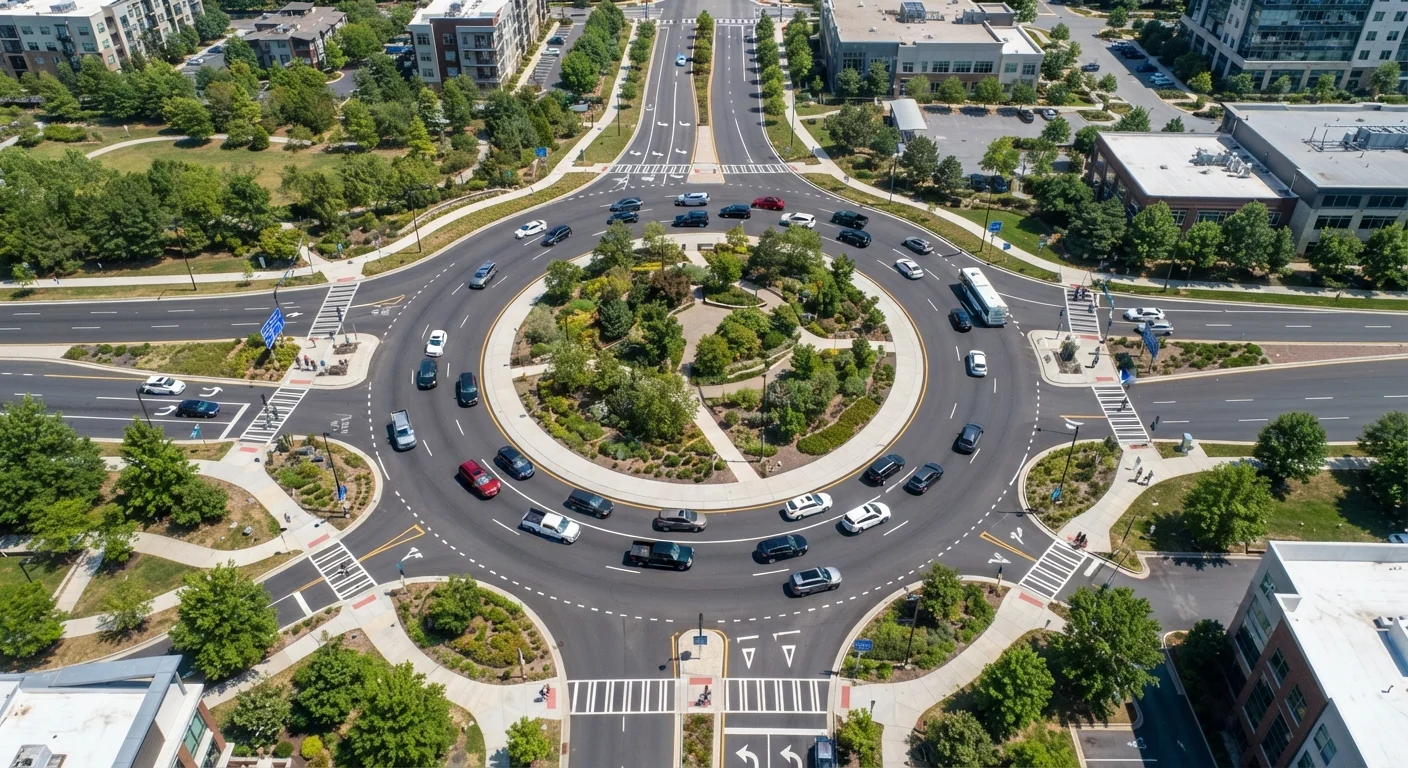
Right-of-Way: The Core Principle
Right-of-way determines which driver has legal priority to proceed at a given point on the road. Crucially, it is never something you can simply take — it must be yielded by the other party. Even if you have the right-of-way, you are still legally and ethically obligated to avoid a collision if the other driver fails to yield.
The foundational rules are relatively few, but they apply across dozens of everyday situations. Mastering the core principles — rather than memorizing every scenario — is what gives confident drivers their edge. For a broader look at road awareness habits, see our guide to spotting hazards early.
Roundabouts: Who Goes First?
At a roundabout, vehicles already inside the circle have the right-of-way over vehicles entering. This is a consistent rule across all US states that have adopted roundabouts. When you approach the entry point, you must yield to circulating traffic before merging — even if the lane appears briefly clear.
Common roundabout mistakes include:
- Stopping inside the roundabout — once you have entered and the way is clear, keep moving.
- Changing lanes mid-circle — stay in your chosen lane for the full arc unless road markings explicitly guide a lane change.
- Treating it like a four-way stop — there is no taking turns by order of arrival; circulating traffic always has priority.
Multi-lane roundabouts follow the same priority rule, but lane selection at entry matters: the right lane is generally used for right turns and straight-through exits, while the left lane handles further exits and full loops. Always follow posted lane guidance where signs are present.
Right-of-way
The legal priority to proceed through a road space before another driver. It must be granted by others — you cannot simply claim it, and holding it does not remove your duty to avoid a crash.
Give-way line
A dashed white line painted across a lane at an intersection or roundabout entry. It signals that you must yield to other traffic, but you only need to stop fully if that traffic requires it.
Stop line
A solid white line across a lane, requiring drivers to come to a complete halt before proceeding — regardless of whether other traffic is visible.
Roundabout
A circular junction where traffic flows in one direction around a central island. Vehicles already inside the roundabout have priority over vehicles waiting to enter.
Unmarked intersection
A junction with no traffic signals, signs, or road markings to assign priority. Standard rules apply: first to arrive proceeds first; simultaneous arrivals yield left to right.
Yield
To slow down, wait, or stop in order to allow another vehicle or pedestrian to proceed safely. Yielding does not always mean stopping — it means giving way as needed.
Give-Way Lines and Stop Lines: What Each One Requires
A give-way line (marked as a dashed white line across your lane) means you must yield to crossing or oncoming traffic but do not have to come to a complete stop if the road is clear. A stop line (solid white line) requires a full stop — even when no other traffic is visible.
These markings appear at junctions, pedestrian crossings, and roundabout entries. Treating a give-way line as optional — or rolling through a stop line — is both a traffic violation and a safety risk. Our road signs reference covers the accompanying sign shapes that reinforce these markings.
Give-Way vs. Yield: Same Rule, Different Words
In the US, road signs typically use the word 'Yield' rather than 'Give Way,' though both mean the same thing: allow other traffic priority before proceeding. Some driver education materials use 'give-way' as a general concept regardless of the sign wording. Either way, the legal obligation is identical — slow down and let crossing or oncoming traffic clear before you enter.
At intersections with neither markings nor signals — sometimes called unmarked intersections — the general rule in most US states is that the driver who arrived first proceeds first. If two vehicles arrive simultaneously, the driver on the left yields to the driver on the right. When in doubt, slow down and make eye contact.
Junctions, Merges, and Pedestrians: Quick-Reference Rules
Several other right-of-way situations trip up even experienced drivers:
- T-intersections
- The driver on the terminating road (the road that ends) yields to traffic on the through road.
- Merging onto a highway
- The merging driver must yield to traffic already on the main roadway. Traffic on the highway is not required to move over, though doing so is courteous. See our highway driving guide for practical merging technique.
- Pedestrians at crosswalks
- In all US states, drivers must yield to pedestrians in a marked crosswalk. Many states also require yielding to pedestrians at unmarked intersections. When a pedestrian steps off the curb, treat that as a yield situation regardless of markings.
- Emergency vehicles
- All traffic must yield immediately to approaching emergency vehicles using lights or sirens. Pull to the right edge of the road and stop until the vehicle has passed.
- School buses
- When a school bus displays flashing red lights and an extended stop arm, all traffic on the same road — in most states including oncoming lanes on undivided roads — must stop.
~40%
Of all US traffic crashes occur at intersections
According to the Federal Highway Administration, intersection-related crashes represent a significant share of total road incidents.
75%
Reduction in fatal crashes at converted roundabout sites
Research published by the Insurance Institute for Highway Safety (IIHS) indicates roundabouts substantially reduce fatal and injury crashes compared to traditional stop-controlled intersections.
For a comprehensive look at how speed interacts with stopping distances and priority decisions, our speed limits reference is a useful companion to this guide.