

Key Takeaways
Why Service Intervals Are Not Arbitrary
Every number in your car's service schedule — 5,000 miles, 30,000 miles, 12 months — was arrived at through engineering testing, not guesswork. Manufacturers stress-test components under real-world and laboratory conditions to determine how long fluids remain effective, how quickly filters clog, and when mechanical parts begin to show measurable wear. The result is a schedule calibrated to keep your specific vehicle running within safe tolerances.
Think of it less like a calendar reminder and more like a set of expiry dates. Just as food doesn't immediately become dangerous the day after its use-by date but is no longer at its best, most car components don't fail the moment a service is due — but their protective margins start to shrink. The schedule exists to service your car before it reaches a point of diminished protection.
For a broader look at ownership responsibilities beyond the service book, see the car ownership hub for practical guidance on everything from insurance to ongoing costs.
Keep a Simple Service Log
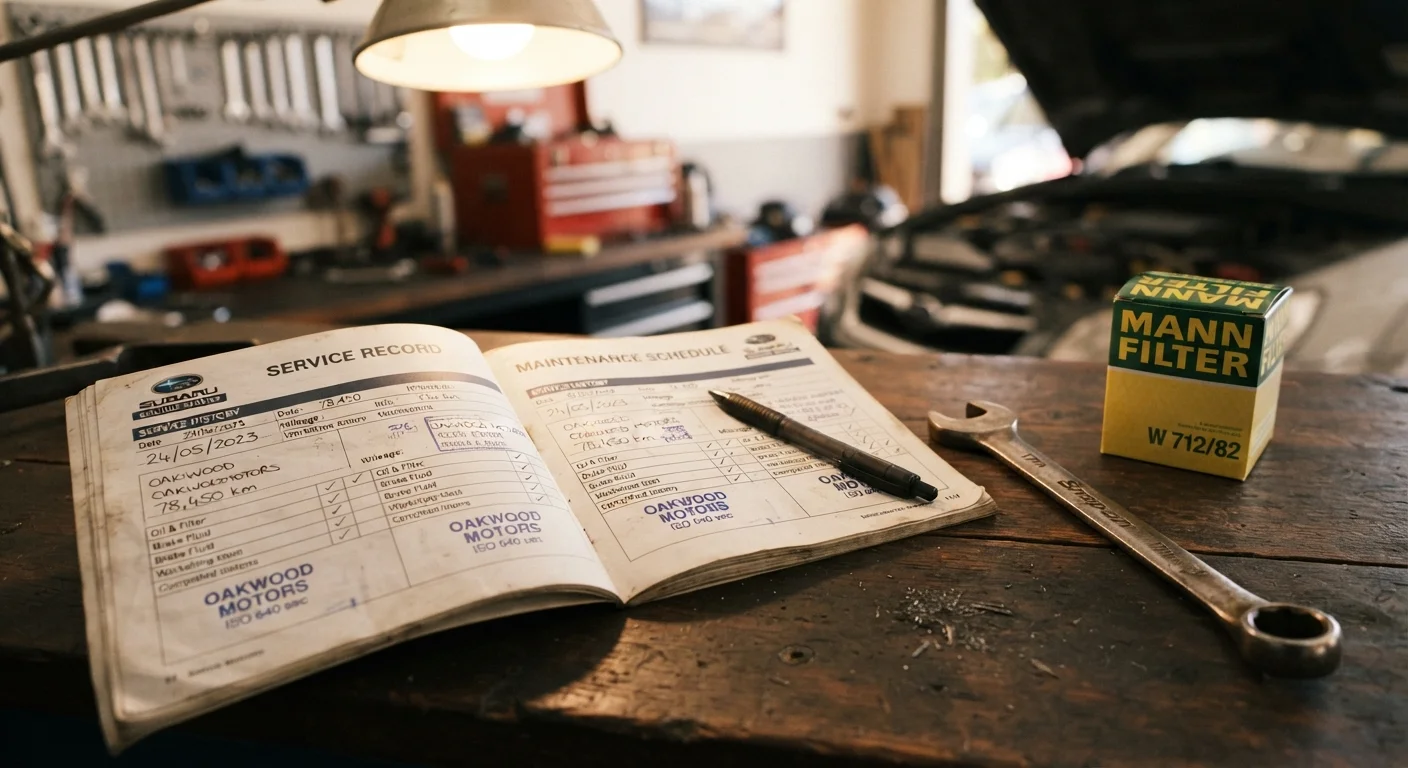
Store a small notebook or a folder of receipts in your glovebox. Recording the date, mileage, and work performed at each service takes two minutes and builds a documented history that benefits you at trade-in or resale. Digital apps can also sync service reminders to your calendar automatically.
What Happens at Each Major Milestone
Not every service visit covers the same ground. Scheduled milestones are layered — routine items are checked at every visit, while more in-depth inspections and replacements are staggered across longer intervals.
30,000–60,000 mi
Typical spark plug replacement interval
Iridium and platinum plugs often last longer, but conventional copper plugs may need replacement sooner — check your manual.
~2 years
Recommended brake fluid change interval
Brake fluid is hygroscopic — it absorbs moisture from the air over time, lowering its boiling point and reducing braking performance.
60,000–100,000 mi
Common timing belt replacement window
Timing belt failure is one of the most costly mechanical failures in interference engines; replacement before failure is strongly advised.
- Every 5,000–7,500 miles (or annually): Oil and filter change, fluid top-offs, tyre rotation, visual brake inspection. This is the foundation of every maintenance plan.
- Every 15,000–30,000 miles: Air filter replacement, cabin air filter swap, brake fluid check, battery test, and inspection of belts and hoses for cracking or fraying.
- Every 30,000–60,000 miles: Spark plug replacement (on petrol engines), coolant flush, transmission fluid service, and a comprehensive brake system evaluation including pad thickness and rotor condition.
- Every 60,000–100,000 miles: Timing belt or timing chain inspection (critical — a snapped timing belt can destroy an engine), power steering fluid flush, and a full suspension and steering component review.
To understand what's actually happening to your oil between these visits, learn how motor oil degrades over time and why the timing of that first change matters most.
Mileage vs. Time: Which Trigger Matters More?
Most service schedules list two triggers: a mileage figure and a time period (commonly 12 months). The rule is straightforward — whichever comes first applies. A driver who covers only 4,000 miles a year still needs an annual oil change because oil oxidizes and degrades chemically even when the car sits idle.
Low-mileage drivers often overlook time-based triggers, assuming their car is fine because the odometer hasn't moved much. In practice, moisture accumulation in engine oil, brake fluid absorbing atmospheric water, and coolant losing its corrosion inhibitors are all time-dependent processes independent of how far you've driven.
Severe Duty Conditions Are More Common Than You Think
The AAA estimates that a significant portion of US drivers operate under conditions that qualify as 'severe duty' — including city commuters who rarely exceed 10 miles per trip. Short trips prevent the engine from fully reaching operating temperature, meaning moisture and fuel byproducts accumulate in the oil faster than on longer highway runs. Check your manual's severe schedule if this sounds familiar.
Equally, high-mileage drivers in demanding conditions — frequent short trips, extreme temperatures, heavy towing — may need to service more frequently than the standard schedule suggests. Most owner's manuals include a separate "severe duty" schedule for exactly this reason. Seasonal checks can help you stay ahead of temperature-driven degradation.
The Cost of Skipping a Service
Deferred maintenance rarely stays cheap. Skipping an oil change allows contaminants and acids to build up, accelerating wear on bearings, camshaft lobes, and cylinder walls. Missing a brake fluid service allows moisture to lower the fluid's boiling point — a serious safety concern under hard braking. A neglected timing belt that snaps mid-drive can cause catastrophic engine damage costing thousands of dollars in repairs.
Never Ignore a Timing Belt Interval
On interference engines — where pistons and valves share the same space in the cylinder — a snapped timing belt causes the two components to collide, resulting in bent valves, damaged pistons, or complete engine destruction. Replacement is a scheduled, preventive expense; failure is an unscheduled, catastrophic one. Check your owner's manual for the specific interval and treat it as non-negotiable.
Beyond mechanical risk, an incomplete service history can reduce your vehicle's resale value. Private buyers and dealerships alike use service records to gauge how well a car has been maintained. A single gap in the log raises questions about what else may have been neglected.
Consistent small habits — including keeping to your service schedule — are among the most reliable ways to add years to a vehicle's working life.
When in doubt about your service interval, use the mileage-or-time rule strictly — whichever trigger arrives first, act on it. Don't wait for both conditions to be met simultaneously.
Fluid degradation and component wear follow independent timelines; waiting for both triggers to align means one condition has already exceeded its recommended limit.
Ask your mechanic to show you the worn part before it's replaced — particularly for air filters, brake pads, and belts. Seeing the condition firsthand calibrates your sense of how quickly parts degrade in your driving environment.
Visual confirmation builds informed trust and helps drivers understand whether they're in normal or accelerated wear territory, which informs future service timing.
Reading Your Owner's Manual Like a Pro
Generic advice is useful as a starting point, but your owner's manual is the authoritative source for your specific vehicle. Manufacturers publish detailed maintenance schedules that account for your engine type, transmission, drivetrain, and operating environment. A turbocharged engine, for instance, typically demands more frequent oil changes than a naturally aspirated one because turbochargers run at extreme temperatures and rely heavily on clean, properly viscous oil for lubrication and cooling.
Look for two distinct schedules in your manual: "normal" and "severe" service. If you regularly drive in heavy stop-and-go traffic, tow a trailer, live in a very hot or cold climate, or frequently take short trips under five miles, the severe schedule likely applies to you — even if your daily routine feels ordinary.
If you're new to vehicle ownership and want a structured overview of what to prioritize from day one, the first-time owner's maintenance guide walks through every foundational task in plain language. And if a dashboard warning light appears between scheduled services, decoding your dashboard symbols can help you judge how urgently to act.