

Key Takeaways
Supports warranty claims with documented proof
Manufacturers and extended warranty providers can deny claims if they believe maintenance was neglected. A timestamped log gives you concrete evidence that scheduled services were performed on time.
Boosts resale value and buyer confidence
A complete service history is one of the most trusted signals of a well-maintained used vehicle. Private buyers are often willing to pay more — or simply more willing to commit — when records back up the seller's claims.
Reveals recurring problems before they escalate
When the same component or system keeps appearing in your records, that pattern becomes visible in a way it wouldn't be from memory alone. Catching a recurring issue early can prevent a minor repair from becoming a major failure.
Makes budgeting for car costs more accurate
Reviewing past entries lets you estimate upcoming maintenance costs and plan for them rather than being caught off guard. Over a year, this visibility can meaningfully reduce financial stress.
Helps mechanics diagnose problems faster
A mechanic who can see what work was done and when is better positioned to narrow down a fault quickly. This can reduce diagnostic time and, by extension, labor costs.
Requires consistent effort to stay useful
A log updated sporadically is substantially less useful than one completed after every service. Many drivers start strong and let entries lapse, which creates gaps that undermine the record's credibility.
Doesn't capture work done informally or at home
If you or a non-professional friend performs maintenance, there's no invoice to file. DIY entries are only as trustworthy as the person reviewing them believes them to be, which limits their value in warranty or resale contexts.
Paper logs can be lost, damaged, or forgotten
A notebook left in a car that's involved in a collision, water damage, or theft is gone. Without a digital backup, years of records can disappear in an instant.
Incomplete logs can raise buyer suspicion
Gaps in a service history — especially around major mileage milestones — can prompt a buyer to wonder what happened during the missing period, potentially causing more doubt than no log at all.
Our Verdict
For the vast majority of drivers, keeping a maintenance log delivers meaningful practical benefits that far outweigh the minor effort involved. It costs nothing beyond a few minutes per service visit, yet it can protect your warranty rights, increase a vehicle's resale appeal, and help you spot patterns that prevent costly surprises. The main risk is simply failing to keep it current.
Any driver who plans to keep their vehicle for more than a year, sell it privately, or wants a clearer picture of what their car actually costs to run.
What a Car Maintenance Log Actually Is
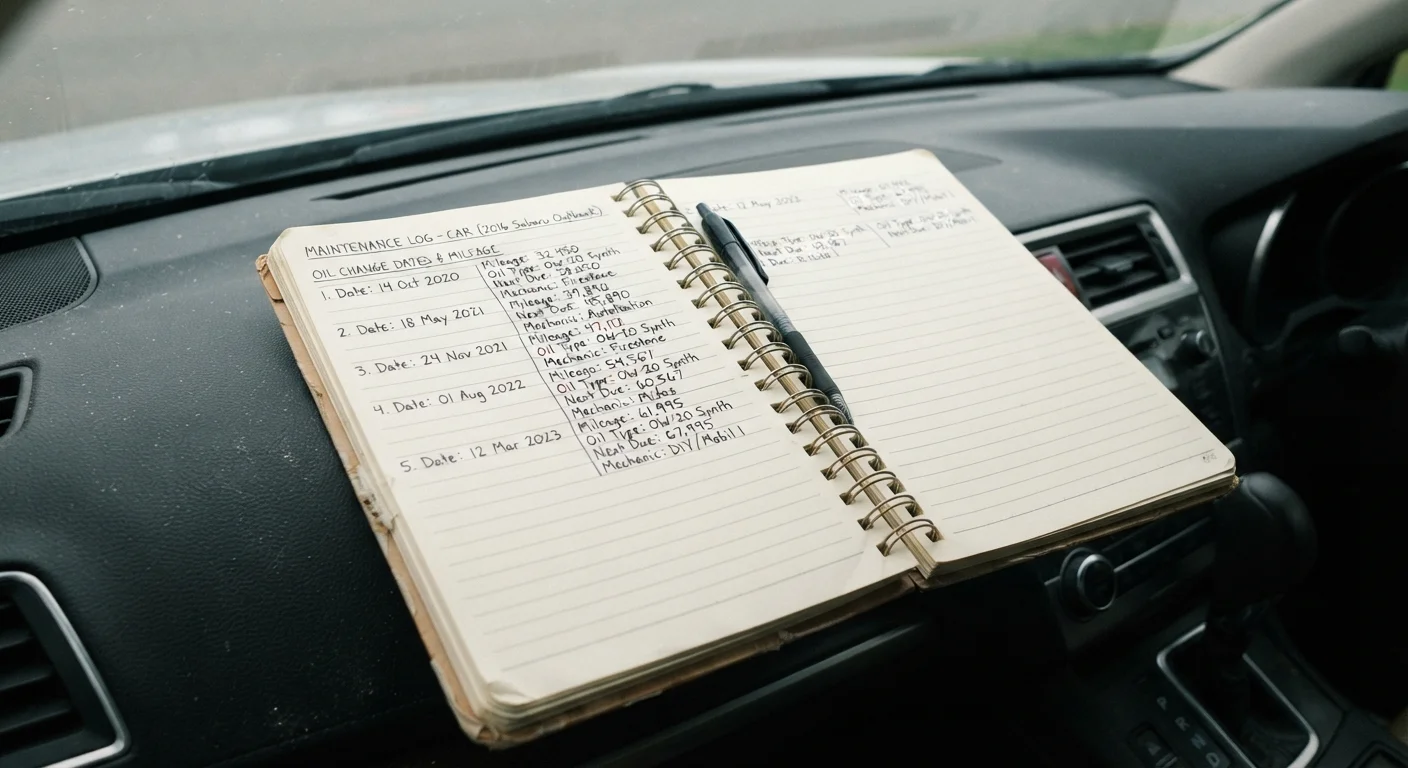
A car maintenance log is a running record of every service, repair, inspection, and part replacement performed on your vehicle. It typically includes the date, current odometer reading, work performed, cost, and the name of the shop or mechanic who did the work. Some drivers add notes about fluid top-offs, tire rotations, or unusual symptoms they noticed.
The format doesn't need to be fancy. A dedicated section in a pocket notebook kept in the glove box works perfectly well. So does a basic spreadsheet or one of several free apps designed for the purpose. What matters is consistency, not presentation. For drivers new to car ownership, getting to grips with essential upkeep tasks is a natural first step — and a log makes those tasks much easier to track.
The Advantages of Keeping a Log
The benefits of maintaining a service record compound over time. A car with documented history tells a verifiable story, which matters in several real-world situations.
Supports warranty claims with documented proof
Manufacturers and extended warranty providers can deny claims if they believe maintenance was neglected. A timestamped log gives you concrete evidence that scheduled services were performed on time.
Boosts resale value and buyer confidence
A complete service history is one of the most trusted signals of a well-maintained used vehicle. Private buyers are often willing to pay more — or simply more willing to commit — when records back up the seller's claims.
Reveals recurring problems before they escalate
When the same component or system keeps appearing in your records, that pattern becomes visible in a way it wouldn't be from memory alone. Catching a recurring issue early can prevent a minor repair from becoming a major failure.
Makes budgeting for car costs more accurate
Reviewing past entries lets you estimate upcoming maintenance costs and plan for them rather than being caught off guard. Over a year, this visibility can meaningfully reduce financial stress.
Helps mechanics diagnose problems faster
A mechanic who can see what work was done and when is better positioned to narrow down a fault quickly. This can reduce diagnostic time and, by extension, labor costs.
Up to $500
Potential resale premium for documented service history
Industry estimates from used-vehicle market analyses suggest cars with verifiable maintenance records can command meaningfully higher private-sale prices than identical models without documentation.
1 in 3
Warranty claims disputed due to lack of maintenance proof
Automotive consumer advocacy groups have noted that maintenance record disputes are among the most common reasons extended warranty claims are complicated or delayed.
Beyond individual incidents, a log makes it easier to follow your manufacturer's recommended service intervals — an often-underappreciated factor in long-term reliability. Our guide on scheduled servicing and why intervals exist explains exactly what those milestones involve and the consequences of missing them.
The Drawbacks Worth Knowing
A maintenance log is only as useful as the effort put into it. There are a few genuine limitations to consider honestly.
Requires consistent effort to stay useful
A log updated sporadically is substantially less useful than one completed after every service. Many drivers start strong and let entries lapse, which creates gaps that undermine the record's credibility.
Doesn't capture work done informally or at home
If you or a non-professional friend performs maintenance, there's no invoice to file. DIY entries are only as trustworthy as the person reviewing them believes them to be, which limits their value in warranty or resale contexts.
Paper logs can be lost, damaged, or forgotten
A notebook left in a car that's involved in a collision, water damage, or theft is gone. Without a digital backup, years of records can disappear in an instant.
Incomplete logs can raise buyer suspicion
Gaps in a service history — especially around major mileage milestones — can prompt a buyer to wonder what happened during the missing period, potentially causing more doubt than no log at all.
Digital Backups Are Worth the Extra Step
Whether you use a paper log or an app, keeping a secondary copy matters. Photographing each page of a paper log and storing the images in cloud storage takes less than a minute per entry. If the original is ever lost, your documented history remains intact and shareable with mechanics or buyers.
It's also worth noting that a log showing deferred or skipped maintenance can work against you — a prospective buyer who sees three years of missed oil changes may negotiate harder or walk away. The log is neutral; it records whatever actually happened.
How a Log Protects You in Practice
Two scenarios where a maintenance record pays off most clearly are warranty disputes and private vehicle sales.
When a mechanical failure occurs under warranty, manufacturers or extended warranty providers may request proof that the vehicle was maintained according to schedule. Without documentation, it can be difficult to refute a claim that owner neglect caused the problem. A log with dated, mileage-stamped entries from a licensed shop is credible evidence in your favor.
For resale, a documented service history signals that the car was cared for. Private buyers and dealerships alike view it as a risk-reduction factor — some are willing to pay a modest premium for the certainty it provides. This ties directly into the broader set of habits that extend a vehicle's lifespan, of which good record-keeping is one part.
Older vehicles benefit especially from thorough logs. As mileage climbs, the number of systems that need attention increases — and maintenance tasks that often get overlooked on older cars become more consequential. A log helps ensure nothing falls through the cracks.