

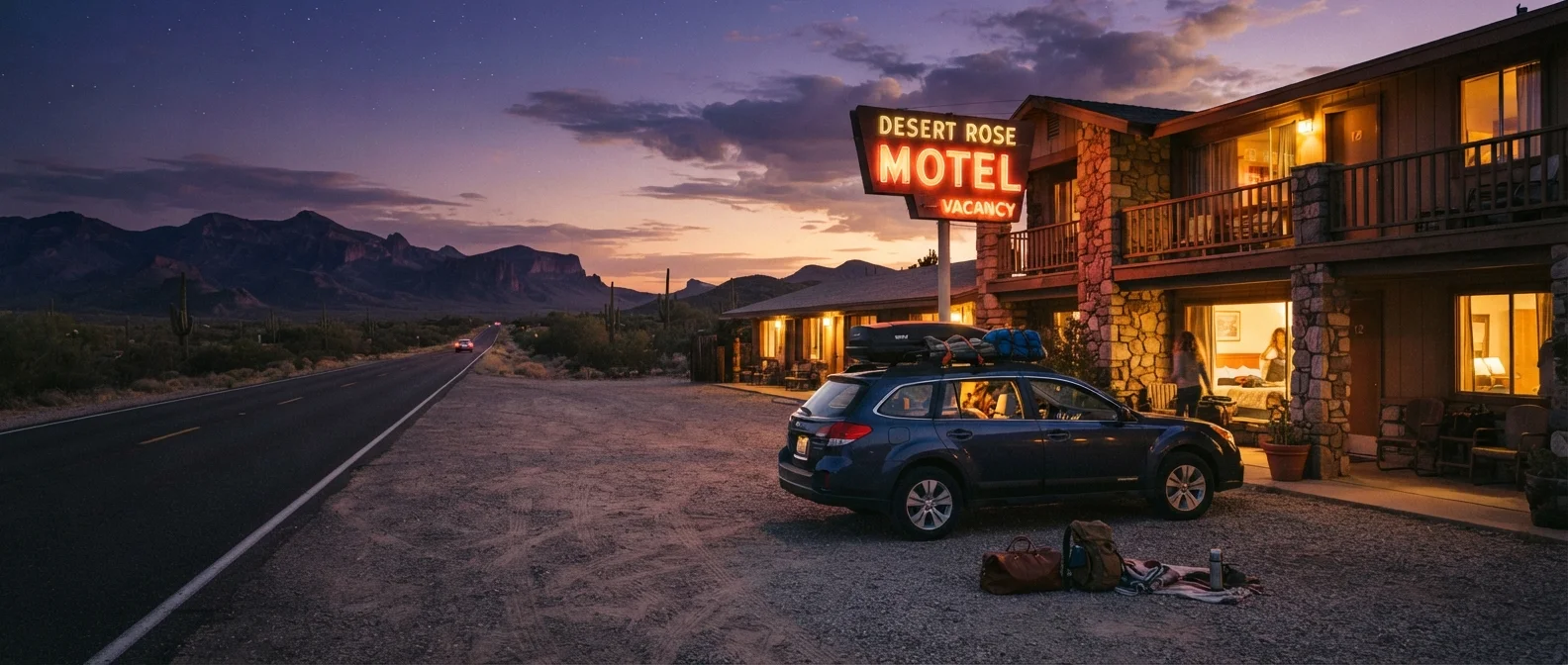
Key Takeaways
Why Overnight Stops Deserve More Thought Than You're Giving Them
Most road trippers plan the destinations and figure the overnights will sort themselves out. A motel near the highway exit, somewhere cheap and forgettable, just a place to sleep before the real stuff continues tomorrow. It's an understandable instinct — but it quietly chips away at how a trip feels.
Overnight stops are roughly half of your trip by day count. Treating them as dead time means you're only half-present for the journey. The good news: a small shift in how you select and use your stops can turn each one into something you actually look forward to. It doesn't require more money or a radical itinerary overhaul — mostly it requires a little intention.
If you're still working out your overall pace, it's worth reading how slow travel compares to whirlwind itineraries before locking in your route. The rhythm you choose shapes how much any single stop can offer.
Smart Practices for Choosing and Using Overnight Stops
These habits work whether you're crossing three states in a weekend or taking two weeks to wander the Southwest. Apply whichever fit your style.
Pick stops based on character, not just distance.
A town with a walkable main street, a local diner, or an interesting history gives you something to engage with even for just one evening. Stopping purely for geographic convenience means you'll spend the night in a blank space between interesting places.
Aim to arrive with at least 90 minutes of daylight remaining.
Pulling in after dark means you see nothing of where you are. Even a short walk around the block after check-in reorients you, beats road fatigue, and gives the stop a sense of place.
Eat one meal somewhere genuinely local.
Food is one of the fastest ways to understand a place. A regional dish, a family-owned café, or a farmers market stand connects you to where you are in a way a chain restaurant simply cannot.
Set a loose evening ritual that signals 'rest mode.'
Switching off driving mode takes conscious effort. A consistent ritual — a short walk, journaling a few lines about the day, or reviewing tomorrow's map over coffee — helps your body and mind actually recover overnight.
Research one unusual thing about each stop town in advance.
Curiosity is a muscle. Knowing that a small town has an unexpected museum, a famous mural, or a viewpoint locals love gives you a reason to look around rather than stare at your phone until sleep.
Leave driving buffer so the stop isn't rushed or ruined by fatigue.
Arriving frazzled after nine hours behind the wheel makes any stop feel like an obstacle. Planning a reasonable daily driving limit — often cited as six to seven hours as a comfortable ceiling for most travelers — means you arrive capable of actually enjoying the evening.
Get Moving on These Today
None of this requires waiting until your next big trip. A few of these actions can improve an upcoming weekend drive or even a solo overnight jaunt.
The Mindset That Makes It All Click
The biggest obstacle to enjoying overnight stops isn't logistics — it's the belief that arrival at the final destination is the only thing that counts. That framing turns every mile in between into a cost you're paying rather than a journey you're taking.
Experienced road trippers tend to describe their best memories not as grand landmarks but as unexpected towns, quirky diners, and the particular light over an unfamiliar parking lot at 7 p.m. Those moments almost always happened at an overnight stop. For further reading on structuring a trip that doesn't exhaust you, see building an itinerary that won't burn you out.
“The journey itself is my home.”
— Matsuo Bashō, 17th-century Japanese poet, author of travel writings including 'The Narrow Road to the Deep North'
And if national parks sit anywhere near your route, consider how proximity to a park might inform your stop choice — national parks along US road trip routes worth detouring for is a useful companion for exactly that kind of planning.