

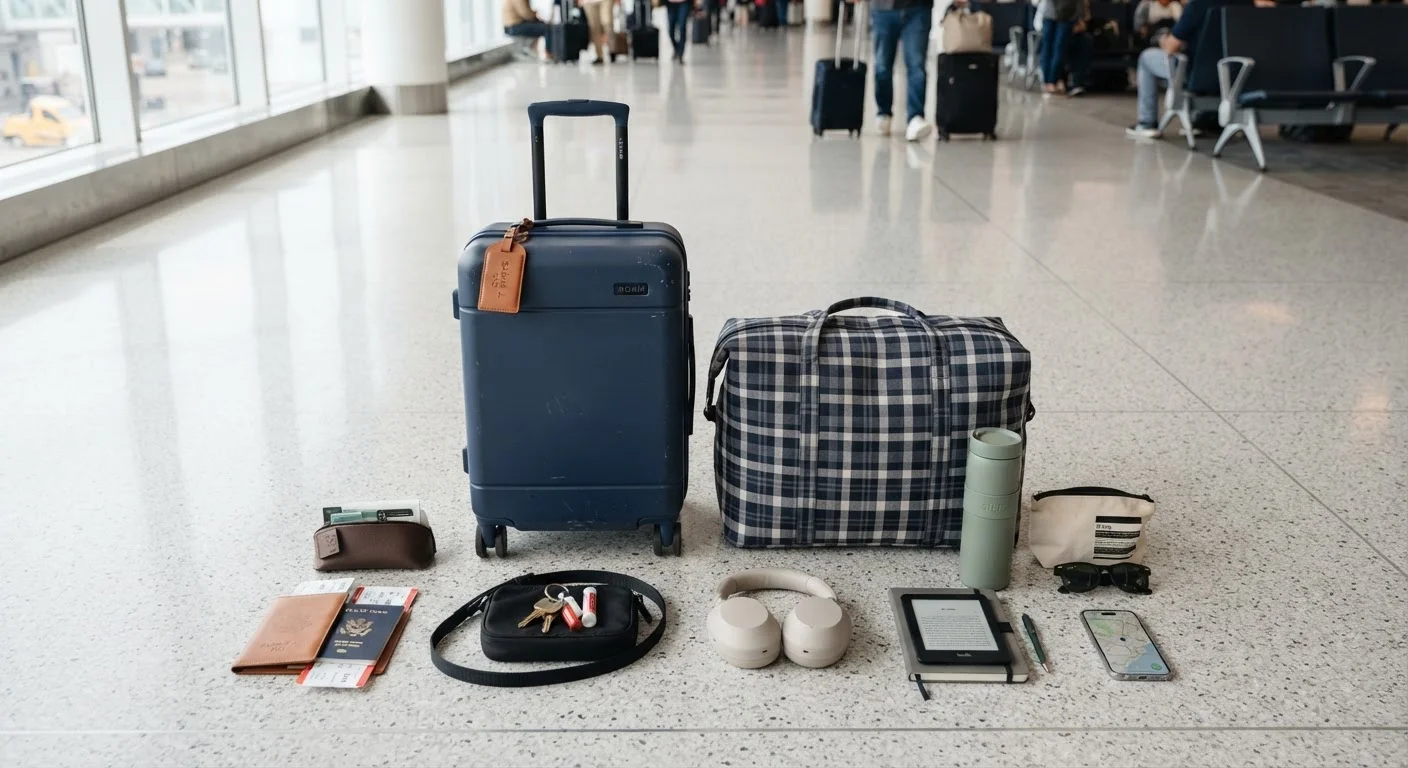
Key Takeaways
No baggage fees on most standard airfares
Many airlines include one carry-on in the base fare, meaning you avoid fees that can range from $30 to $75 or more each way on checked bags, depending on the carrier and route.
Skip baggage claim entirely
Walking off the plane and straight out of the airport saves anywhere from 20 to 45 minutes — time that adds up meaningfully across a multi-leg trip.
No risk of lost or delayed luggage
Airlines mishandle millions of bags each year globally; keeping your belongings in the cabin eliminates that risk and the disruption it causes.
Greater flexibility for last-minute changes
Switching flights, rebooking, or hopping a different carrier is far simpler when you're not waiting for a bag to be transferred or retrieved.
Encourages intentional, lighter packing
Constraints often produce better decisions — travelers who pack light frequently report feeling less burdened and more mobile throughout a trip.
Strict size and weight limits apply
Most US carriers cap carry-on bags at 22 x 14 x 9 inches, and international or budget airlines may be even more restrictive — overpacked bags can be gate-checked at added cost.
Liquids are heavily restricted
TSA's 3-1-1 rule limits liquids to containers of 3.4 oz or less in a single quart-sized bag, which complicates longer trips where toiletries matter more.
Overhead bin space isn't guaranteed
On full flights, gate agents may require carry-ons to be checked at the last moment — removing a key advantage and sometimes resulting in a fee.
Limits clothing and gear options significantly
Multi-week travel, cold-weather destinations, or activity-specific gear like hiking boots or formal attire may simply not fit within carry-on constraints without sacrificing essentials.
Can be physically tiring to manage
Lifting a packed carry-on repeatedly into overhead bins — especially on a trip with multiple flights — can be genuinely taxing, particularly for travelers with mobility considerations.
Our Verdict
Neither carry-on nor checked luggage is universally superior — the right choice depends on your trip's length, purpose, and your personal tolerance for packing constraints. Carry-on is a powerful tool for short, flexible trips where speed and savings matter most. Checked luggage earns its place on longer journeys, family vacations, or any adventure requiring gear that simply won't fit overhead.
Carry-on travel is ideal for solo travelers and frequent flyers on short-to-medium trips; checked luggage is the smarter pick for extended travel, group trips, or destinations requiring specialized equipment.
Why This Decision Matters More Than You Think
Choosing between carry-on only and checked luggage isn't just a packing question — it shapes your entire airport experience, your schedule flexibility, and potentially your trip budget. A carry-on keeps you nimble: no fees, no waiting at baggage claim, no anxiety watching the carousel spin. But a checked bag unlocks genuine freedom in what you can bring, which matters enormously on a two-week adventure or a ski trip. Understanding the real trade-offs of each approach helps you travel smarter, not just lighter.
It's also worth remembering that your luggage strategy connects to broader trip planning. As we explore in The Anatomy of a Travel Budget, baggage fees are one of those hidden costs that quietly inflate trip spending — and they're largely avoidable with intentional choices.
The Case for Carry-On Only
No baggage fees on most standard airfares
Many airlines include one carry-on in the base fare, meaning you avoid fees that can range from $30 to $75 or more each way on checked bags, depending on the carrier and route.
Skip baggage claim entirely
Walking off the plane and straight out of the airport saves anywhere from 20 to 45 minutes — time that adds up meaningfully across a multi-leg trip.
No risk of lost or delayed luggage
Airlines mishandle millions of bags each year globally; keeping your belongings in the cabin eliminates that risk and the disruption it causes.
Greater flexibility for last-minute changes
Switching flights, rebooking, or hopping a different carrier is far simpler when you're not waiting for a bag to be transferred or retrieved.
Encourages intentional, lighter packing
Constraints often produce better decisions — travelers who pack light frequently report feeling less burdened and more mobile throughout a trip.
For a growing number of travelers, carry-on only has become a point of pride and practicality. Domestic flights and short international hops are especially well-suited to this approach. You board faster, deplane faster, and walk straight to ground transportation without a detour to baggage claim. That efficiency compounds over multiple trips in a year.
Packing light also encourages smarter choices. If you're curious about maximizing your carry-on space, rolling vs. folding packing techniques can make a meaningful difference in how much fits without overstuffing.
20–45 min
Average time saved bypassing baggage claim
Industry observers and traveler surveys consistently estimate this range for domestic US airports, though actual time varies by airport and flight load.
$30–$75+
Typical one-way checked bag fee per US carrier
Fee structures vary widely by airline, fare class, and loyalty status — always verify current fees directly with your carrier before booking.
The Case for Checked Luggage
Strict size and weight limits apply
Most US carriers cap carry-on bags at 22 x 14 x 9 inches, and international or budget airlines may be even more restrictive — overpacked bags can be gate-checked at added cost.
Liquids are heavily restricted
TSA's 3-1-1 rule limits liquids to containers of 3.4 oz or less in a single quart-sized bag, which complicates longer trips where toiletries matter more.
Overhead bin space isn't guaranteed
On full flights, gate agents may require carry-ons to be checked at the last moment — removing a key advantage and sometimes resulting in a fee.
Limits clothing and gear options significantly
Multi-week travel, cold-weather destinations, or activity-specific gear like hiking boots or formal attire may simply not fit within carry-on constraints without sacrificing essentials.
Can be physically tiring to manage
Lifting a packed carry-on repeatedly into overhead bins — especially on a trip with multiple flights — can be genuinely taxing, particularly for travelers with mobility considerations.
Checked luggage gets unfairly dismissed in minimalist travel circles, but for many trips it's the genuinely practical choice. Traveling for two or more weeks? Packing a week's worth of clothes and doing laundry mid-trip is feasible, but not always realistic — especially in destinations where laundromats are scarce or your schedule is packed.
Families traveling with children, hikers bringing trekking poles, photographers with camera equipment, or skiers with gear have no reasonable carry-on alternative. And for travelers who find the mental load of extreme packing constraints stressful, a checked bag can simply make the trip more enjoyable.
Always Verify Current Airline Rules
Carry-on size allowances, personal item policies, and baggage fees change regularly and differ significantly between carriers. What applied on your last trip may not apply on your next one. Check your specific airline's current policy — including for any connecting carriers — well before travel day to avoid surprises at the gate.
Key Factors That Should Drive Your Decision
No single rule fits every traveler. Here are the questions worth asking before you decide:
- Trip length: Weekend to four nights? Carry-on is almost always manageable. Seven-plus days with varied activities? A checked bag often wins.
- Destination climate and activities: Warm-weather beach trips pack light; mountain treks or cold-weather destinations demand bulkier gear.
- Airline and route: Budget carriers frequently charge for carry-on bags above a basic personal item, which can flip the cost equation entirely. Always check the specific airline's fee structure.
- Connections and layovers: Tight layovers are significantly less stressful without checked luggage — missed-bag scenarios become non-issues.
- Group travel: Traveling with others allows strategic splitting — one checked bag shared across a group can be more economical than multiple checked fees.
If you're comparing travel modes entirely, road trips vs. flying involves a different luggage calculus altogether — your car's trunk is effectively an unlimited checked bag.
The Hybrid Approach Many Travelers Overlook
A frequently underused strategy is adapting your luggage choice trip by trip rather than committing to one philosophy permanently. A seasoned traveler might fly carry-on for a four-day city break in Europe, then check a bag for a two-week journey through slow travel destinations where the pace allows for more gear. Context should always override habit.
Some travelers also adopt a middle-ground kit: a full-size carry-on plus a personal item packed to its permitted maximum. This setup clears the overhead bin requirement while carrying considerably more than a minimalist would. It's not for everyone, but it threads the needle between flexibility and capacity — without checking a bag.