

Key Takeaways
Why These Spaces Get Away from Us
Garages, sheds, and utility rooms share one thing in common: they absorb whatever doesn't belong anywhere else. Over months and years, they quietly fill with seasonal gear, half-finished projects, duplicate tools, and items that "just need somewhere to go." Because these spaces sit outside the main living areas, the mess rarely triggers the same urgency as a cluttered kitchen or bedroom.
The result is that most households end up with one or more spaces that function as overflow zones rather than purposeful rooms. If you're feeling stuck on where to begin overall, our framework for prioritising which spaces to tackle first can help you build momentum before diving into the harder spaces.
The good news is that these areas respond exceptionally well to organisation because they tend to hold fewer emotionally charged items, and the logic of what belongs there is usually straightforward. Once you apply a consistent system, they're also among the easiest to maintain.
Start with a Full Clear-Out
No matter which space you're tackling first, the process begins the same way: remove everything. Attempting to organise around existing clutter simply rearranges the problem. Take items outside if weather permits, or stage them in a nearby hallway or driveway.
As you empty the space, sort into four broad groups: keep, relocate, donate/sell, and discard. Be honest about items that have sat untouched for more than two years — particularly in the garage and shed, where "maybe someday" items tend to accumulate.
Clean Before You Reorganise
After emptying a utility space entirely, resist the urge to immediately start putting things back. Sweep floors, wipe down shelves, and check for any signs of damp, mould, or pests. Addressing these issues before reinstalling storage means you won't have to undo your work later.
Once the space is empty, take a moment to sweep, wipe down shelves, and check for damp, pest activity, or any structural concerns before reinstalling anything. This step is easy to skip but pays dividends later.
If you'd like a structured approach to this sorting process, the weekend decluttering walkthrough offers time estimates and decision prompts to keep you moving.
Tackling the Garage
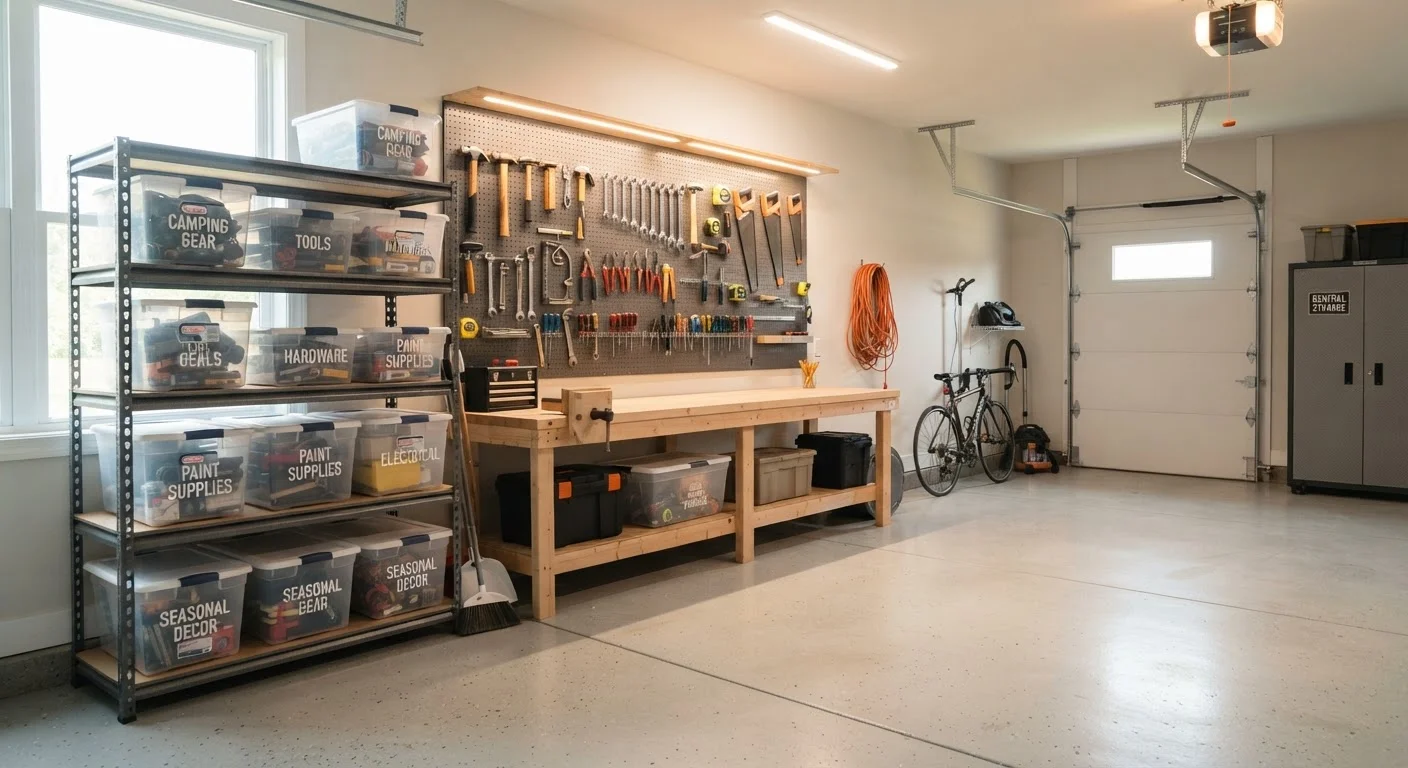
The garage is the most complex of the three spaces because it often serves multiple functions: vehicle storage, workshop, sports equipment depot, and seasonal storage all at once. The key is to zone by activity rather than trying to make it all look uniform.
Common garage zones include: automotive (oils, tools, jump leads), gardening (pots, hand tools, fertiliser), sports and recreation (bikes, balls, camping gear), seasonal (holiday decorations, snow gear), and a workbench area for projects.
Wall space is the garage's greatest asset. A pegboard panel above a workbench keeps frequently used hand tools visible and accessible. Heavy-duty wall-mounted shelving handles bins and bulkier items. Overhead ceiling racks — if your garage ceiling height allows — are ideal for rarely accessed seasonal items. Just ensure anything stored overhead is secured safely and not excessively heavy; consult a professional if you're adding structural fixings to masonry or load-bearing elements.
When setting up garage zones, walk through a typical week and note every task you perform there — then design the layout around those workflows rather than guessing at categories.
Zones built around real habits are far more likely to be maintained than those based on an idealised vision of how the space 'should' work.
Photograph the contents of opaque storage bins before sealing them and tape the photo to the outside — it's faster to read than a written label and immediately tells you what's inside.
Visual labels dramatically reduce the time spent searching and the likelihood of buying duplicates of items you already own but can't locate.
Floors should remain as clear as possible. Bikes can hang vertically on hooks; long-handled tools like rakes and shovels fit neatly in a wall-mounted holder or a dedicated floor rack. For more inspiration on using overlooked wall and corner space, see our guide to storage solutions you may not be using.
Organising the Shed
Most sheds are primarily gardening spaces, which makes zoning relatively straightforward. The challenge is usually moisture, pests, and the sheer volume of single-use seasonal items that accumulate over time.
Start by grouping items into growing-season tools, lawn care equipment, pots and planters, chemicals and fertilisers, and propagation supplies. Store chemicals on a high, dedicated shelf away from children's reach, and ensure containers are sealed and clearly labelled — never store them in unmarked containers.
Hang long-handled tools (spades, forks, hoes) on wall hooks rather than leaning them against walls, where they create trip hazards and deteriorate faster. A simple rail with S-hooks works well for this. Smaller hand tools benefit from a wall-mounted canvas tool roll or a dedicated drawer unit.
If your shed connects to your garden activities, consider linking it into a broader outdoor plan — the Garden & Outdoors hub covers growing and landscaping topics that may inform what you actually need to store versus what can be let go.
Bringing Order to the Utility Room
The utility room — or laundry room, depending on your setup — is a working space, and it should be arranged to support its primary functions: laundry, cleaning, and often household admin. Unlike the garage and shed, this space benefits from a tighter, more domestic approach to organisation.
Dedicate wall space above the washer and dryer to open shelving for detergents, cleaning sprays, and laundry supplies. Keep everyday items at eye level and less-used items higher up. Use a small bin or wall-mounted holder for dryer lint, loose items found in pockets, and replacement batteries — the miscellaneous things that need a home but often end up on top of the machine.
If the utility room doubles as a mudroom or entry point, add hooks at consistent heights for bags, coats, and keys. A shoe rack or tray near the entry keeps dirt contained. For households with multiple people contributing to this space, the guide to organising shared spaces addresses how to set systems that work across different tidiness habits.
Labelling and Maintenance Systems That Actually Stick
Organisation without labelling tends to revert within weeks. Labels don't need to be elaborate — a simple printed or handwritten label on each bin, shelf section, or hook means anyone in the household can return items to the right place without guessing.
For bins and boxes, label both the front and the top so items are identifiable whether stacked or shelved. Use broad category names rather than overly specific ones: "Car Care" will stay accurate longer than "Tyre Pressure Gauges."
Maintenance is what separates a one-off tidy from a lasting system. Schedule a brief seasonal review — roughly every three to four months — to check that zones still reflect how the space is actually being used, discard anything that's expired or broken, and reset any items that have drifted out of place. Twenty minutes four times a year is far less effort than a full reorganisation every couple of years.
If you find these utility spaces are picking up overflow from the rest of the home, that's often a sign that storage elsewhere needs attention too. Our comparison of vertical and drawer-based storage systems can help you evaluate options in smaller rooms where space is genuinely limited.