

| Typical Battery Lifespan | 3–5 years (General industry guideline; actual lifespan varies by climate, driving habits, and battery type) |
| Battery Voltage (fully charged) | Approx. 12.6 V (Standard 12-volt lead-acid automotive battery at rest) |
| Cold Cranking Amps (CCA) | Rated per battery model (CCA measures starting power at 0°F; match or exceed your vehicle's OEM specification) |
| Recycling Requirement | Mandatory — do not landfill (Lead-acid batteries regulated under federal and state hazardous-waste rules) |
| Alternator Recharge Time | 30+ minutes of highway driving (Approximate; depends on alternator output and battery state of charge) |
How Long Does a Car Battery Actually Last?
Most automotive lead-acid batteries are engineered to last between three and five years under typical driving conditions in the US. That range, however, is genuinely variable. Extreme heat accelerates internal corrosion and fluid loss, while extreme cold temporarily reduces the battery's ability to deliver starting current — two reasons why drivers in Phoenix and Minneapolis often see different lifespans from the same battery type.
Short, frequent trips are a significant lifespan reducer. Every time you start your engine, the battery discharges; the alternator then recharges it while driving. If most of your trips are under ten minutes, the alternator rarely has enough time to complete a full recharge cycle, and repeated partial charging gradually degrades capacity. If your driving pattern fits this description, monitoring battery health more frequently than average is worthwhile.
For context on where the battery fits within your broader maintenance calendar, see our complete guide for first-time car owners.
| Typical Battery Lifespan | 3–5 years (General industry guideline; actual lifespan varies by climate, driving habits, and battery type) |
| Battery Voltage (fully charged) | Approx. 12.6 V (Standard 12-volt lead-acid automotive battery at rest) |
| Cold Cranking Amps (CCA) | Rated per battery model (CCA measures starting power at 0°F; match or exceed your vehicle's OEM specification) |
| Recycling Requirement | Mandatory — do not landfill (Lead-acid batteries regulated under federal and state hazardous-waste rules) |
| Alternator Recharge Time | 30+ minutes of highway driving (Approximate; depends on alternator output and battery state of charge) |
Warning Signs Your Battery Is Struggling
Batteries rarely fail without warning. Learning to read those signals early can prevent a no-start situation at an inconvenient moment.
- Slow or labored engine cranking: If the starter sounds sluggish — particularly on cold mornings — the battery may no longer be holding a full charge.
- Dimming headlights or interior lights: Electrical accessories draw directly from the battery when the engine is off. Noticeably dim lights at idle suggest reduced capacity.
- Frequent need for jump-starts: One jump-start might be a fluke; needing them repeatedly points to a failing battery or a charging system problem.
- Dashboard battery warning light: This light monitors the charging system, not the battery in isolation. It can indicate a failing battery, a faulty alternator, or a loose drive belt — a qualified mechanic should diagnose the cause.
- Swollen or bloated battery case: Excessive heat can cause the plastic casing to expand. A swollen battery should be replaced promptly and handled with care.
- Corrosion on terminals: A white or bluish powdery buildup around the terminal posts can interrupt the electrical connection and indicates the battery should be inspected.
Staying alert to these signs is one of the small habits that extend a vehicle's overall lifespan.
Lead-acid battery
The most common type of automotive starting battery, using lead plates submerged in sulfuric acid solution to store and release electrical energy. It is the standard in gasoline and diesel vehicles.
Cold Cranking Amps (CCA)
A measurement of how much current a battery can deliver for 30 seconds at 0°F while maintaining a minimum voltage. Higher CCA ratings indicate better cold-weather starting ability.
Alternator
A generator driven by the engine that produces electricity to power vehicle systems and recharge the battery while the engine runs.
Terminal corrosion
A powdery white or blue-gray buildup that forms on battery terminal posts, often caused by hydrogen gas reacting with the metal. It can impede electrical flow between the battery and vehicle.
Reserve Capacity (RC)
The number of minutes a fully charged battery can sustain a minimum load if the alternator fails. It indicates how long the car could run on battery power alone.
Safe Handling: Checks, Jump-Starts, and Replacement
Car batteries contain sulfuric acid and produce hydrogen gas during charging — both serious hazards if ignored. The following guidance reflects standard US automotive safety practice; for any task you are uncertain about, consult a qualified mechanic.
Battery Visual Inspection
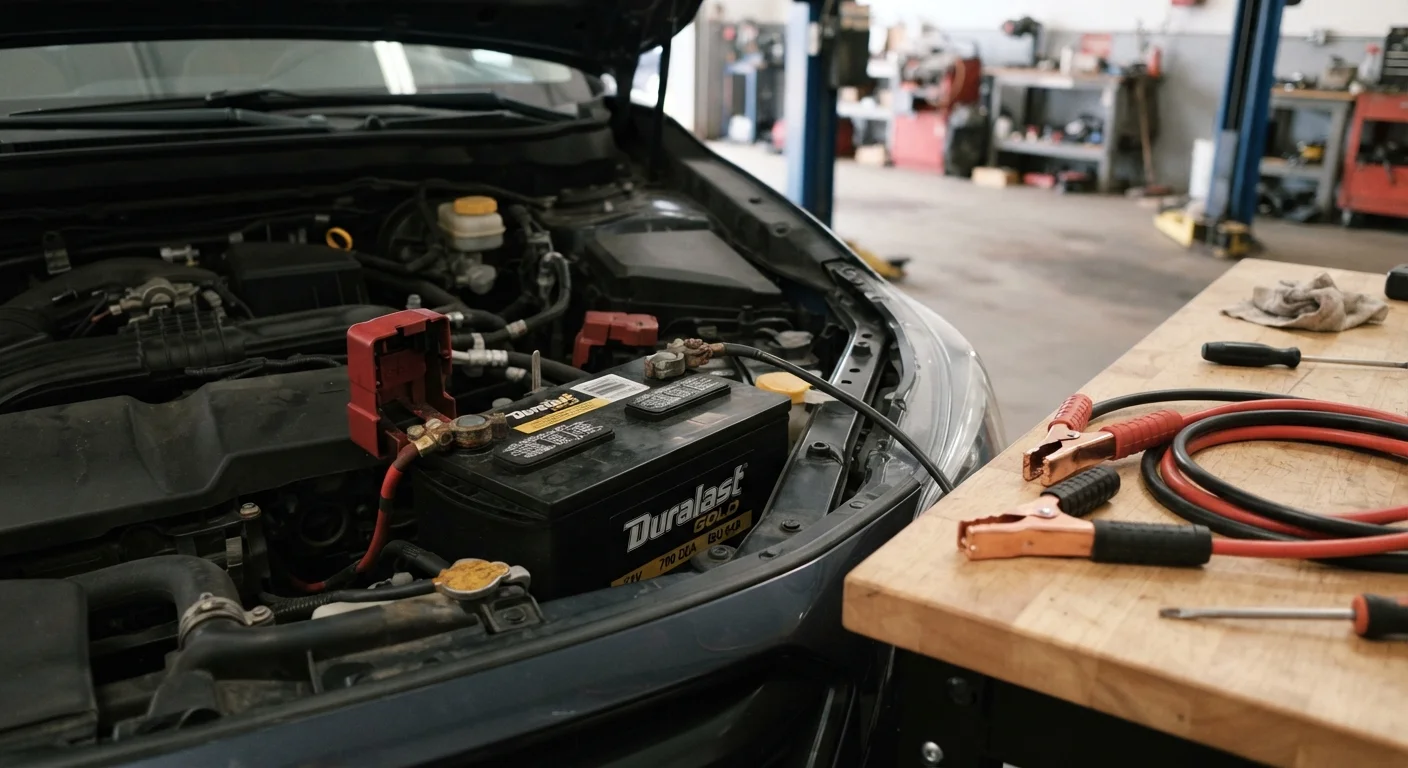
Before touching any component, turn the engine off and let the vehicle sit for several minutes. Wear safety glasses and chemical-resistant gloves. Look for cracks, corrosion, and loose cable connections. Never lean directly over the battery, and keep any open flame or sparks well away from it.
Jump-Starting Safely
- Position the working vehicle so the batteries are close but the cars do not touch.
- Connect the red (positive) clamp to the dead battery's positive terminal first, then the other red clamp to the working battery's positive terminal.
- Connect the black (negative) clamp to the working battery's negative terminal, then the final black clamp to an unpainted metal surface on the dead vehicle's engine block — not to the dead battery itself. This reduces spark risk near the battery.
- Start the working vehicle, wait two minutes, then attempt to start the dead vehicle.
- Remove clamps in the exact reverse order.
Battery Replacement
Replacement is generally straightforward but involves disconnecting and reconnecting live terminals — always disconnect the negative cable first and reconnect it last. Dispose of old batteries at a designated recycling facility; federal and state regulations prohibit throwing lead-acid batteries in household trash, and most auto parts retailers accept them for recycling at no charge.
Older vehicles often have additional battery-related maintenance needs. Our article on overlooked maintenance tasks for ageing vehicles covers several worth reviewing.
When to Call a Professional
If your dashboard warning light stays on after a successful jump-start, or if the battery fails within days of replacement, the problem may lie with the alternator or another charging-system component rather than the battery itself. Diagnosing charging-system faults requires specialized equipment. Have a qualified mechanic perform a full charging-system test before purchasing another battery.