

Key Takeaways
The Gap Between Confidence and Reality
Most people who run dangerously low on fuel during a road trip weren't being reckless — they were just using the wrong mental model. They assumed the road ahead worked like the roads back home. It often doesn't.
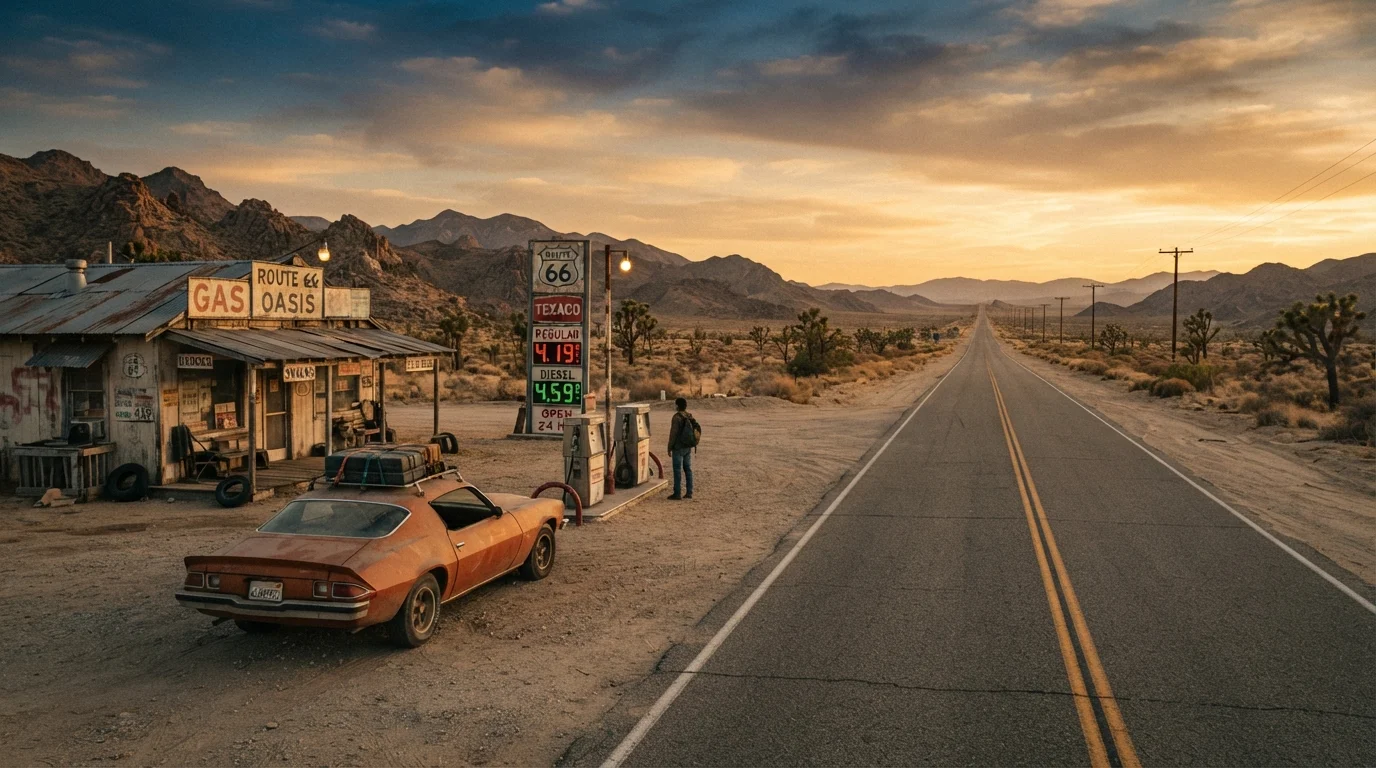
Fuel planning is one of those skills that feels obvious until you're coasting into a closed station in the Mojave at 9 p.m. wondering how this happened. The answer, almost always, is a cluster of small, compounding miscalculations that each seemed harmless on their own.
If you're planning your first US road trip, fuel logistics deserve real attention alongside your route and overnight stops. Here's where things typically go wrong.
Assuming fuel stops will appear as frequently as they do at home.
Why it happens: Drivers from densely populated areas are conditioned to seeing gas stations every few miles, so they rarely think to check spacing in advance when driving through unfamiliar regions.
Treating the manufacturer's fuel range estimate as a reliable road trip figure.
Why it happens: EPA fuel economy ratings are tested under controlled conditions that don't reflect real-world variables like high speeds, headwinds, full passenger loads, cargo weight, and air conditioning use.
Depending entirely on a navigation app or fuel-finder app without a backup plan.
Why it happens: Apps are accurate most of the time, so it's easy to trust them completely — but cell coverage drops in exactly the remote places where you most need fuel information.
Ignoring the effect of terrain and conditions on fuel consumption.
Why it happens: Fuel efficiency feels abstract until you notice the needle dropping faster than expected climbing a mountain pass or driving into a headwind across open plains.
Leaving on a long segment without a full tank because "there's still plenty."
Why it happens: Half a tank feels like more than enough in the moment, especially when the last stretch went smoothly and a full stop feels like unnecessary time lost.
How to Build Fuel Stops Into Your Route the Right Way
The fix isn't complicated — it's mostly about intention. Before you leave, pull up your full route and identify the segments with the longest gaps between fuel options. For remote stretches like those covered in desert corridor road trips, a gap of 60 or 80 miles is genuinely common and worth marking explicitly on your plan.
Don't Trust Station Listings Blindly
Fuel-finder apps and maps sometimes list stations that have closed, changed hours, or are card-only with no working terminal. In remote areas, a station that appears open on your screen may not be operational when you arrive. If you're heading into a genuinely isolated stretch — think parts of the Great Basin, eastern Oregon, or the Texas Big Bend region — call ahead when possible or verify hours through a recent traveler review. This extra step takes two minutes and can save hours of misery.
Set a personal refueling rule — something like "fill up when the tank hits one-quarter, no exceptions" — rather than playing the guessing game of how many miles you might squeeze out. This removes the temptation to push it just a little further.
Also factor in what your car will be doing differently on the road. Sustained highway speeds, mountain passes, roof racks, a packed trunk, and running the AC in high heat all pull your efficiency down from the window-sticker number. If your car claims 32 mpg, plan on somewhere closer to 26–28 on a loaded road trip day.
Fuel planning pairs naturally with the kind of itinerary thinking described in building an itinerary that won't burn you out — spacing your stops deliberately so you're never scrambling. The same logic that keeps your schedule sane keeps your tank healthy. Treat fuel stops as waypoints, not emergencies.