
OLED vs LED Screens: The Visual Difference That Actually Matters in a Real Room

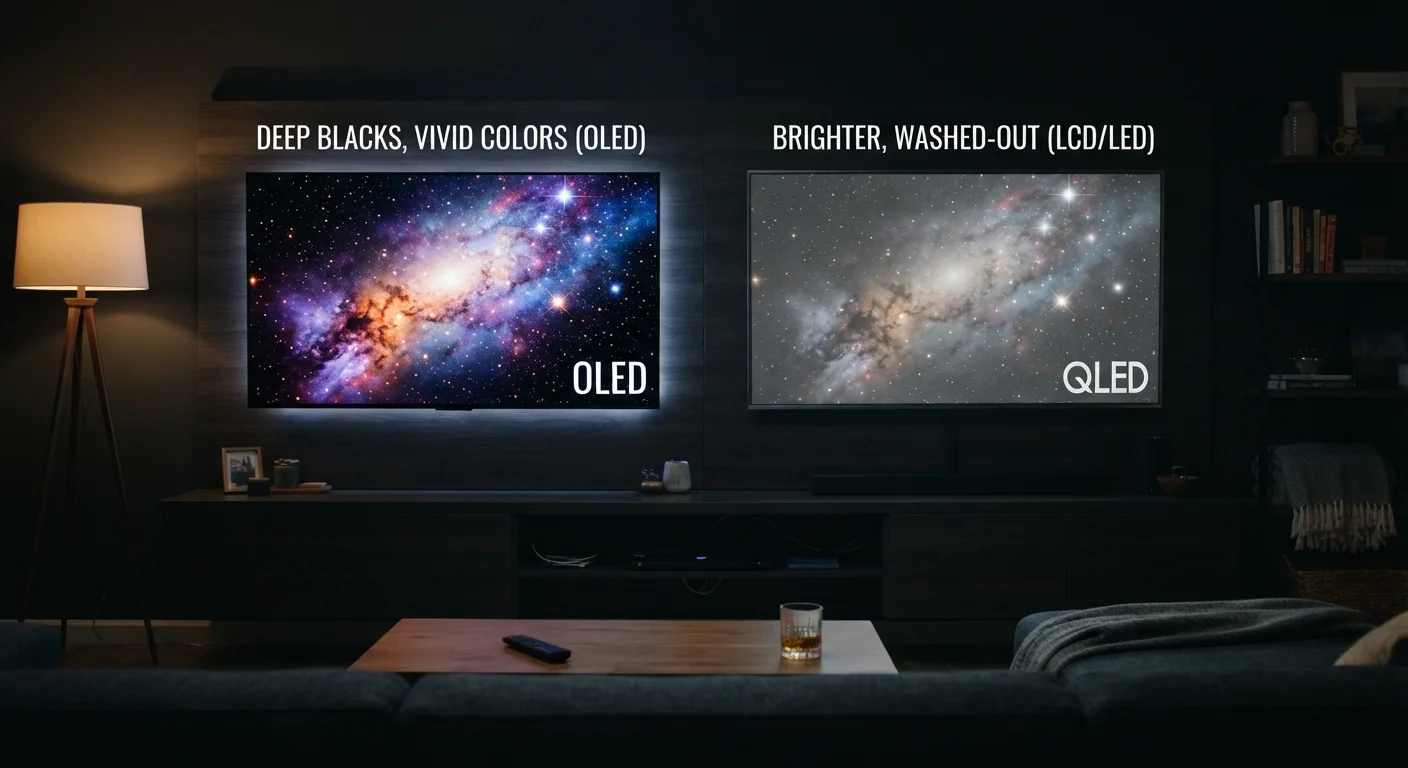
Key Takeaways
Option A
OLED
The precision display with pixel-perfect contrast.
Best for: Viewers who watch in dim or dark rooms and prioritize deep blacks, vivid color, and cinematic image quality.
Option B
LED (LCD-backlit)
The bright, durable workhorse for everyday use.
Best for: Households with bright, naturally lit rooms that want a reliable, high-brightness screen at a lower entry price.
If you watch movies or TV in a dark or dim room
OLED
OLED's ability to produce true blacks and control contrast at the pixel level creates a genuinely cinematic experience that LED simply cannot replicate in low-light environments.
If your living room gets a lot of natural daylight
LED
LED screens typically achieve higher peak brightness levels, which makes the image easier to see and more vibrant in sunlit rooms where OLED's contrast advantage is largely negated.
If you display news tickers, sports scores, or static graphics for many hours daily
LED
Prolonged static images can cause burn-in on OLED panels over time; LED panels are not susceptible to this issue.
If picture quality is your primary priority and budget is flexible
OLED
OLED delivers superior color accuracy, wider viewing angles, and true black levels that remain the benchmark for image quality in home displays.
If you want a large screen at a lower upfront cost
LED
LED technology scales more economically to large screen sizes, giving you more screen real estate for the same spend compared with OLED equivalents.
How Each Technology Actually Works
The core difference between OLED and LED screens comes down to one question: where does the light come from?
In a standard LED screen — more precisely called an LED-backlit LCD — a layer of LEDs sits behind a liquid crystal display (LCD) panel. The LEDs shine white light through the crystals, which act as shutters to shape and color the image. Because the backlight is always on, truly dark scenes require the crystals to block nearly all the light passing through them. This is imperfect: some light still leaks around the edges of the crystals, producing a subtle glow in areas that should appear black.
An OLED screen works on an entirely different principle. OLED stands for Organic Light-Emitting Diode. Each individual pixel generates its own light — and can switch off completely. When a pixel is off, it produces no light at all. That means black areas of an image are genuinely black, not a very dark grey. This per-pixel control is the reason OLED contrast is so visually striking.
For a plain-language breakdown of how display specs translate to real-world performance, see our device spec glossary for terms you'll encounter while shopping.
| Criterion | OLED | LED (LCD-backlit) |
|---|---|---|
| Black level | True black (pixel off) | Dark grey (backlight bleed) |
| Peak brightness | Moderate to high | Very high |
| Contrast ratio | Effectively infinite | High, but limited by backlight |
| Viewing angles | Excellent from wide angles | Varies; VA panels shift color at angles |
| Burn-in risk | Low to moderate over time | None |
| Typical price range | Higher entry price | Lower entry price |
| Best room lighting | Dim or controlled lighting | Bright or sunlit rooms |
| Panel thickness | Very thin possible | Slightly thicker (backlight layer) |
What the Difference Looks Like in Your Living Room
Specifications on paper rarely capture what your eyes actually experience. The visible gap between OLED and LED depends heavily on where and how you watch.
In a darkened room — lights off, curtains drawn — OLED's advantage is immediately apparent. Dark scenes in films have real depth; shadow detail is preserved without the murky grey veil that backlit panels produce. Bright colors appear against a genuine black background rather than a dim haze.
In a bright, sunlit room, the picture changes. LED panels are capable of significantly higher sustained peak brightness, measured in nits. That extra luminance helps the image cut through ambient light and keeps colors looking saturated even in direct sunshine. OLED panels, while bright enough for typical indoor lighting, can look relatively dim when competing with strong daylight.
0 nits
OLED black level output
OLED pixels switch off completely in dark areas, producing a measured black level of effectively zero nits — a key reason contrast appears so pronounced.
1,000–2,000+ nits
Typical LED peak brightness
High-brightness LED panels can sustain peak luminance well above typical OLED panels, giving them a clear advantage in bright, sunlit viewing environments.
~178°
OLED typical viewing angle
OLED panels generally maintain accurate color and contrast across a wide viewing angle, compared with narrower effective angles on many VA-type LED panels.
Viewing angle is another practical consideration. OLED panels maintain color and contrast accuracy when viewed from wide angles — useful if your seating isn't directly in front of the screen. Many LED panels, particularly those using VA (Vertical Alignment) LCD technology, can show noticeable color shift or contrast loss when viewed from the side.
Upgrading a screen is one of those small home changes that can genuinely transform a room's atmosphere, especially if your current display is more than five years old.
The Burn-In Question and Long-Term Reliability
One concern that comes up consistently with OLED is burn-in — the gradual fading of a permanent ghost image into the panel caused by static elements displayed for long periods. Channel logos, news tickers, and sports score overlays are the most common culprits.
Manufacturers have introduced software tools — pixel shifting, screen savers, and automatic brightness adjustments — to reduce burn-in risk significantly. For most viewers who watch varied content and don't leave static images on screen for hours every day, burn-in is unlikely to be a practical problem. But it remains a real consideration for users who leave screens showing fixed graphics for extended periods, such as in retail or office settings.
LED panels have no equivalent vulnerability. They can degrade over time as backlights dim, but this is a gradual, uniform process rather than the localized image retention that affects OLED.
If you use a display late in the evening, the type of screen matters less for sleep than how you use it. Our article on screen time and sleep separates the genuine evidence from common assumptions.
Cost, Size, and Practical Trade-offs
OLED panels cost more to manufacture, and that cost is passed on to consumers. The gap has narrowed over time as production has scaled, but OLED screens remain more expensive than LED equivalents at comparable sizes. Very large OLED panels — above 77 inches — carry a considerable premium.
LED technology scales more economically. It's the dominant choice across budget and mid-range display segments, and it covers a wider range of sizes at accessible price points. For households that simply want a large, reliable screen without prioritizing reference-grade image quality, LED delivers strong value.
Thickness and form factor are also worth noting. OLED panels can be manufactured extremely thin since they don't require a separate backlight assembly. This makes them popular in high-end smartphones and laptops, not just televisions.
The decision ultimately comes down to your specific room, your viewing habits, and what you value most in a display. Neither technology is objectively superior in every situation — they each have conditions where they genuinely excel.