

Key Takeaways
Why Indoor Enrichment Matters More Than You Might Think
Indoor pets live in a world that is largely static and predictable. While that stability offers safety — and there are genuine tradeoffs worth understanding when keeping animals indoors — it also removes the environmental complexity that wild ancestors relied on for cognitive engagement. The result, for many pets, is chronic understimulation.
Understimulation doesn't just mean a bored animal. Research in animal behavior consistently links cognitive deprivation with stress-related conditions, compulsive behaviors, and a shorter healthy lifespan. Destructive chewing, excessive grooming, repetitive vocalisation, and aggression are frequently expressions of unmet mental needs rather than character flaws. Understanding that framing is the first step to addressing the root cause. Visit the Animal Behavior hub for deeper context on how pets communicate distress.
The strategies below apply across the most common household pets — dogs, cats, and small animals like rabbits and guinea pigs — with notes where species-specific nuance matters most.
Use Puzzle Feeders to Make Meals Work the Brain
In the wild, animals spend a significant portion of their waking hours foraging. Serving food in a standard bowl eliminates that cognitive work entirely. Puzzle feeders — containers that require manipulation to release food — reintroduce problem-solving into the feeding routine.
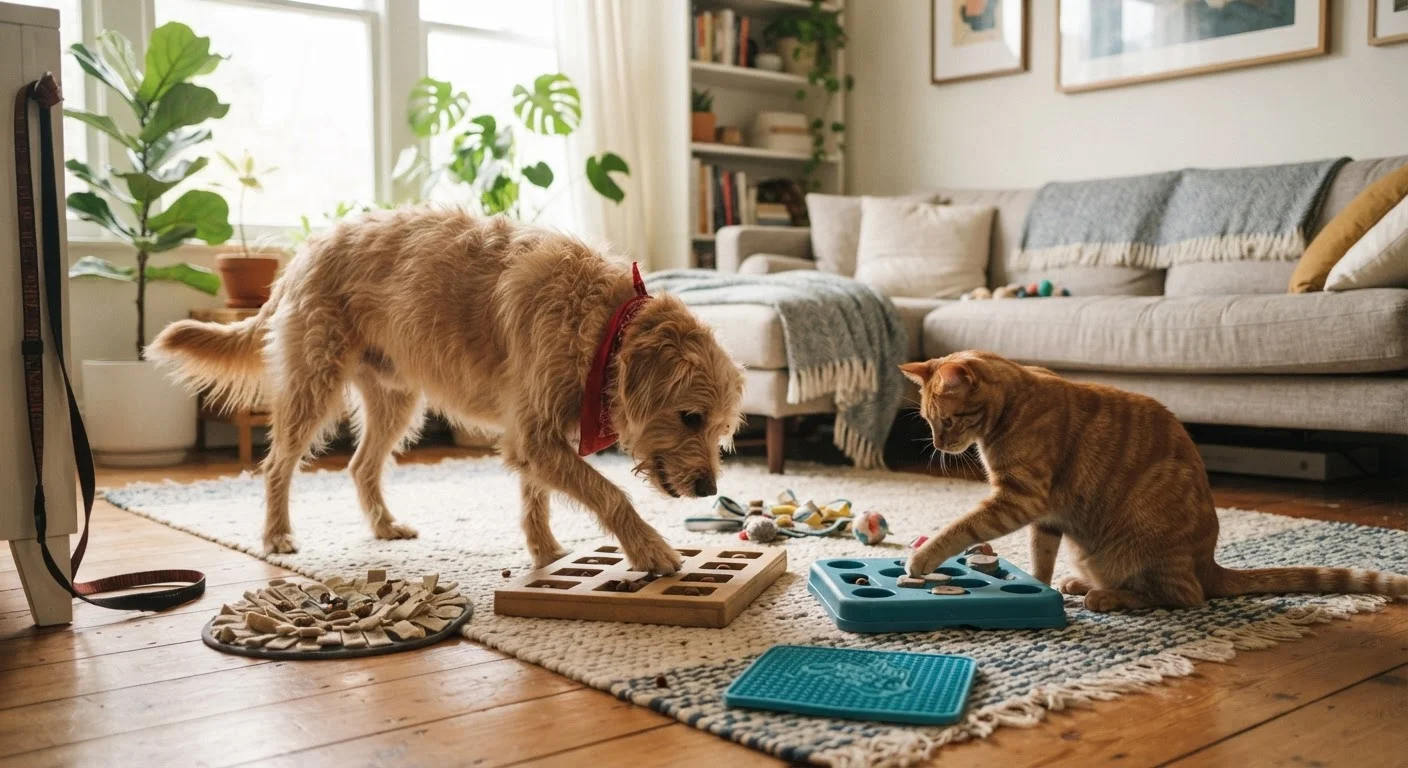
For dogs, puzzle boards and snuffle mats engage scent and motor skills simultaneously. For cats, treat-dispensing balls or food hidden in cardboard tubes encourage hunting sequences. Small animals like rabbits benefit from hay scattered across their enclosure rather than served in a single pile. Start with a low difficulty level to build confidence, then increase complexity gradually as your pet masters each challenge.
Puzzle feeders restore the foraging work that a bowl eliminates, engaging cognition at every meal.
Tap Into Your Pet's Most Powerful Sense: Smell
Scent is the primary sense through which dogs — and to a significant degree, cats and small mammals — interpret the world. Scent enrichment is low-cost, low-effort, and highly effective at producing calm, focused engagement.
Simple approaches include rotating novel scents (dried herbs, pet-safe botanicals, or outdoor items like pinecones and leaves) into the environment. Nose work games — hiding small treats around a room for your dog or cat to sniff out — provide intensive mental exercise that can tire an animal more thoroughly than a physical play session. For dogs, even brief off-leash sniff time during an outdoor walk is far more enriching than the same distance covered on a tight lead.
A focused sniff session can be more mentally tiring for a dog than a brisk physical walk.
Incorporate Short, Regular Training Sessions
Training is one of the most efficient forms of mental enrichment available, and it builds the human-animal bond as a secondary benefit. Contrary to a common assumption, training is not only for puppies or dogs with behavioural problems — adult cats, rabbits, and even guinea pigs are capable of learning cues through positive reinforcement.
Keep sessions short: five to ten minutes is typically more productive than a thirty-minute marathon, which often leads to frustration and disengagement. Focus on teaching new behaviours rather than drilling already-mastered ones. Novel challenges sustain engagement; repetition of the familiar does not. For cats specifically, understanding their natural behavioural patterns helps owners time and frame training sessions more effectively.
Five focused minutes of learning something new outperforms thirty minutes of repeating what a pet already knows.
Create Vertical Space and Environmental Complexity
Static, flat environments become invisible to pets over time. Adding vertical dimension — cat trees, wall-mounted shelves, or even safely secured furniture arrangements — dramatically expands the perceived territory available to an indoor cat. Elevated vantage points satisfy a biological need to survey surroundings and reduce stress associated with feeling trapped at ground level.
For dogs, rearranging furniture occasionally, adding a new textured mat, or changing the location of their bed introduces novelty without requiring any new purchases. Small animals benefit from tunnels, hides, and platforms within their enclosures. The principle is the same across species: environmental complexity that encourages exploration and choice supports psychological wellbeing.
Adding vertical space to a cat's environment expands perceived territory and meaningfully reduces stress.
Rotate Toys and Activities to Prevent Habituation
Animals habituate to familiar objects rapidly — a toy that produces enthusiastic play on Monday may be ignored by Wednesday. Rotating a selection of toys in and out of accessibility every few days maintains novelty and extends each item's engagement value considerably.
The same logic applies to activities. Alternating between scent games, training, play, and independent puzzle work creates variety that sustains curiosity. For households with multiple pets, the social dynamics between animals can themselves serve as enrichment — or complicate it — depending on individual personalities. Supervise multi-pet play carefully and ensure each animal has access to enrichment without competition pressure.
Rotating toys back into use after a short absence makes them feel genuinely new again.
Provide Species-Appropriate Outlets for Natural Behaviours
Destructive or unwanted behaviours rarely appear without cause. Scratching, digging, chewing, and chasing are instinctual — suppressing them without redirection simply shifts the expression. The more effective approach is providing appropriate outlets that satisfy the underlying drive.
Cats need scratching surfaces at various heights and orientations. Dogs prone to chewing need durable, size-appropriate chew items. Rabbits require sufficient hay to support both their digestive health and their natural gnawing behaviour. Guinea pigs benefit from tunnels and foraging materials. Matching the outlet to the species-specific drive transforms problem behaviours into healthy self-regulation. The Pet Health & Wellness hub offers further guidance on how behavioural and physical health intersect.
Every unwanted behaviour signals an unmet need — redirecting the drive is more effective than suppression.
Putting It All Together
Effective indoor enrichment isn't about buying every puzzle toy on the market. It's about understanding your individual animal's species, age, energy level, and sensory strengths, then designing a consistent but varied environment that meets those needs. Pairing enrichment with a structured daily routine gives activities predictable context, which itself reduces anxiety in many pets.
Start Small and Observe Closely
Introducing multiple enrichment activities at once can overwhelm anxious or sensitive pets. Begin with one new activity — a puzzle feeder or a short nose work game — and watch how your animal responds before adding more. Engagement, calm focus, and willingness to return to an activity are signs it's working. Avoidance, frustration, or hyperarousal suggest the difficulty level or type of activity needs adjustment.
One honest caution: even well-intentioned enrichment can go wrong. Overloading a shy animal with novelty, using food puzzles that frustrate rather than challenge, or neglecting rest between sessions can backfire. Our guide to common care mistakes covers several enrichment-related pitfalls in detail. When in doubt, introduce new activities gradually and watch your pet's response closely — they will tell you what's working.