

Key Takeaways
Option A
Gross Income
The headline number — before anything is taken out.
Best for: Understanding your total earning power, negotiating salaries, and qualifying for loans or rental applications.
Option B
Net Income
The real number — what actually lands in your account.
Best for: Building any real-world budget, planning monthly expenses, and managing day-to-day spending.
If you are building or adjusting a monthly spending plan
Net Income
Net income is the money you can actually spend or save. Any budget built on a higher gross figure will be out of balance from day one.
If you are evaluating a job offer or negotiating a raise
Gross Income
Employers quote and compare salaries in gross terms. Use gross figures to benchmark the offer, then convert to net to understand real-life impact.
If you are applying for a mortgage or personal loan
Gross Income
Most lenders calculate debt-to-income ratios using gross income, so knowing this figure helps you understand how much you may qualify to borrow.
If you are a freelancer or self-employed worker
Net Income
Self-employed individuals must account for self-employment taxes themselves, making net income after estimated taxes the only safe budgeting baseline.
What Each Term Actually Means
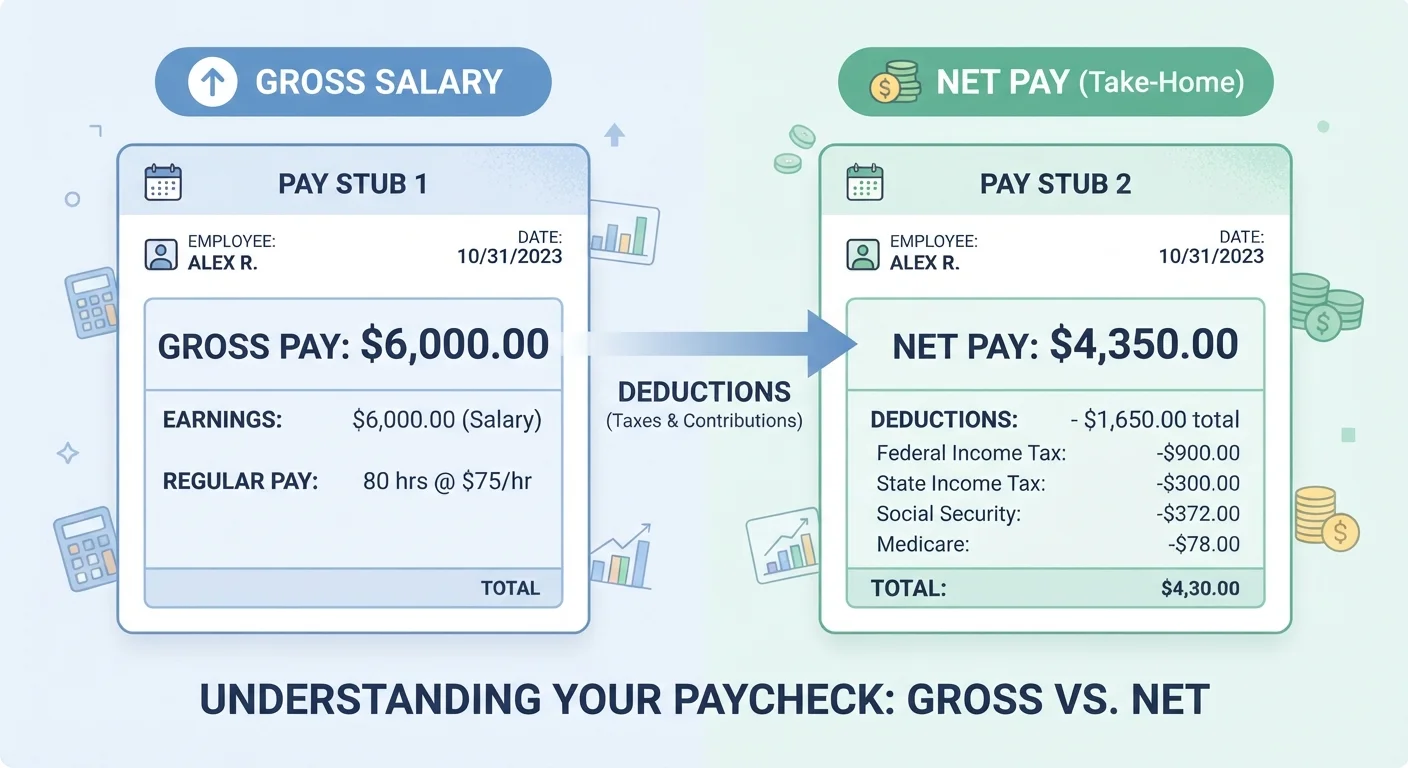
Gross income is the total amount your employer agrees to pay you before any deductions occur. If your offer letter says $60,000 per year, that is your gross salary. It is the number used in job postings, salary surveys, and most loan applications.
Net income — often called take-home pay — is what remains after all mandatory and voluntary deductions are subtracted. Federal income tax, state income tax (where applicable), Social Security tax (6.2%), Medicare tax (1.45%), and any contributions you make toward health insurance, a 401(k), or a flexible spending account all come out of your gross amount before your paycheck is issued.
The result is that a $60,000 gross salary might produce a net paycheck of roughly $3,800–$4,200 per month for a single filer with standard withholding — depending on state taxes and elected benefits. That is a meaningful gap, and it is why understanding what a budget really is starts with knowing which income figure to use.
Gross Income for Self-Employed Individuals
If you are self-employed or a freelancer, your gross income is your total revenue before business expenses and taxes. You are responsible for calculating and setting aside your own taxes — there is no employer withholding them automatically. This makes identifying your true net income even more important before building any budget. A tax professional can help you estimate quarterly obligations accurately.
Head-to-Head: How They Differ Across Key Situations
The table below compares how gross and net income function differently depending on the context you are in.
| Criterion | Gross Income | Net Income |
|---|---|---|
| Definition | Total pay before any deductions | Pay after all taxes and deductions |
| What it appears on | Offer letters, salary databases | Bank deposit, pay stub bottom line |
| Used for budgeting? | No — misleadingly high | Yes — the only accurate baseline |
| Used for loan applications? | Yes — lenders typically use gross | Rarely required by lenders |
| Reflects actual spending power? | No | Yes |
| Includes employer benefits deductions? | Yes, before they are subtracted | No — already removed |
As the table shows, neither figure is universally "better" — they serve different purposes. Mixing them up in the wrong context is where financial confusion begins. Gross income tells the story of your earning capacity; net income tells the story of your spending reality.
Why Budgeting from Gross Income Is a Common — and Costly — Mistake
When someone first builds a budget, it is natural to grab the biggest, most familiar income number available. But if you allocate spending based on $5,000 per month when your paycheck is actually $3,900, you are starting every month with a $1,100 shortfall that has nowhere to go except onto a credit card or out of savings.
This single error accounts for a large portion of budgets that "never seem to work." It is not a discipline problem — it is a data problem. Common budgeting myths often reinforce this mistake by encouraging people to think in terms of annual salary rather than monthly take-home pay.
The fix is straightforward: look at two or three recent pay stubs and identify the net deposit amount. Use that figure — not the salary printed on your employment letter — as the income line in your budget. If your income varies, see our guide on budgeting with irregular income for frameworks that handle the unpredictability.
~25–35%
Typical gap between gross and net pay
For many full-time US employees, combined federal tax, state tax, and payroll deductions reduce gross pay by roughly a quarter to a third, depending on income level and withholding elections.
15.3%
Self-employment tax rate on net earnings
Self-employed individuals pay both the employee and employer share of Social Security and Medicare taxes, per IRS guidelines, making the gross-to-net gap especially large for freelancers.
Putting It Into Practice: Building Your Budget on Net Income
Once you are working from your actual net income, a straightforward structure becomes possible. Many financial educators describe a starting allocation along these lines: roughly 50% of net income toward necessities (housing, utilities, groceries, transportation), about 20% toward savings and debt repayment, and 30% toward discretionary spending. These are general guidelines, not guarantees — your situation will shape the right proportions.
Whether you prefer a paycheck-based or monthly budget rhythm, the starting point is always the same: the actual dollars deposited. From there, you assign every dollar a job before the month begins. For a broader foundation, the complete practical guide to personal budgeting walks through frameworks, tracking methods, and habits that help budgets last long-term.
This article is for general informational and educational purposes only and does not constitute personalized financial, tax, or legal advice. Tax withholding and deduction amounts vary by individual circumstances. Consult a qualified financial professional for guidance specific to your situation.