

Key Takeaways
Envelope Budgeting
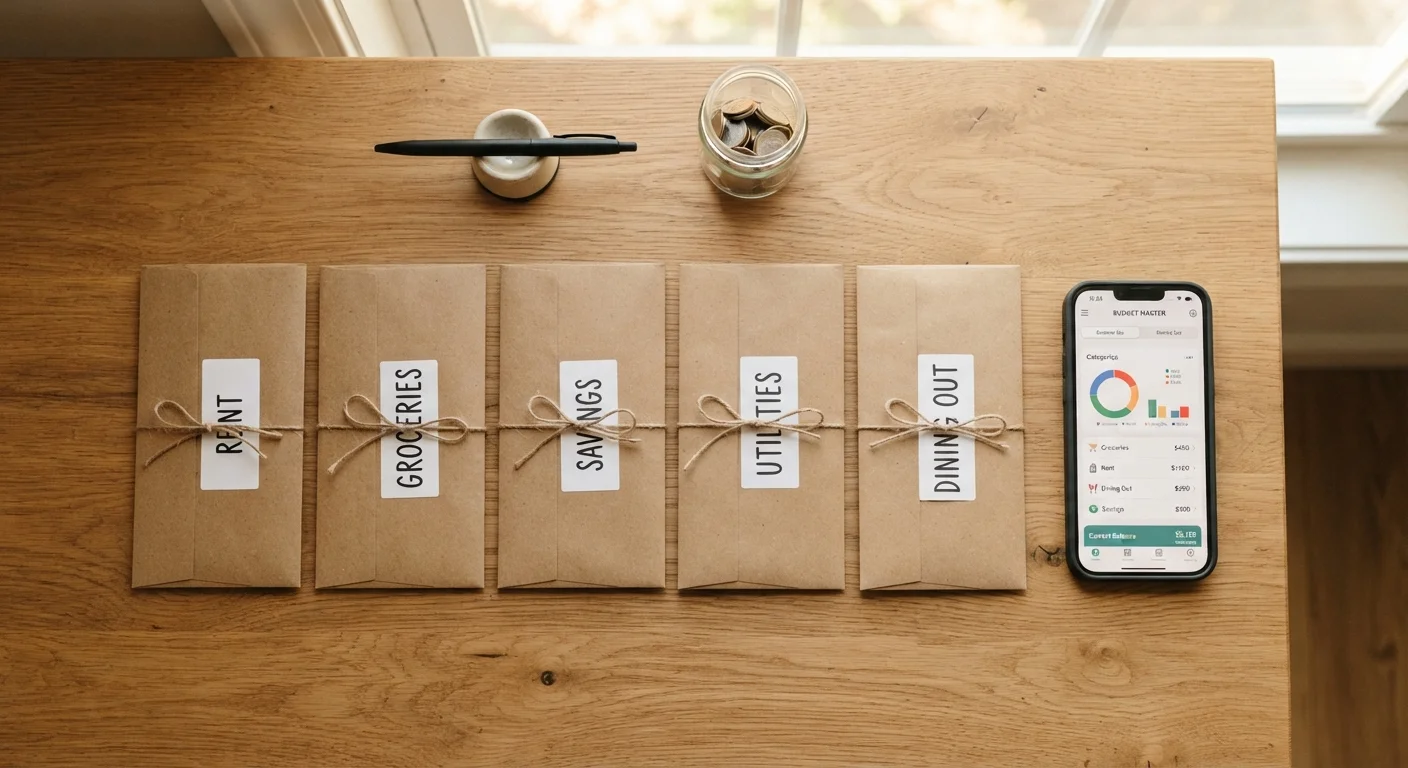
Envelope budgeting is a cash-based spending method where you divide your monthly income into physical envelopes, each labeled for a specific spending category — groceries, gas, dining out, and so on. You spend only what's in each envelope. When the envelope is empty, spending in that category stops for the month. The method creates a hard, visible boundary around every dollar.
In zero-based budgeting terms, envelope budgeting is a subset: every dollar of income is pre-assigned to a category, so income minus all envelope totals equals zero.
Where the Idea Comes From
Long before bank apps and credit cards, households managed money with a straightforward system: divide the paycheck into labeled envelopes on payday, then spend from the right envelope throughout the month. Groceries came from the grocery envelope. Nothing more came out once it was empty. The constraint was built in by the physical limits of paper and ink.
The method gained wide popularity through mid-twentieth-century personal finance culture and has remained a foundational concept in budgeting education. Its durability comes not from nostalgia but from the psychology it exploits: money you can see and touch feels finite in a way that a bank balance on a screen often does not.
For a broader look at how this fits within the full landscape of personal budgeting, see our complete practical guide to personal budgeting.
78%
Americans living paycheck to paycheck
According to LendingClub's Paycheck To Paycheck report, a significant share of U.S. consumers report spending all or most of their income each month, highlighting why pre-allocation strategies matter.
~$1,000
Average monthly household discretionary spend
U.S. Bureau of Labor Statistics Consumer Expenditure data consistently shows that food away from home, entertainment, and apparel together represent a substantial and variable portion of household budgets.
Why the Psychology Still Works
Behavioral economists call it the pain of paying: spending cash produces a mild emotional friction that card swipes and digital payments largely eliminate. Envelope budgeting deliberately reintroduces that friction. When you pull bills out of an envelope and watch the stack shrink, the cost of each purchase registers more concretely than a number decreasing on a screen.
This is particularly effective for variable, discretionary categories — the areas where most household budgets leak. Fixed obligations like rent or car insurance don't need the extra guardrail because their amounts don't change month to month. Eating out, groceries, clothing, and entertainment are the categories where the envelope's hard stop earns its value.
“A budget is telling your money where to go instead of wondering where it went.”
— Dave Ramsey, Personal finance author and radio host, widely associated with popularizing the cash envelope system in the U.S.
The method also shifts the decision-making moment. Instead of deciding whether you can afford something at the register, you've already made that call at the start of the month when you loaded the envelopes. That advance commitment is harder to rationalize away under in-the-moment temptation.
Going Digital Without Losing the Discipline
Most adults today rarely carry cash, which raises a fair question: can the envelope method work without the envelopes? The answer is yes — if the digital version preserves the core mechanic of pre-allocated, category-specific limits.
Several approaches accomplish this:
- Budgeting apps with virtual envelopes: Some apps are built explicitly around the envelope concept, letting you create spending categories, load them with a set amount each month, and track deductions in real time as you log purchases.
- Separate checking accounts: Opening two or three accounts — one for fixed bills, one for discretionary spending, one for savings — creates a physical separation that mirrors the envelope logic without requiring cash.
- Spreadsheet tracking: A manually maintained spreadsheet with category columns and running totals replicates the method for people who prefer not to use third-party apps.
The risk in any digital adaptation is convenience. It's easier to quietly ignore a virtual limit than to stare at an empty envelope. Building in a weekly check-in — just five minutes reviewing each category balance — helps preserve the accountability the physical version delivers automatically.
If you're deciding how frequently to reset your envelopes, consider whether a paycheck-based or monthly rhythm fits your income pattern better. Our comparison of budgeting by paycheck vs. monthly budgeting walks through the trade-offs.
Common Pitfalls and How to Sidestep Them
The envelope method is simple, but simple doesn't mean effortless. A few patterns trip people up repeatedly:
- Setting unrealistic category amounts
- If the grocery envelope is funded at $200 but the household consistently spends $350, the envelope empties in two weeks and the system feels like a failure. Track actual spending for one full month before setting envelope amounts — the data will be humbling but accurate.
- Treating transfers between envelopes casually
- Moving money between categories is allowed and sometimes necessary. The problem is doing it reflexively without acknowledging the trade-off. Every transfer means another category gets less. Make it a deliberate, recorded decision, not a quiet workaround.
- Leaving irregular expenses out
- Annual costs like car registration, holiday gifts, or a yearly subscription don't fit neatly into a monthly envelope. The fix is to divide the annual total by twelve and set aside that amount monthly in a dedicated envelope or savings bucket. Our article on building a budget that survives unexpected expenses covers this in detail.
This article is for general informational and educational purposes only and does not constitute personalized financial advice. Consult a qualified financial professional for guidance tailored to your individual circumstances.