
Organisation Systems for Renters: What Works Without Drilling or Permanent Changes

Key Takeaways
Organising on Someone Else's Walls
Renting comes with real constraints — no drilling into tile, no mounting shelves into drywall, no painting an accent wall to match your storage baskets. But those limits don't have to mean living in clutter. With the right approach, renters can build genuinely functional organisation systems that pack up cleanly when it's time to move.
The key is shifting the mindset from permanent to portable. Instead of asking "where can I mount this?", the better question is "how can I store this without touching the walls?" Many renters discover that freestanding, adhesive, and tension-based solutions actually work better for their lifestyle — flexible enough to adapt as needs change. If you've ever set up a tidy system only to watch it fall apart weeks later, the article on why tidiness doesn't last offers useful perspective on building habits alongside structure.
The seven strategies below focus on methods that leave no lasting marks, suit apartments and rental houses alike, and can scale to almost any budget.
Command hooks and adhesive strips for vertical storage
Adhesive hooks and strips have improved significantly and now hold considerable weight when applied correctly to clean, dry surfaces. They work well on painted walls, tiles, and smooth cabinet exteriors — and remove cleanly without paint damage when manufacturer instructions are followed.
Use them to hang everything from lightweight shelving strips and pegboard panels to hooks for bags, keys, and cleaning tools behind doors. Always check the weight rating of each product and test on a small hidden area first, especially on older paint. This approach turns dead wall space into functional storage without a single nail.
Adhesive hooks remove cleanly and hold surprising weight when applied correctly.
Tension rods to multiply storage inside cabinets and closets
A tension rod — the same spring-loaded type used for curtains — installs in seconds and holds firm between two surfaces without any fixings. Inside kitchen cabinets, a horizontal tension rod can create a second tier for hanging spray bottles or mugs. In closets, a second rod below the main hanging rail doubles your hanging space for shorter garments.
Tension rods also work well in bathroom cabinets, under sinks, and between pantry shelves for holding lids upright. They're inexpensive, infinitely repositionable, and leave no trace when removed.
A single tension rod can effectively double usable storage space inside any cabinet.
Freestanding shelving units that move with you
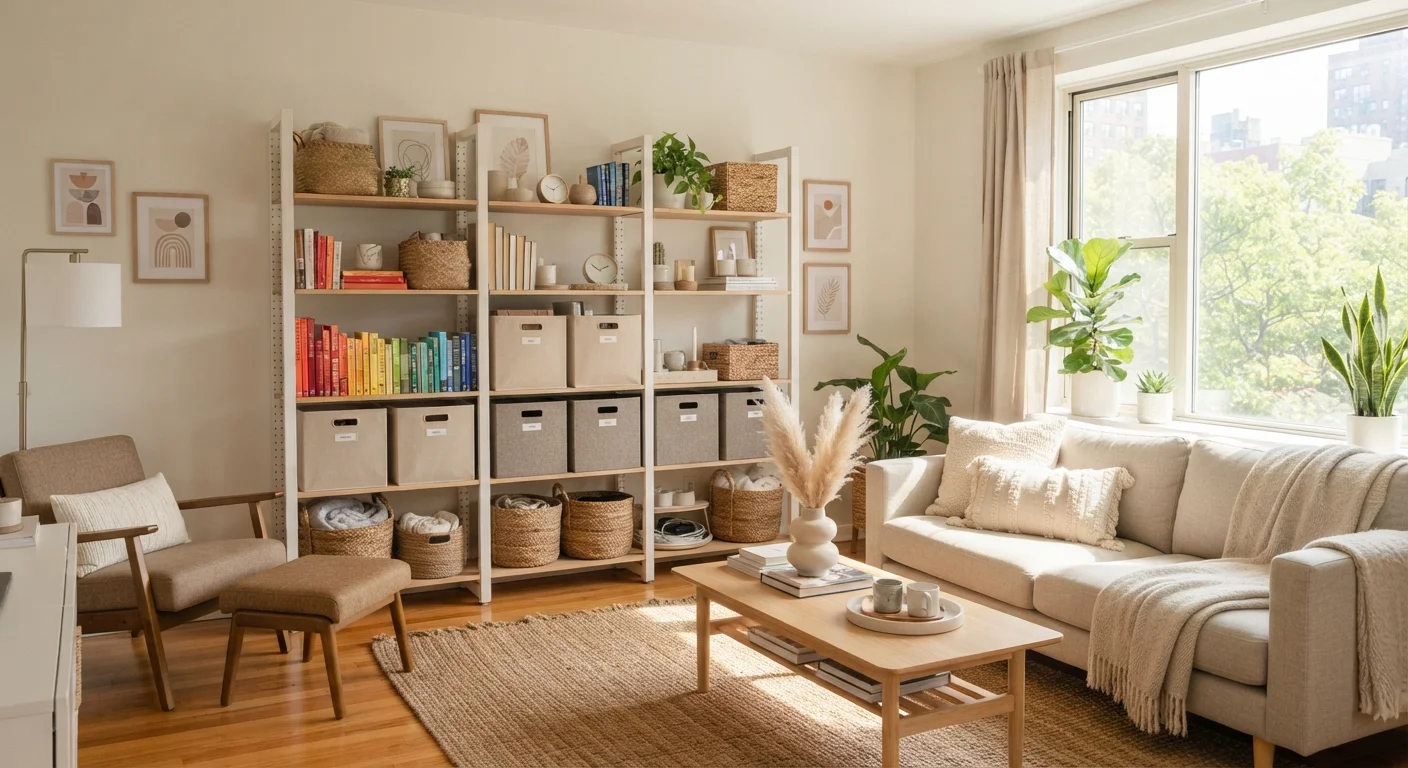
A quality freestanding shelving unit is one of the best investments a renter can make. Unlike built-ins, it goes with you to every future home. Open metal shelving suits kitchens, laundry areas, and garages. Wooden ladder shelves work well in living areas or bedrooms as a stylish, functional display and storage solution.
When choosing a unit, consider height — floor-to-ceiling options maximise vertical space without touching the ceiling. Use baskets and bins on shelves to keep loose items corralled and visually calm. Freestanding units can also define zones in open-plan spaces, acting as loose room dividers.
Freestanding shelving units are portable investments that serve every home you'll ever rent.
Over-door organisers for overlooked real estate
The back of every door in a rental is essentially free storage space. Over-door organisers hang from the top of a door without drilling and can hold an enormous range of items: shoes, cleaning supplies, pantry staples, toiletries, craft materials, and more.
For bathroom doors, a pocket organiser holds hair tools, skincare, and medicines neatly out of sight. On pantry doors, a rack for spices or small jars frees up significant shelf space. Measure door clearance before purchasing — some frames don't accommodate deep hooks, though slim profile models are widely available.
Every door in your rental is untapped storage — over-door organisers cost little and hold a lot.
Modular bins and labelled containers to create portable zones
Zoning — grouping items by purpose or frequency of use — is a core organisation principle that works regardless of your space's size or layout. Modular bins and containers let you create clear zones on any surface: a drawer, shelf, countertop, or even the floor of a closet.
Standardised container sizes stack neatly and move easily. Labels make the system maintainable for everyone in the household — when there's a clear home for every item, things get returned rather than dumped. For an introduction to zoning and other organisation concepts, the home organisation terminology reference explains key terms in plain language.
Labelled zones eliminate ambiguity — when everything has a clear home, clutter has nowhere to land.
Rolling carts for flexible, moveable storage
A rolling cart on casters adds storage exactly where you need it and rolls away when you don't. In kitchens, a cart can serve as extra counter space and pantry storage. In home offices, it organises supplies and tucks under a desk. In bathrooms, it holds towels, toiletries, and hair tools without occupying precious floor space permanently.
Carts are particularly useful in rentals with limited built-in storage, such as older apartments. Because they're entirely freestanding and mobile, they're completely renter-safe and practical for spaces that shift in function over time.
Rolling carts bring storage directly to where you need it — and move again when you don't.
Furniture with built-in storage to eliminate excess pieces
In a rental, every piece of furniture should ideally earn its footprint twice — once through its primary function and once through the storage it provides. Ottoman beds, lift-top coffee tables, storage benches at entries, and sofas with hidden compartments all consolidate function into a smaller visual and physical footprint.
This approach is especially effective in studios and smaller apartments where separate storage furniture would overwhelm the space. It also keeps clutter concealed within existing furniture rather than requiring additional shelving or bins. When you move, the storage moves with you — built into pieces you already own. It's worth noting that this approach is quite different from minimalism, which focuses on owning less rather than storing smarter — a distinction explored in the article on minimalism versus organisation.
Furniture that doubles as storage earns its space twice — essential in smaller rental homes.
Making It Stick — Without the Damage
Renter-friendly organisation works best when it's treated as a whole-home system rather than a collection of individual fixes. Think in zones: a spot near the door for everyday items, a dedicated area in the kitchen for cooking tools, clearly separated spaces in shared rooms. Our guide to keeping a functional kitchen goes deeper on pantry and countertop arrangement that doesn't require any cabinetry changes.
Test adhesives before committing
Before installing any adhesive hook or strip in a prominent location, apply it in a low-visibility spot first and leave it for 24 hours. This tests surface compatibility without risking visible damage. Always follow the manufacturer's weight limits and removal instructions to protect your deposit.
If you share your rental with others, organisation becomes a negotiation as much as a design challenge. Different tidiness standards are common — and workable — when systems are clearly communicated. The guide to organising shared spaces covers how to set up systems multiple people can actually maintain without conflict.
Above all, remember that no organisation system runs on autopilot. The physical tools here create the structure; your daily habits keep it functioning. Start with two or three of these strategies in the areas that frustrate you most, and build from there.