

Key Takeaways
Where the Confusion Starts
Scroll through any home organisation content online and you will almost certainly encounter bare countertops, neutral palettes, and sparse shelves. That visual language belongs to minimalism — a lifestyle philosophy centred on intentionally owning fewer possessions. But it has quietly become the default image of an organised home, and that conflation is causing real problems for everyday households.
When people believe they must own less before they can be organised, they face an impossible-feeling prerequisite. The result is often paralysis: nothing gets tidied because the deeper purge never happens. Understanding that these are two distinct concepts — with different goals, methods, and outcomes — is the first step toward a home that actually works for you.
For a deeper look at how clutter affects your mood and mental energy, see our piece on the psychology behind a cluttered home.
Myth
To get organised, you first need to own fewer things.
Fact
Organisation is about systems and designated places — you can be highly organised with a full household of belongings.
Decluttering can make organisation easier, but it is not a prerequisite. Many households function beautifully with large quantities of possessions because every item has a clearly defined home and a routine for returning to it. Removing things you genuinely use just to meet an aesthetic standard tends to create new problems rather than solve existing ones.
Myth
A minimalist home is automatically a tidy and organised home.
Fact
Owning fewer items does not guarantee those items are well-managed or easy to find.
Minimalism reduces visual noise, but it does not create systems. A minimalist who has not established consistent storage habits or routines can still lose track of essentials, struggle to find items quickly, or experience surfaces that collect clutter just as any other household does. The appearance of order and the function of order are not the same thing.
Myth
If your home looks full, it cannot be organised.
Fact
A full home can be exceptionally well-organised if every category of item has a consistent, accessible location.
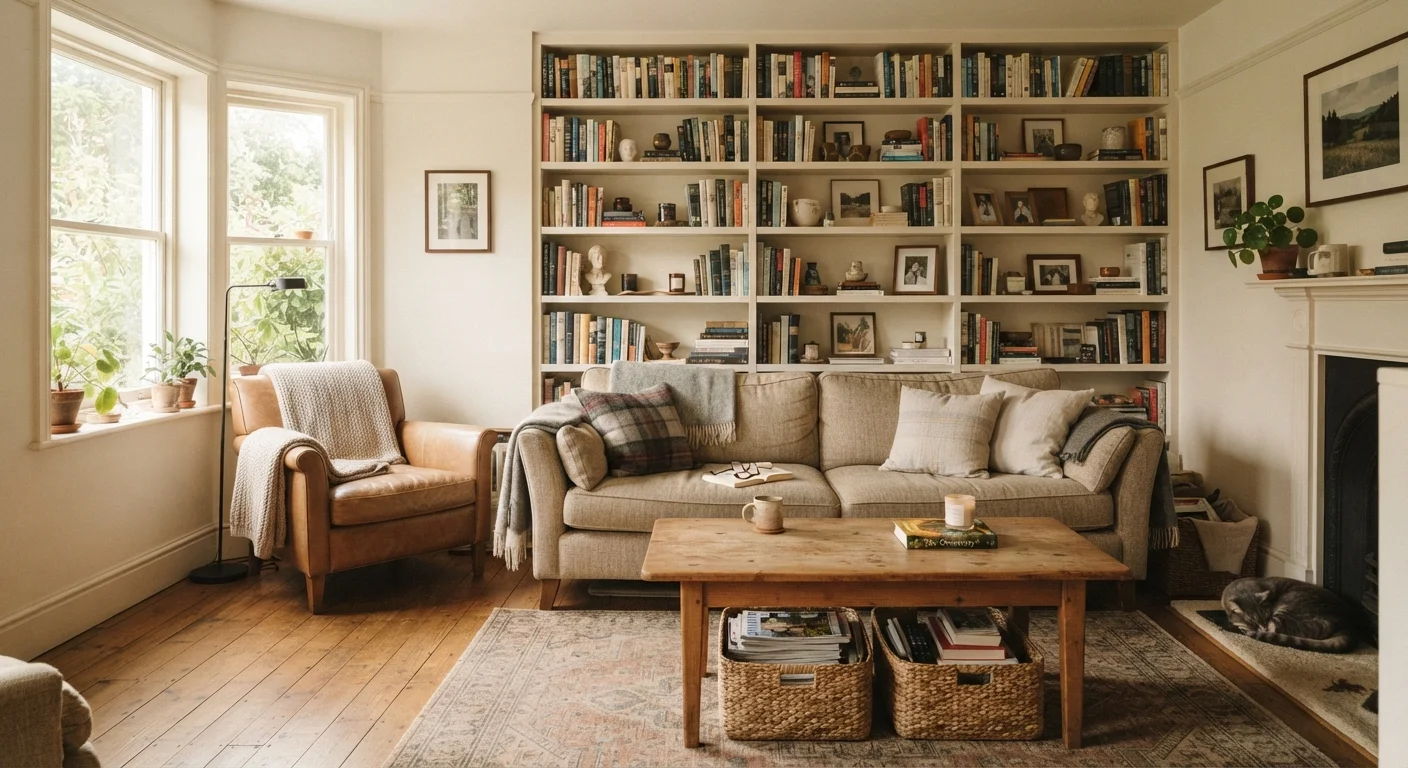
Many deeply organised homes — such as those of collectors, keen cooks, or families with young children — are visually dense. What distinguishes them is that items can be retrieved and returned reliably. Organisation is measured by function, not visual sparsity. A packed bookshelf arranged by subject is organised; a sparse shelf where nothing has a consistent place is not.
Myth
Minimalism is the only path to a calm, stress-free home environment.
Fact
Calm comes from predictability and ease of use — qualities that any home can achieve through good systems, regardless of how much it contains.
Research in environmental psychology suggests that the stress associated with cluttered spaces is linked to the cognitive load of unresolved items — things without a clear status or place. That load can be reduced through organisation systems without significantly changing the number of possessions owned. A home feels calming when you know where things are and can manage daily routines without friction.
Myth
Professional organisers tell everyone to own less.
Fact
Professional organisers typically work with what clients own, building systems around existing belongings rather than prescribing a specific ownership philosophy.
Editing possessions may be part of the process in some cases — particularly when storage capacity is genuinely insufficient — but it is a tool, not a mandate. The core work of a professional organiser involves understanding how a household functions, identifying where systems are breaking down, and designing practical solutions. That process is entirely compatible with owning a full and varied collection of belongings.
What Each Concept Actually Means
Minimalism is a personal philosophy. It asks you to question whether each possession adds genuine value to your life, and to let go of what does not. Practitioners often reduce their belongings significantly — but that is a choice driven by values, not a requirement for tidiness.
Home organisation, by contrast, is a practical discipline. It is about creating systems that make everyday life easier: knowing where things live, being able to retrieve and return them quickly, and reducing the mental load of managing a household. You can have a home full of meaningful objects, hobby supplies, children's toys, and a well-stocked kitchen and still be highly organised — if every category has a designated place and a reliable routine behind it.
Professional organisers rely on principles like zoning, natural traffic flows, and category grouping — none of which require owning fewer things. Our guide to zones, categories, and flows breaks these ideas down in plain terms.
54%
of Americans feel overwhelmed by clutter
According to a survey by the National Association of Productivity and Organizing Professionals, more than half of respondents cited clutter as a source of stress, independent of how much they owned.
1 in 4
US households cite disorganisation as the main issue
Consumer research consistently finds that lack of systems — not volume of possessions — is the most commonly cited cause of household disorder among US adults.
Why Mixing Them Up Makes Organisation Harder
When someone organises their home based on minimalist aesthetics rather than their own habits, the result rarely sticks. A near-empty pantry shelf looks clean in a photograph but fails a household that genuinely needs a deep stock of ingredients. Baskets hidden away look serene until nobody can find anything in them.
Sustainable organisation works with the way people actually live. If you cook frequently, your kitchen needs accessible, layered storage — not a minimised one. If you have young children, a tidy home means systems they can participate in, not a reduced toy count. Our article on why tidiness doesn't last explores this pattern in detail.
There is also good news in the distinction: if organisation is about systems rather than sacrifice, it is far more accessible. You may not want to live with less — but you almost certainly want a home where things are easy to find, return, and maintain. Those goals are achievable without changing your ownership philosophy at all.
Don't Discard What You Still Need
A common mistake when someone first discovers minimalism is removing items too quickly in pursuit of a cleaner look — only to replace them later at additional cost and effort. Before letting anything go, ask honestly whether the system around that item is the real problem. Reorganising is usually more effective, and less disruptive, than reducing.
Building Organisation That Works for Your Actual Life
Start by observing your home's natural patterns rather than imposing an aesthetic on top of them. Where do bags land when people come through the door? Where do dishes pile up? What surfaces attract clutter? These are not failures — they are information about where storage and systems are genuinely needed.
From there, focus on three practical foundations: a designated place for every category of item, a realistic routine for returning things to those places, and enough storage capacity to match what you actually own. You do not need to reduce your possessions first. If space is tight, look for underused storage opportunities before discarding things — our article on storage solutions you already have is a useful starting point.
If you share your home with others, their habits matter too. A system only one person maintains will collapse. See our guidance on organising a home with multiple people for practical strategies that households can actually agree on.
The goal is a home that functions smoothly for the people living in it — not one that looks a certain way in photographs. Those are very different standards, and only one of them is worth building toward.