

| Origin of 'declutter' | Traced to the late 20th century (Merriam-Webster Dictionary) |
| Most commonly organised room | Kitchen (Frequently cited in professional organiser surveys) |
| Related field | Interior design and space planning |
| Professional credential body (US) | National Association of Productivity and Organizing Professionals (NAPO) (napo.net) |
| Common organising unit | Category (not room) — grouping by item type (Standard professional organiser methodology) |
| Typical first step recommended by organisers | Purge before you purchase containers (General professional consensus) |
Why Terminology Matters in Home Organisation
Home organisation has its own language — and knowing it makes a real difference. When you understand what a professional organiser means by zoning or decanting, you can apply those ideas deliberately rather than guessing. This reference covers the terms you're most likely to encounter, whether you're reading an organisation guide, watching a tidying series, or working through a room yourself.
For a deeper look at how these ideas connect in practice, see Zones, Categories, and Flows: The Core Principles of Home Organisation, which walks through the foundational methods professional organisers rely on.
Zoning
Dividing a room or home into distinct areas based on activity or purpose — for example, a reading nook, a homework station, or a cooking prep area. Zones help ensure items are stored near where they're actually used.
Decanting
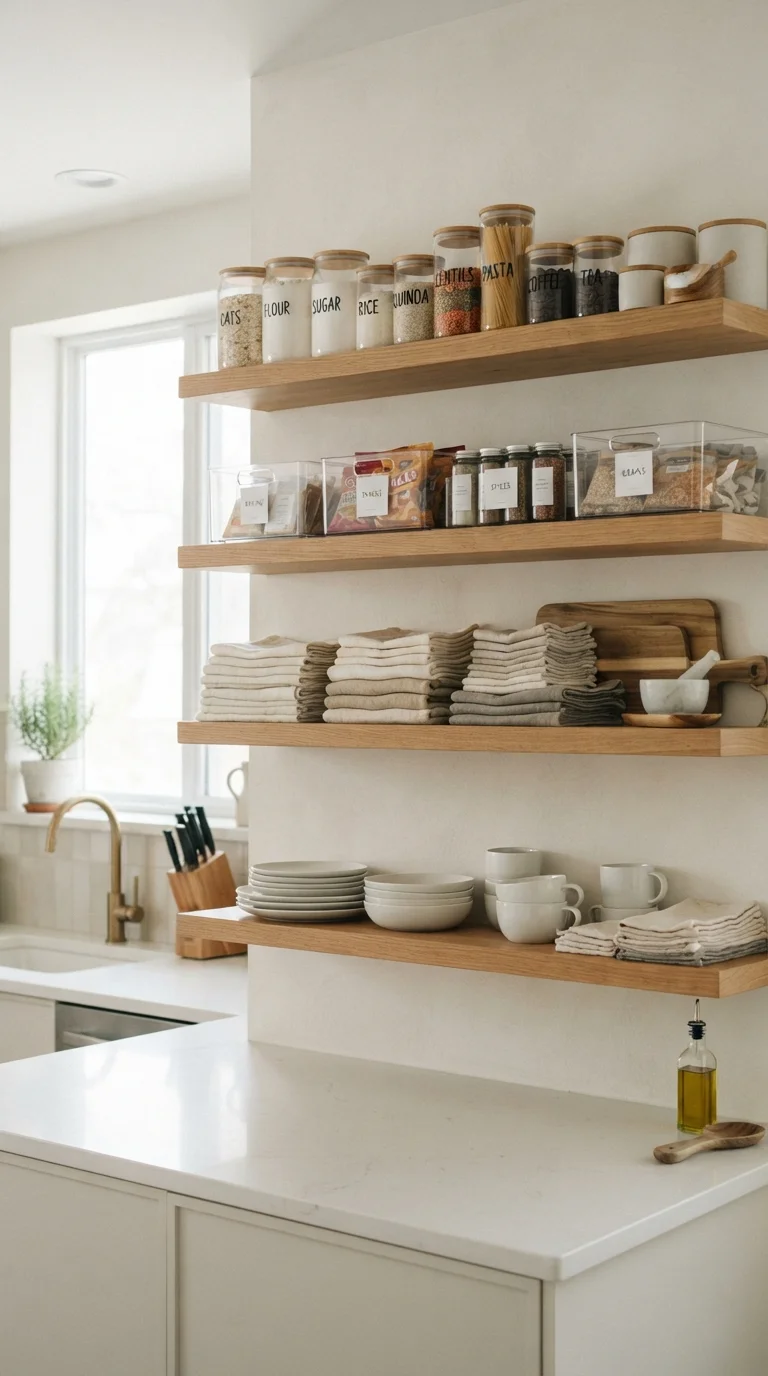
Transferring items from their original packaging into uniform containers — such as moving cereal from a box into a lidded canister. This is done to save space, improve visibility, and create visual consistency.
Negative Space
Intentionally empty areas left in a drawer, on a shelf, or within a cupboard. Negative space prevents overcrowding, makes it easier to find items, and gives a space a sense of calm.
One-In, One-Out Rule
A maintenance habit where every new item brought into the home is matched by removing an existing one. This keeps volume steady over time without requiring periodic large purges.
Containerising
Grouping loose items together inside a bin, box, basket, or tray. Containerising creates boundaries around categories so items don't drift and spaces stay consistent.
Category Sorting
Gathering all items of one type together before deciding how to store them — for example, pulling every pen in the house into one pile. It reveals true quantity and prevents duplicate storage across multiple locations.
Flow
The natural path a person takes through a room during routine tasks. Organising with flow in mind means placing items where you naturally reach for them, reducing friction and the chance of things being left out.
Landing Zone
A designated spot near an entry point — often a console table, hook rail, or tray — where frequently carried items like keys, bags, and mail are deposited on arrival. A well-designed landing zone prevents scatter throughout the home.
Purging
The process of deliberately removing items from a space — whether by donating, discarding, or relocating them. Purging is typically done before organising so that only items with a clear purpose or value are stored.
Vertical Storage
Using wall height rather than floor space to store items — via shelving, wall-mounted hooks, or stackable units. Vertical storage is especially useful in small rooms where floor space is limited.
Dedicated Home
A fixed, consistent location for a specific item. When every object has a dedicated home, it's easy to return it after use — and easy to notice when it's missing.
Staging Area
A temporary holding spot for items in transition — things that need to be returned, repaired, donated, or dealt with soon. A staging area keeps in-progress tasks visible without cluttering active spaces.
Core Concepts at a Glance
The terms below cover the full spectrum — from how items are stored to how decisions are made about what stays and what goes. Use this section as a quick-reference card for the facts and figures that give context to the field.
| Origin of 'declutter' | Traced to the late 20th century (Merriam-Webster Dictionary) |
| Most commonly organised room | Kitchen (Frequently cited in professional organiser surveys) |
| Related field | Interior design and space planning |
| Professional credential body (US) | National Association of Productivity and Organizing Professionals (NAPO) (napo.net) |
| Common organising unit | Category (not room) — grouping by item type (Standard professional organiser methodology) |
| Typical first step recommended by organisers | Purge before you purchase containers (General professional consensus) |
It's also worth noting that organisation and minimalism are often conflated. If you've wondered about the difference, Minimalism and Home Organisation Are Not the Same Thing unpacks why you don't need to own less to live tidily.
When more than one person shares a home, agreed terminology becomes even more useful. A shared vocabulary for systems and zones can reduce friction significantly — something explored in depth in Shared Spaces, Different Standards: Organising a Home with Multiple People.