

Key Takeaways
Builds continuous awareness of daily activity patterns
Passive, automatic tracking removes the effort of self-reporting, helping users notice real gaps in movement or sleep that they might otherwise rationalize away.
Motivates incremental habit formation
Goal prompts such as step targets or stand reminders have been shown in behavioral studies to nudge sedentary individuals toward more consistent movement over time.
Detects early signals worth discussing with a doctor
Features like irregular rhythm notifications and resting heart rate trends have, in some documented cases, prompted users to seek care that led to earlier diagnosis of conditions like atrial fibrillation.
Supports accountability for fitness goals
Visible progress data — weekly step totals, active minutes — provides a feedback loop that helps maintain momentum through the early stages of habit change, when motivation is least reliable.
Tracks long-term trends across multiple health markers
Viewing months of resting heart rate, sleep duration, or HRV data together can reveal meaningful patterns that no single doctor's appointment could surface.
Consumer accuracy falls short of clinical standards
Heart rate estimates during high-intensity exercise, SpO2 readings on darker skin tones, and sleep stage classifications all carry documented inaccuracies that limit medical reliability.
Can trigger health anxiety and obsessive monitoring
For some users — particularly those prone to health anxiety — continuous data access increases worry rather than reducing it, leading to compulsive checking behavior that affects quality of life.
Privacy protections are weaker than many users assume
Consumer wearable platforms typically fall outside HIPAA protections, meaning health data sharing and retention practices are governed by corporate terms of service rather than federal law.
Risk of mistaking estimates for medical findings
Users who act on wearable readings as if they were clinical diagnoses — adjusting behavior, stopping medications, or avoiding care — risk making poorly informed health decisions.
Gamification can undermine intrinsic motivation
When health becomes a points-scoring exercise, research suggests some people lose their internal motivation to stay active once the novelty of the device fades.
Data volume without context can overwhelm users
Access to dozens of daily metrics is only useful if the user understands what they mean; without that context, the data can confuse more than it clarifies.
Our Verdict
Wearable health trackers can be genuinely useful tools for building awareness and sustaining healthy habits — particularly around movement and sleep. However, their accuracy has real limits, and the data they generate requires careful interpretation. Used with appropriate expectations, they complement a health-conscious lifestyle well; treated as medical-grade monitors, they can mislead.
Best suited to adults motivated by data who want a low-friction nudge toward more consistent physical activity, and who understand that readings are estimates rather than clinical measurements.
What Wearables Actually Track
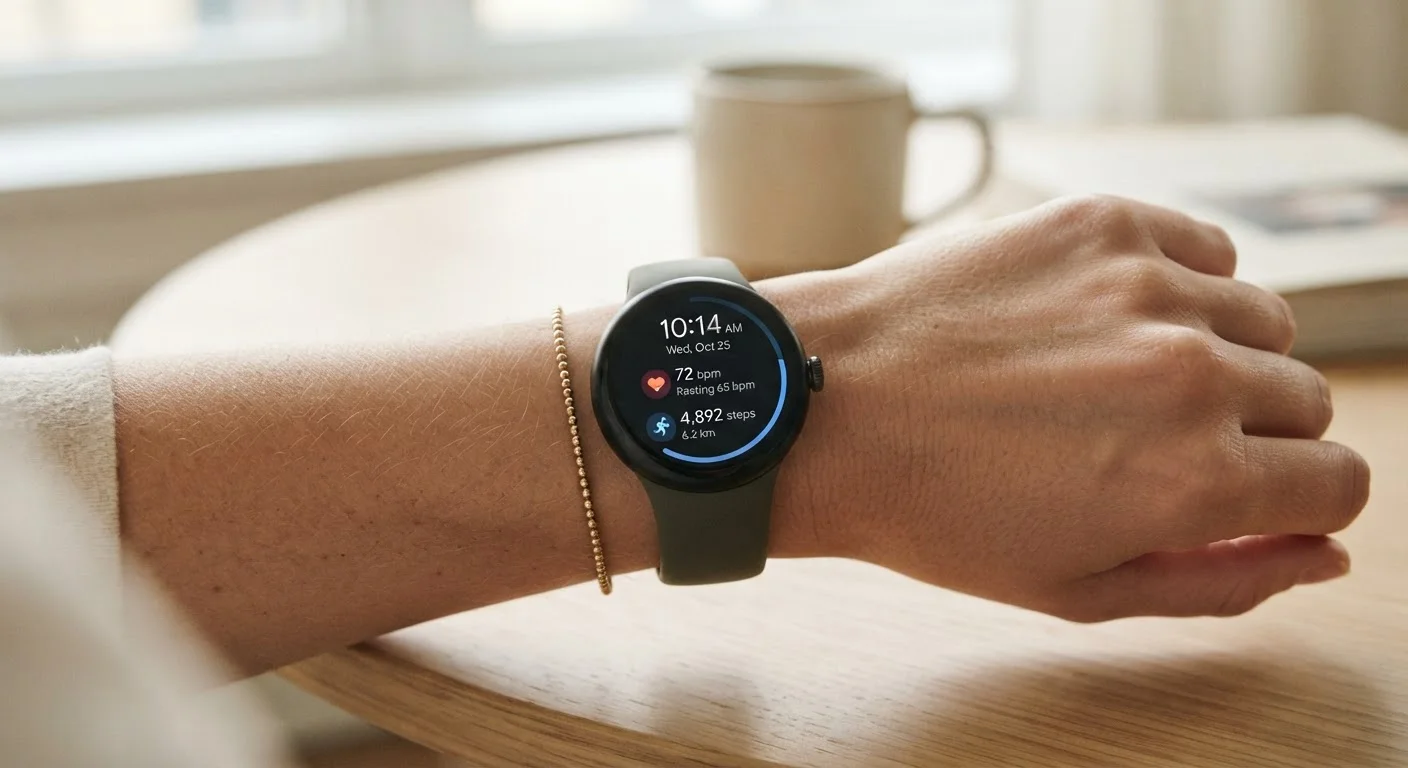
Modern health wearables — smartwatches, fitness bands, and rings — typically monitor steps, heart rate, sleep duration and stages, blood oxygen saturation (SpO2), and in some cases, skin temperature or electrocardiogram (ECG) readings. A handful of newer devices also estimate stress levels through heart rate variability (HRV).
It's important to understand what these numbers represent. Most wearable sensors work through photoplethysmography (PPG) — using light to estimate blood flow through the skin. This is a non-invasive proxy, not a direct measurement. The result is that consumer wearables can be reasonably useful for spotting trends over time, but their single-point readings should not be treated as diagnostically precise.
For general context on building physical health habits that complement what a tracker might measure, see the Physical Health hub for everyday guidance on movement, nutrition, and recovery.
The Genuine Benefits of Wearing One
Used with realistic expectations, wearables offer several meaningful advantages for everyday health management.
Builds continuous awareness of daily activity patterns
Passive, automatic tracking removes the effort of self-reporting, helping users notice real gaps in movement or sleep that they might otherwise rationalize away.
Motivates incremental habit formation
Goal prompts such as step targets or stand reminders have been shown in behavioral studies to nudge sedentary individuals toward more consistent movement over time.
Detects early signals worth discussing with a doctor
Features like irregular rhythm notifications and resting heart rate trends have, in some documented cases, prompted users to seek care that led to earlier diagnosis of conditions like atrial fibrillation.
Supports accountability for fitness goals
Visible progress data — weekly step totals, active minutes — provides a feedback loop that helps maintain momentum through the early stages of habit change, when motivation is least reliable.
Tracks long-term trends across multiple health markers
Viewing months of resting heart rate, sleep duration, or HRV data together can reveal meaningful patterns that no single doctor's appointment could surface.
One of the most consistent findings in behavioral research is that awareness precedes change. Seeing a real-time step count or resting heart rate trend can surface patterns that would otherwise go unnoticed. For example, a gradual rise in resting heart rate over several days may signal that your body is under unusual stress — whether from poor sleep, overtraining, or illness onset. That kind of passive signal has practical value.
Activity-focused wearables pair naturally with habit-building goals. If you're weighing how to structure daily movement, our walking vs. running comparison covers which approach tends to be more sustainable for long-term health.
The Limitations and Risks Worth Knowing
The case for wearables is real — but so are the drawbacks. Being clear-eyed about these makes the difference between a useful tool and a source of unnecessary worry.
Consumer accuracy falls short of clinical standards
Heart rate estimates during high-intensity exercise, SpO2 readings on darker skin tones, and sleep stage classifications all carry documented inaccuracies that limit medical reliability.
Can trigger health anxiety and obsessive monitoring
For some users — particularly those prone to health anxiety — continuous data access increases worry rather than reducing it, leading to compulsive checking behavior that affects quality of life.
Privacy protections are weaker than many users assume
Consumer wearable platforms typically fall outside HIPAA protections, meaning health data sharing and retention practices are governed by corporate terms of service rather than federal law.
Risk of mistaking estimates for medical findings
Users who act on wearable readings as if they were clinical diagnoses — adjusting behavior, stopping medications, or avoiding care — risk making poorly informed health decisions.
Gamification can undermine intrinsic motivation
When health becomes a points-scoring exercise, research suggests some people lose their internal motivation to stay active once the novelty of the device fades.
Data volume without context can overwhelm users
Access to dozens of daily metrics is only useful if the user understands what they mean; without that context, the data can confuse more than it clarifies.
~30%
Heart rate error rate during vigorous exercise
Research published in the Journal of the American Medical Association found optical wrist-based heart rate monitors showed error rates of around 30% or more during high-intensity activity compared to ECG reference readings.
1 in 5
Adults who report increased health anxiety from wearables
Survey data from consumer health research groups suggests a meaningful minority of wearable users experience heightened health-related worry tied directly to device alerts and metric fluctuations.
Sleep tracking deserves particular scrutiny. While wearables can estimate total sleep time with reasonable consistency, their ability to accurately classify sleep stages (light, deep, REM) is limited compared to clinical polysomnography. Studies published in peer-reviewed sleep journals have found that consumer devices frequently misclassify sleep stages, particularly in light sleepers. If you're concerned about screen-related sleep disruption, our piece on screen time and sleep quality separates evidence-based concern from overreaction.
There's also a documented phenomenon sometimes called orthosomnia — a preoccupation with achieving perfect sleep scores that paradoxically worsens sleep. Any tool that gamifies health can tip from motivating into anxiety-inducing.
A Note on Medical-Grade vs. Consumer Devices
Some wearables now include FDA-cleared features — such as ECG recording for detecting atrial fibrillation. These specific cleared features are held to a higher regulatory standard than general wellness metrics like step count or stress scores. Being clear on which features are cleared and which are wellness estimates matters when deciding how much weight to give any reading. If a device feature prompts genuine concern about your heart rhythm, consult a healthcare professional promptly.
Privacy and Data: An Overlooked Consideration
Health data collected by wearables is sensitive. Depending on the platform, your heart rate history, sleep patterns, menstrual cycle tracking, and activity data may be stored on company servers, shared with third-party partners, or potentially accessible in ways that aren't immediately obvious from the device's marketing.
Consumer wearables are generally not covered by HIPAA (the Health Insurance Portability and Accountability Act) in the same way that health data held by medical providers is protected. This means the privacy protections governing your wearable's data are largely governed by the company's terms of service, not federal healthcare law.
Before committing to a platform, it's worth reviewing what data is collected, how long it's retained, and whether it can be deleted. This is a practical step that's easy to skip but worth taking seriously.
Using Wearables as One Tool Among Many
The healthiest relationship with a wearable is one where it informs rather than dictates. Tracking data is most valuable when it feeds into broader self-reflection — rather than becoming a rigid scorecard that drives compulsive behavior.
A useful frame: use your wearable to spot directional trends over weeks, not to obsess over individual readings day to day. A single night of poor sleep data matters far less than a two-week pattern of shortened rest. Integrating that kind of reflection into a broader weekly health review can be genuinely productive. Our weekly wellness audit offers a practical structure for doing exactly that.
If a reading ever concerns you — an irregular heart rhythm flagged by an ECG feature, for instance — treat that as a prompt to consult a qualified healthcare professional, not a diagnosis. Wearables can notice; they cannot interpret.
This article is for general informational purposes only and does not constitute medical advice. Always consult a qualified healthcare professional for questions about your health, symptoms, or any medical device.