

Key Takeaways
Night Driving
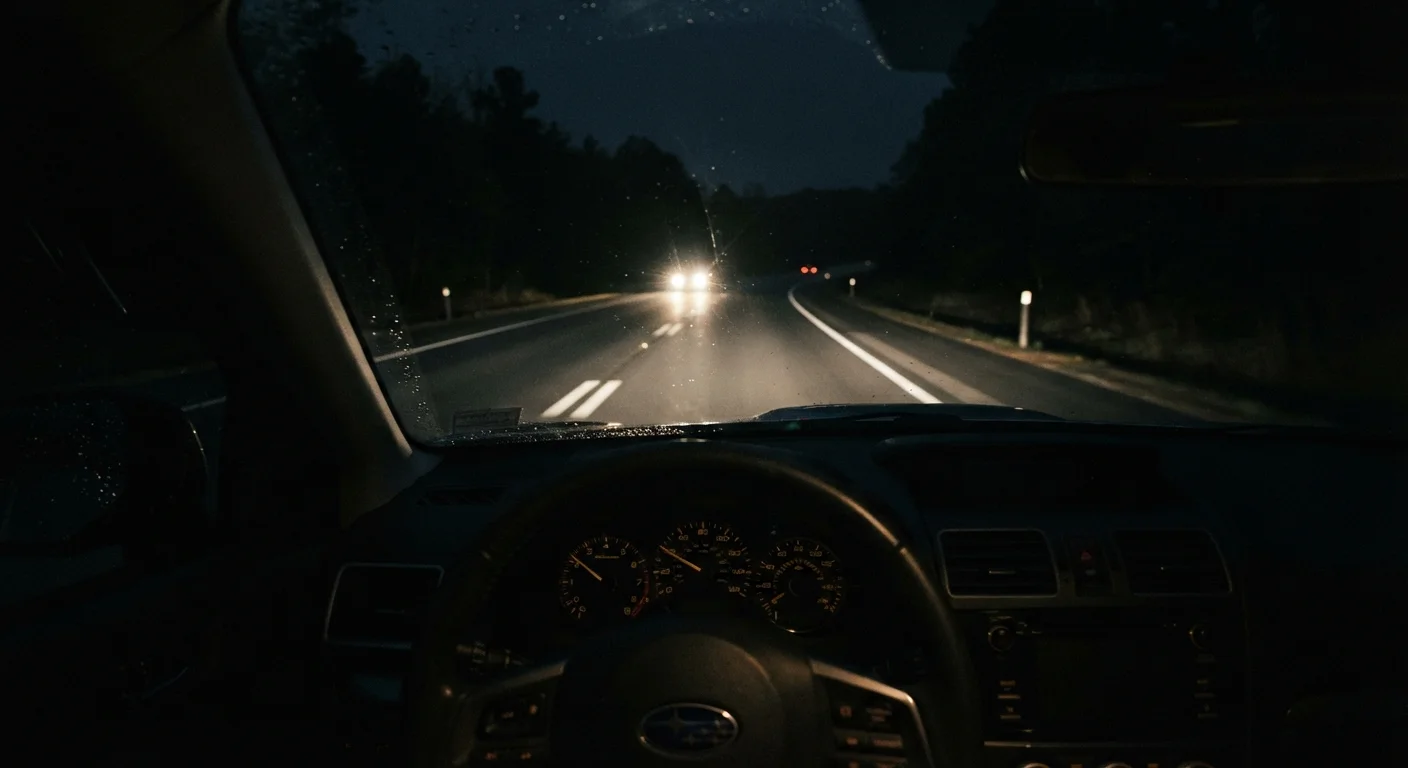
Night driving refers to operating a vehicle after sunset or before sunrise, when natural light is absent or severely reduced. Unlike daytime driving, the visual system relies almost entirely on artificial light sources — headlights, streetlights, and traffic signals — which illuminate only a fraction of what the eye can process in daylight. The result is a driving environment where hazards appear later, depth perception is less reliable, and the brain must work harder to interpret what it sees.
The human eye shifts from cone-dominated (color, high-acuity) vision in daylight to rod-dominated (low-light, peripheral) vision at night — a transition that reduces visual acuity and contrast sensitivity significantly.
What Your Eyes Are Actually Doing After Dark
When light fades, your visual system undergoes a fundamental shift. During daylight, your eyes rely on cone cells concentrated in the center of the retina — the cells responsible for sharp detail and color. At night, the cones become far less effective, and your vision increasingly depends on rod cells, which are spread across the periphery of the retina and are sensitive to movement and low light, but not fine detail or color.
The practical consequence is significant: your central vision becomes less precise at night, while your peripheral vision becomes comparatively more useful. Objects that are directly ahead — a pedestrian in a dark jacket, a pothole, a stopped vehicle — can be harder to resolve clearly than something caught in your side vision. This is why experienced night drivers learn to scan slightly to the sides of the road rather than fixing a hard stare straight ahead.
Recovery from glare compounds this further. When an oncoming vehicle's headlights flood your visual field, the rods temporarily lose their adaptation to darkness — a phenomenon called glare recovery lag. Depending on age and eye health, this can take anywhere from a few seconds to considerably longer, during which your effective vision is substantially reduced.
Night Vision Declines Gradually With Age
The ability to see clearly in low light decreases with age, often beginning in a driver's 40s and becoming more pronounced by the 60s. Conditions such as cataracts, glaucoma, and reduced pupil responsiveness all affect night vision. If you notice increasing difficulty driving at night, an eye examination is a sensible first step — not a sign to avoid driving entirely.
The Stopping Distance Problem Nobody Talks About
One of the most underappreciated dangers of night driving is the relationship between speed and how far your headlights reach. Standard low-beam headlights illuminate roughly 160–200 feet of road ahead. At 60 mph, you're covering about 88 feet per second. Factor in your perception and reaction time — typically 1.5 seconds — and you've already traveled over 130 feet before you've even touched the brake. The math is uncomfortable: at highway speeds on low beams, you may not have enough distance to stop for a hazard that appears at the edge of your light range.
This is sometimes called overdriving your headlights — traveling faster than your ability to stop within the distance you can see. It's a subtle trap because the road feels familiar and the car feels normal, yet the safety margin has quietly collapsed.
Understanding how stopping distance changes with speed is one of the most practical foundations for safer night driving. Reducing speed by even 10 mph meaningfully extends the time you have to respond.
~50%
Of traffic fatalities occur at night
According to the National Safety Council, roughly half of all US traffic fatalities occur during nighttime hours, despite far less traffic volume than daytime.
160–200 ft
Typical low-beam headlight range
Most standard low-beam headlights illuminate approximately 160 to 200 feet ahead — a distance covered in under two seconds at highway speeds.
3x
Higher fatality risk driving at night
The National Highway Traffic Safety Administration (NHTSA) has noted that nighttime driving carries a fatality rate roughly three times higher per mile traveled compared to daytime.
Fatigue, Circadian Rhythm, and Why Night Driving Is a Different Task
Night driving doesn't just challenge your eyes — it works against your body's internal clock. The circadian rhythm, the biological cycle that governs sleep and wakefulness, naturally triggers drowsiness after dark. Melatonin production increases, alertness drops, and the brain begins preparing for sleep. Driving directly against this process demands real cognitive effort, and that effort diminishes over time.
The danger is that fatigue doesn't always feel dramatic. Microsleeps — unconscious lapses of awareness lasting one to several seconds — can occur without the driver realizing they happened. A two-second microsleep at 60 mph means traveling nearly 180 feet without any conscious awareness of the road.
Driver fatigue is particularly insidious at night because it can feel like normal tiredness rather than a safety-critical impairment. If you're yawning repeatedly, struggling to maintain lane position, or finding your thoughts drifting, those are signals to stop and rest — not push through.
New drivers navigating unfamiliar environments at night face compounded challenges. The same attentional demands that make highway driving challenging for the first time are amplified considerably after dark.
Practical Adjustments That Make a Real Difference
Adapting to night driving is less about special equipment and more about adjusting your habits and expectations. A few consistent practices make a measurable difference:
- Slow down. Matching your speed to your actual visibility range — not the posted limit — is the single most effective safety adjustment at night.
- Keep your windshield clean. Interior haze and exterior grime both scatter light and amplify glare significantly. Cleaning the inside of your windshield is one of the most overlooked maintenance steps for night visibility.
- Use high beams appropriately. On unlit rural roads with no oncoming traffic, high beams dramatically extend your visibility. Switch back to low beams when a vehicle approaches within roughly 500 feet.
- Dim your dashboard. Bright instrument lighting increases the contrast between inside the car and the dark road ahead, making it harder for your eyes to adapt to external darkness.
- Increase following distance. With reduced visibility and potentially slower reaction times, more space between you and the vehicle ahead gives you critical extra seconds.
It's also worth scheduling regular eye exams. Many vision issues — reduced contrast sensitivity, early-stage cataracts, and difficulty with glare recovery — first become apparent during night driving long before they cause daytime problems.
Keep Your Windshield Clean — Inside and Out
A hazy interior windshield can scatter oncoming headlights dramatically, creating a wash of glare across your entire field of view. Use a dedicated glass cleaner on the inside surface regularly, especially in colder months when interior fogging is common. This simple step can noticeably reduce glare and eyestrain on night drives.