

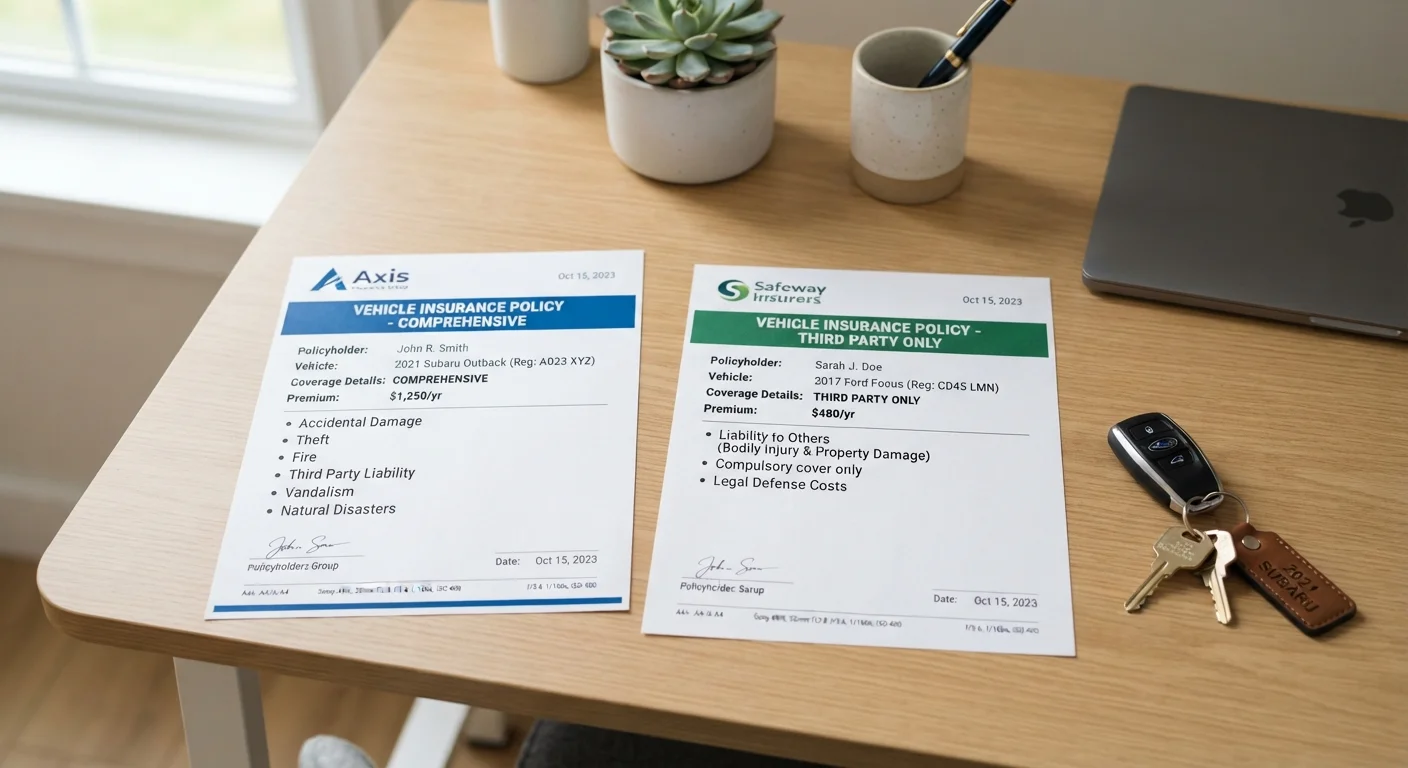
Key Takeaways
Option A
Comprehensive Car Insurance
The broadest protection available for your vehicle.
Best for: Drivers who want coverage for damage to their own car — regardless of who caused it.
Option B
Third-Party Car Insurance
The legal minimum: protection for others, not yourself.
Best for: Drivers seeking the most basic legally required coverage, often for older or lower-value vehicles.
If you drive a newer or higher-value vehicle
Comprehensive Car Insurance
The cost of repairing or replacing a newer car after theft or a major accident often far exceeds any premium savings from choosing minimal coverage.
If your car is older and its market value is low
Third-Party Car Insurance
When a vehicle's value is modest, the additional premium for comprehensive coverage may exceed what you'd receive in a claim payout.
If you are financing or leasing your vehicle
Comprehensive Car Insurance
Most lenders and leasing companies contractually require comprehensive and collision coverage for the duration of the loan or lease.
If you are a first-time car owner on a tight budget
Third-Party Car Insurance
Meeting the legal minimum is essential; once budget allows, upgrading to broader coverage is worth considering for added peace of mind.
What Each Coverage Type Actually Means
Car insurance terminology can be confusing, especially when terms like "comprehensive" and "third-party" are used interchangeably with phrases like "full coverage" or "liability only." Understanding what each type actually covers — and what it leaves out — is fundamental to making an informed choice.
Third-party insurance covers damage or injury you cause to other people and their property. If you rear-end another vehicle or damage a fence, third-party coverage pays for those costs. It does not pay for repairs to your own car or your own medical bills resulting from the crash.
Comprehensive insurance is a broader policy that typically includes third-party liability but also covers damage to your own vehicle. This includes losses from theft, vandalism, fire, flooding, hail, and collisions — depending on the specific policy terms. In the US market, "comprehensive" technically refers to non-collision incidents (weather, theft, etc.), while collision coverage handles accident-related damage. Many people purchase both together, which is commonly called "full coverage."
For a deeper look at the terms inside any policy, see our guide to decoding car insurance policy language.
| Criterion | Comprehensive Insurance | Third-Party Insurance |
|---|---|---|
| Covers damage to others | Yes | Yes |
| Covers damage to your own car | Yes (collision + non-collision) | No |
| Covers theft of your vehicle | Yes | No |
| Covers weather/natural events | Yes | No |
| Typical premium cost | Higher | Lower |
| Required for financed vehicles | Usually yes | Usually no |
| Legal minimum in most states | Exceeds minimum | Meets minimum |
Cost, Value, and When the Math Changes
Premium costs vary significantly between these coverage levels and are shaped by factors like your driving history, location, vehicle age, and the deductible you choose. Generally, comprehensive (or full coverage) costs noticeably more per year than a basic third-party policy.
~$1,771
Average US full coverage premium per year
According to Bankrate's analysis of industry data, the average annual cost of full coverage car insurance in the US is approximately $1,771, though this varies widely by state and driver profile.
~$635
Average US minimum coverage premium per year
Bankrate estimates the average annual cost of minimum liability-only coverage in the US at around $635 — roughly one-third the cost of full coverage.
1 in 8
US drivers estimated to be uninsured
The Insurance Research Council has estimated that approximately one in eight US drivers carries no auto insurance, underscoring the real-world risk of relying on third-party coverage alone.
A useful rule of thumb: if your annual comprehensive premium exceeds 10% of your vehicle's current market value, many financial advisers suggest reconsidering whether the additional cost is justified. However, this is a general heuristic — not a guarantee of the right outcome for every driver's situation.
If you are leasing or financing, the decision is often made for you — lenders typically require comprehensive and collision coverage. Owning versus leasing carries distinct insurance implications worth understanding before you sign.
When budgeting for ownership overall, insurance is just one piece. Our guide to building a realistic annual car budget helps you see how coverage costs fit alongside fuel, maintenance, and registration fees.
"Comprehensive" Means Different Things
In the US, "comprehensive" is a specific coverage type that protects against non-collision events — theft, weather damage, fire, and vandalism. It is distinct from collision coverage, which handles accident-related damage. When people say "full coverage," they typically mean a policy that bundles liability, comprehensive, and collision together. Always check exactly what a policy includes rather than relying on the label alone.
Making the Right Call for Your Situation
There is no universally correct answer — the right coverage level depends on your specific circumstances. Ask yourself: could you afford to repair or replace your car out of pocket if it were totalled or stolen? If not, comprehensive coverage provides a meaningful financial safety net.
First-time owners navigating these decisions for the first time will find broader context in our overview of everything involved in owning your first car, which covers registration, running costs, and insurance together.
Whatever level you choose, always read the policy exclusions carefully. Coverage gaps — such as exclusions for uninsured motorists or medical payments — can leave you exposed in ways that the basic policy labels don't immediately reveal. Consult a licensed insurance professional to review options suited to your state's requirements and your personal situation.
This article is for general informational purposes only and does not constitute personalised insurance or financial advice. Coverage requirements, terms, and regulations vary by state. Always consult a licensed insurance professional for guidance specific to your circumstances.