
Currency Exchange, Cards Abroad, and the Myths Around Spending Money Overseas

Key Takeaways
Why Travel Money Myths Cost Travelers Real Money
Managing money abroad sits at the intersection of habit, fear, and incomplete information — a fertile ground for myths. Travelers routinely overpay by hundreds of dollars on a single trip simply because common beliefs about exchange rates, card fees, and cash feel intuitively true but aren't. Understanding how foreign-currency transactions actually work is one of the most practical things you can do before any international trip.
This article tackles the most persistent misconceptions head-on. Whether you're planning your first overseas adventure or you've been making the same avoidable mistakes for years, the corrections below will help you stretch every dollar further. For a broader look at where travel money disappears, see The Anatomy of a Travel Budget.
Myth
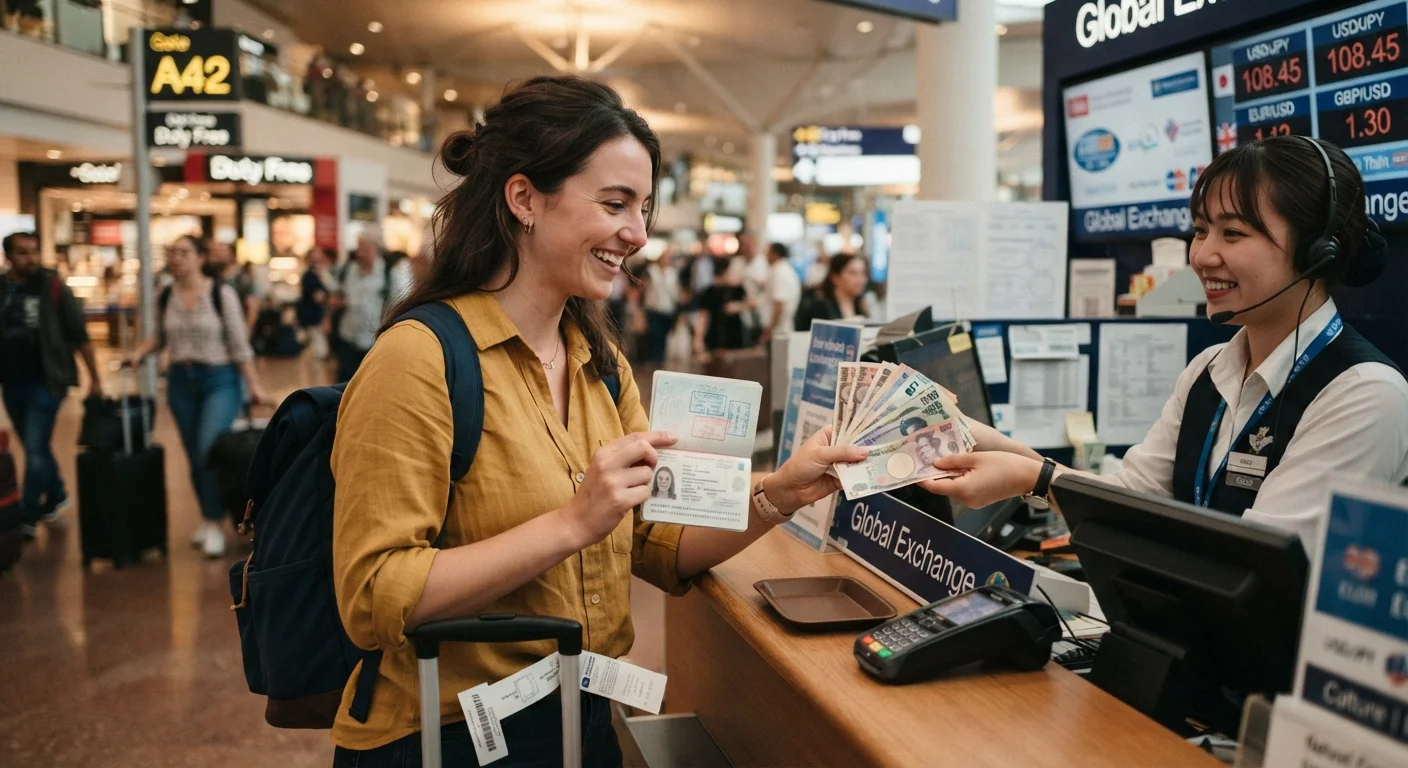
Exchanging currency at the airport before your flight is the safest and most convenient option — so it's worth doing.
Fact
Airport exchange kiosks are consistently among the highest-fee, lowest-rate currency exchange points available to travelers.
Convenience comes at a steep price. Airport exchange bureaus typically apply exchange rates significantly worse than the interbank (mid-market) rate — sometimes 10–15% below it — and many layer on fixed service fees on top. The captive audience and high overhead of airport retail locations mean operators have little competitive pressure to offer fair rates.
Better alternatives include withdrawing local currency from an ATM at your destination (ideally one operated by a major bank network), or using a fee-free travel card that processes transactions close to the interbank rate. If you feel safer arriving with some local cash in hand, exchange only a small emergency amount before departure and get the bulk of your currency via ATM or card once you land.
Myth
Paying by card abroad always means paying extra fees — cash is cheaper.
Fact
Many travel-focused cards charge no foreign transaction fees, making them cost-competitive with — or cheaper than — cash in most situations.
The assumption that cards automatically trigger extra charges is outdated. While it's true that many standard bank-issued credit and debit cards charge foreign transaction fees of 1–3% per purchase, a wide range of travel-oriented cards have eliminated these fees entirely. When used at merchants that accept card payments without surcharges, such cards often deliver exchange rates very close to the interbank rate.
Cash, by contrast, involves exchange rate markups at the point of acquisition and sometimes additional ATM withdrawal fees. The real takeaway: the type of card matters enormously. Checking your card's terms before you travel — rather than defaulting to cash out of habit — is always worth doing. Misunderstandings about how fees quietly erode spending power are explored further in Savings Myths That Hold People Back.
Myth
When a merchant offers to charge you in your home currency, you should accept — it's easier to track your spending.
Fact
Dynamic Currency Conversion almost always gives travelers a worse rate than letting the transaction process in local currency.
Dynamic Currency Conversion (DCC) is a service offered at many card terminals and ATMs that converts the transaction into your home currency at the point of sale. It sounds helpful — you can see exactly what you're paying in familiar terms — but the exchange rate applied is set by the merchant's payment processor, not your bank, and it typically includes a significant markup.
Your card issuer's exchange rate, applied when you pay in local currency, is almost always more favourable. The correct habit is simple: whenever prompted to choose between local currency and your home currency, always select local currency. This applies at ATMs as well as physical merchant terminals. Fine print in travel transactions is worth understanding broadly — Reading the Fine Print covers related concepts well.
Myth
Carrying cash abroad is risky and outdated — cards work everywhere now.
Fact
Cash remains essential in many destinations, particularly outside major urban centers and tourist corridors.
Card acceptance has expanded dramatically worldwide, but coverage is far from universal. In rural areas, at local markets, on public transport in many countries, at small family-run guesthouses, and at street food vendors, cash is often the only option. Some destinations levy surcharges on card payments, making cash the cheaper choice in those contexts.
The practical approach is a hybrid one: use a fee-free card as your primary payment method where accepted, and carry a reasonable amount of local cash — sized to your destination's typical reliance on it — for situations where cards aren't viable. Research your specific destination before assuming cards will cover everything. Destination-specific context can inform this decision; explore global destination guides for regional nuance.
Myth
You don't need to tell your bank you're travelling — fraud detection systems are sophisticated enough to tell the difference.
Fact
Banks frequently block foreign transactions flagged as unusual activity, even on legitimate trips, without prior notification.
Fraud detection algorithms are designed to identify patterns that deviate from your normal spending behavior. An international transaction in an unfamiliar country, especially in quick succession with a domestic one, is precisely the kind of signal that can trigger an automatic block. Being left without access to your funds in a foreign country is an avoidable stressor.
Most banks allow you to set travel notifications through their app or by calling ahead. This doesn't guarantee your card will never be blocked, but it significantly reduces the risk. Carrying a backup card from a different issuer — stored separately from your primary card — provides an important safety net even after you've notified your bank.
Smart Habits That Actually Protect Your Money Abroad
Correcting myths is only half the battle — building a few reliable habits seals the deal. Before departure, review every card in your wallet for foreign transaction fees (typically 1–3% per purchase) and identify which, if any, waive them. Inform your bank and card issuers of your travel dates and destinations; a blocked card in a foreign city is a stressful and avoidable problem.
Never Accept Dynamic Currency Conversion
When a card terminal or ATM offers to display your charge in your home currency and complete the transaction that way, always decline and choose local currency instead. The rate applied by the merchant's payment processor is almost never competitive, and you lose the benefit of your own card issuer's exchange rate. This single habit can save meaningful money across a multi-week trip.
Once abroad, use ATMs affiliated with major banking networks when you need local cash, and withdraw larger amounts less frequently to minimise per-withdrawal fees. When a merchant or ATM offers to charge you in your home currency — that's Dynamic Currency Conversion — always choose to pay in the local currency instead. The rate they apply is virtually never competitive.
Diversify your approach: a fee-free travel card for most purchases, a small reserve of local cash for markets, tipping, and small vendors, and a backup card stored separately from your primary wallet. These habits don't require specialist knowledge — just a bit of pre-trip planning. Blind spots in travel budgeting are covered in detail at Why Your Travel Budget Always Falls Short.
Finally, remember that not all destinations are equally card-friendly. Rural areas, local markets, small guesthouses, and street food stalls across much of the globe still operate primarily in cash. Research your specific destinations rather than assuming a one-size-fits-all approach will work.
This article is for general informational purposes only and does not constitute financial or legal advice. Exchange rates, card terms, and ATM fee structures vary by provider and are subject to change. Verify current terms with your bank or card issuer before travelling.