
African Safari Destinations: A Continent-Wide Overview for First-Time Visitors

Key Takeaways
Start here
Why Africa? Understanding the Safari Appeal
Explore regions
East Africa: The Classic Safari Heartland
Compare options
Southern Africa: Diverse Ecosystems and Self-Drive Options
Go deeper
West and Central Africa: Off the Beaten Path
Make your choice
How to Choose the Right Region for Your First Safari
Why Africa? Understanding the Safari Appeal
For many travelers, an African safari represents something different from an ordinary vacation — a chance to witness ecosystems largely unchanged over millennia, to see animals moving freely across vast landscapes, and to genuinely feel small in the natural world. That pull is real, and it's why safari travel continues to draw curious adults who've never thought of themselves as "adventure travelers."
Africa is not a single destination. It's a continent of 54 countries, spanning deserts, rainforests, mountains, and grasslands. When people talk about "going on safari," they're typically referring to guided wildlife experiences in specific national parks and reserves — most commonly in East Africa or Southern Africa, though West and Central Africa hold extraordinary options too.
If you're building your first international itinerary from scratch, our complete trip-planning walkthrough is a practical starting point before diving into region-specific research.
Game reserve
A protected area where wildlife lives and can be observed, typically managed to prevent hunting and human encroachment. Some are government-run national parks; others are privately owned conservancies.
Big Five
A term originally used by hunters, now widely adopted in tourism, referring to lion, leopard, elephant, Cape buffalo, and rhinoceros — historically considered the most challenging animals to track on foot.
Dry season
The period of the year with little to no rainfall. In most safari regions, this is when wildlife is easiest to spot because animals congregate around limited water sources and vegetation is lower.
Walking safari
A guided wildlife experience conducted on foot rather than by vehicle, allowing closer engagement with smaller animals, tracks, and the broader ecosystem. Typically led by armed professional guides.
Conservancy
A privately managed wildlife area, often adjacent to national parks, where landowners (sometimes local communities) collaborate to protect habitat and wildlife in exchange for revenue from controlled tourism.
Gorilla trekking permit
A government-issued authorization required to visit mountain gorilla habitats in Uganda and Rwanda. Permits are strictly limited in number to minimize disruption to the animals and must be booked well in advance.
East Africa: The Classic Safari Heartland
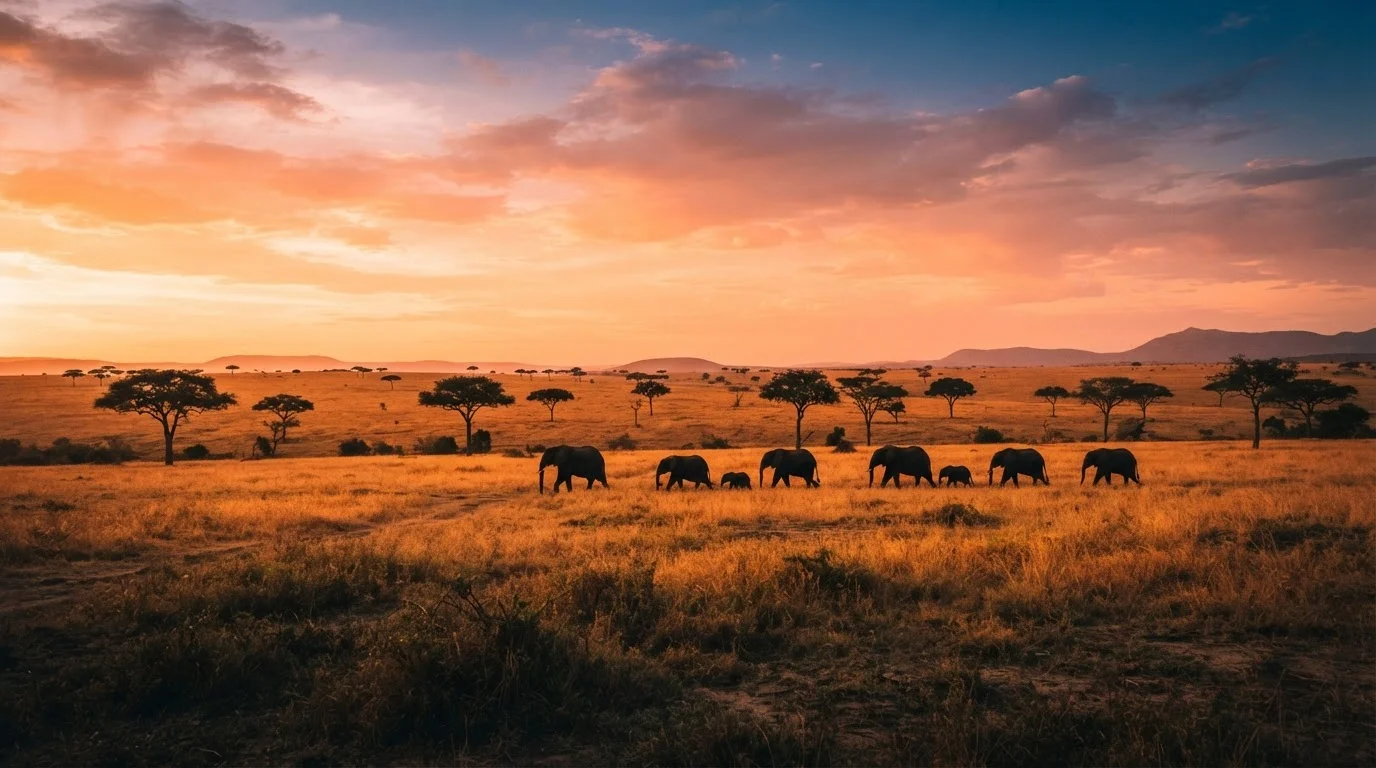
When most people picture a safari, they're imagining East Africa — sweeping golden plains, vast herds of wildebeest, lions resting in acacia shade. Kenya and Tanzania are the region's twin anchors, and for good reason.
Kenya is home to the Masai Mara National Reserve, one of the most celebrated wildlife areas on earth. The annual wildebeest migration — when over a million animals move between the Serengeti and the Mara — typically peaks between July and October, drawing visitors from around the world. Kenya's safari infrastructure is mature, with a wide range of camps and lodges catering to different budgets.
Tanzania offers the Serengeti, Ngorongoro Crater, and Tarangire National Park — each with a distinct character. The Serengeti's scale is staggering; Ngorongoro's caldera creates a naturally enclosed ecosystem that concentrates wildlife in remarkable density. Tanzania also gives access to Zanzibar for post-safari beach recovery.
Uganda and Rwanda round out East Africa with a very different drawcard: mountain gorilla trekking. Permits are limited, experiences are deeply regulated to protect the animals, and the encounters are unlike anything else on the continent.
Book Gorilla Permits Early
Mountain gorilla trekking permits in Rwanda and Uganda are issued in limited quantities and frequently sell out months in advance. If this experience is on your list, treat the permit as the anchor of your itinerary and build everything else around it. Check availability through official national park booking channels.
Southern Africa: Diverse Ecosystems and Self-Drive Options
Southern Africa is the region most accessible to first-timers who want more independent control over their itinerary. South Africa, in particular, has excellent road infrastructure and a number of malaria-free reserves — a meaningful consideration for travelers with health concerns or families with young children.
South Africa's Kruger National Park is one of the world's largest game reserves and can be explored via self-drive, guided day trips, or private lodges. The country also offers the Cape Winelands, coastal scenery, and world-class cities — making it easier to build a varied itinerary beyond pure wildlife viewing.
Botswana takes a deliberately low-volume, high-value approach to tourism. The Okavango Delta — a vast inland river delta that floods seasonally — creates a singular aquatic safari environment. Botswana's strict visitor limits keep the experience exclusive, though costs reflect that positioning.
Zambia and Zimbabwe offer Victoria Falls as a dramatic gateway, along with excellent walking safaris in South Luangwa and Hwange National Park respectively. Walking safaris — guided on foot rather than by vehicle — are a distinctly immersive way to experience the bush.
West and Central Africa: Off the Beaten Path
West and Central Africa represent a different proposition entirely. Tourism infrastructure is less developed than in East or Southern Africa, which means fewer crowds but more complex logistics. These regions suit travelers who have some international travel experience and are comfortable with greater uncertainty.
Gabon protects roughly 11% of its land as national parks and is home to forest elephants, western lowland gorillas, and hippos surfing on Atlantic beaches — a genuinely surreal combination. Cameroon offers a similar mix of rainforest biodiversity, though access requires careful planning.
Ghana and Senegal are more accessible entry points for West Africa, with improving tourism infrastructure and the opportunity to combine wildlife with rich cultural experiences. Mole National Park in Ghana offers elephant and antelope sightings in a setting that sees a fraction of the visitors of East African equivalents.
For travelers considering multiple long-haul adventures and wondering how African destinations compare to other global regions, our guide to first-time Southeast Asia travel offers a useful contrast in logistical complexity and travel style.
How to Choose the Right Region for Your First Safari
The most important factor in choosing your first safari region isn't the wildlife — it's fit. Consider these practical dimensions:
- Budget: East African private conservancies and Botswana camps sit at the premium end. South Africa and Tanzania offer broader price ranges. West Africa's logistics can be expensive despite lower headline costs.
- Travel time: From the US, most African destinations require connecting flights through European or Gulf hubs. Budget 20–30 hours of travel time each way and plan your jet lag strategy accordingly. Our long-haul travel guide covers the essentials of managing extended flights.
- Health requirements: Malaria risk varies by country, season, and altitude. Some reserves are malaria-free; others require prophylaxis. Always consult a qualified healthcare provider and verify entry requirements with official government travel advisories — these change and must be confirmed before booking.
- Wildlife priorities: If the Great Migration is your primary goal, East Africa in the dry season is the obvious choice. For gorillas, Uganda or Rwanda. For self-drive flexibility, South Africa.
- Group vs. independent travel: First-timers often benefit from joining a guided group tour, especially in regions where navigation and animal tracking expertise is critical to a rewarding experience.
Africa rewards preparation. The more clearly you define what you want from the experience — scale, solitude, specific animals, cultural immersion — the easier it becomes to match yourself to the right corner of this extraordinary continent.
Verify Entry Requirements Before Booking
Visa policies, vaccination requirements, and health advisories for African countries can change on relatively short notice. Always consult your government's official travel advisory portal (such as travel.state.gov for US travelers) and a qualified travel medicine provider well before confirming any bookings. Do not rely solely on tour operator information for health or entry requirements.