

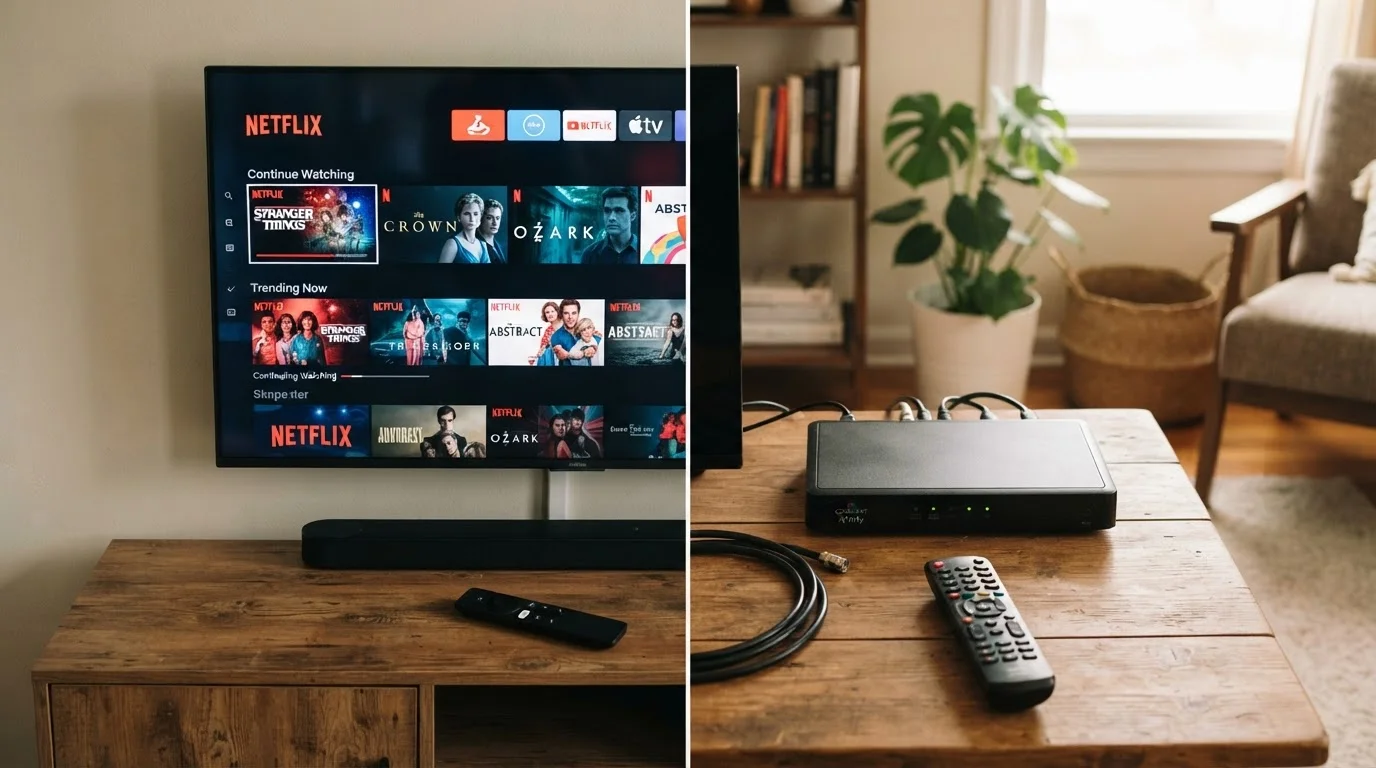
Key Takeaways
Option A
Streaming Services
The flexible, internet-based alternative.
Best for: Viewers who want on-demand content, flexible contracts, and the ability to watch across multiple devices.
Option B
Cable Television
The established, comprehensive broadcast model.
Best for: Households that prioritize live TV, local news, sports, and a single-provider bundle for internet and TV.
If you watch mostly on-demand shows and movies at your own pace
Streaming Services
On-demand libraries let you watch what you want, when you want, without scheduling your evening around a broadcast.
If live sports, local news, or real-time events are non-negotiable
Cable Television
Cable still offers the most consistent and comprehensive access to live regional and national sports broadcasts and local news channels.
If you want to avoid long-term contracts and monthly commitments
Streaming Services
Most streaming platforms are month-to-month, making it easy to subscribe and cancel without early termination fees.
If you want one bill covering internet, TV, and phone
Cable Television
Cable providers commonly offer bundled packages that combine multiple services under a single monthly statement.
If your household has inconsistent or slow internet connectivity
Cable Television
Cable TV operates over its own physical infrastructure and does not depend on broadband speed or reliability for picture quality.
How Each Model Actually Delivers Video to Your Screen
The most fundamental difference between streaming and cable isn't price — it's the underlying delivery mechanism.
Cable television transmits video signals through a physical network of coaxial or fiber-optic cables run to your home by a service provider. Your cable box decodes those signals and displays channels in real time. The system operates independently of your internet connection — even if your Wi-Fi goes down, your cable TV keeps working. Channels are broadcast continuously, meaning content airs on a fixed schedule whether or not anyone is watching.
Streaming services work entirely over the internet. When you press play, the platform's servers send video data to your device in small packets, decoded and displayed almost instantly. This process — known as adaptive bitrate streaming — adjusts video quality up or down based on your available bandwidth. There are no fixed schedules; the content sits in a library and you request it whenever you choose.
That architectural difference shapes almost every other distinction between the two models: contracts, hardware, content selection, and cost.
| Criterion | Streaming Services | Cable Television |
|---|---|---|
| Delivery method | Over the internet (broadband) | Physical cable infrastructure |
| Contract required | Usually none (month-to-month) | Typically 12–24 months |
| Hardware | Your existing devices | Provider-rented cable box |
| Live TV access | Limited; varies by platform | Comprehensive, including local |
| On-demand library | Extensive original and licensed content | Limited; varies by provider |
| Internet dependency | Required; quality tied to speed | Not required for TV signal |
| Cost structure | Per-service; can multiply | Single bundled bill; fees common |
| Cancellation | Anytime, no penalty | May incur termination fees |
Contracts, Hardware, and What You're Actually Committing To
Cable subscriptions have traditionally required a 12- to 24-month contract, a cable box (usually rented from the provider), and in some cases a professional installation visit. Early termination fees can apply if you cancel before the contract ends. Equipment rental fees — often $10–$20 per box per month — are separate from the base subscription price and can meaningfully increase your total bill.
Streaming services operate on a fundamentally different commercial model. Most are month-to-month, meaning you can cancel anytime without penalty. You typically use a device you already own — a smart TV, laptop, phone, tablet, or a small plug-in media player — rather than renting dedicated hardware. There's no technician visit required; setup usually takes minutes.
The trade-off is fragmentation. Because content is distributed across multiple competing platforms, watching a broad range of shows and films often means maintaining several separate subscriptions. That accumulation of small monthly fees can add up faster than many users expect. If you're already managing multiple subscriptions, it's worth auditing them periodically — see how subscription costs quietly add up for a practical framework.
~115M
U.S. households with a streaming subscription
According to Nielsen's 2023 State of Play report, streaming now reaches the majority of American TV households.
3–4
Average streaming services per U.S. household
Research from Deloitte's Digital Media Trends survey has consistently found that U.S. households maintain multiple simultaneous streaming subscriptions.
$83+
Typical monthly cable TV base cost (U.S.)
Industry analysts at Leichtman Research Group have tracked average U.S. cable TV bills rising steadily over successive years.
Content Selection: Where Each Model Has the Edge
Cable's strongest suit is live and linear content: local news, regional sports, breaking events, and network primetime programming. A cable package can deliver hundreds of channels — including niche interests like cooking, home improvement, or foreign language programming — without requiring you to know in advance what you want to watch. It's a passive, browseable experience.
Streaming platforms built their reputations on original programming and deep on-demand libraries. Exclusive series, films, and documentaries that aren't available anywhere else have become a defining feature of the major platforms. Documentaries, classic TV archives, and international content are often easier to access through streaming than through a cable lineup.
Live sports remain the most complicated category. While some streaming services have secured rights to major leagues and events, coverage is fragmented — different sports and even different games may sit on different platforms. For viewers whose primary use case is live sports, cable (or a cable-adjacent live TV streaming service) still typically offers more comprehensive access in a single place.
The clearest summary: cable excels at real-time and local; streaming excels at depth, discovery, and flexibility.
Thinking About the Switch — or the Combination
Many households today use some combination of both models: they've dropped a full cable package but kept internet service from the same provider, and layered one or two streaming services on top. This approach can offer flexibility without giving up live TV entirely — especially if local broadcast channels are accessible via an antenna for free.
Before making any change, it helps to audit your actual viewing habits honestly. If you regularly watch live news, follow local sports, or have family members who graze through channels without a specific destination in mind, cable's always-on model may serve your household better than you'd expect. If your viewing is mostly planned — specific series, films you've bookmarked, or kids' content on a schedule — an on-demand model is likely a natural fit.
There's no universally correct answer. The right model depends on how your household actually watches, not on what the prevailing trend happens to be. Understanding the structural differences between the two systems puts you in a better position to make a decision based on your real needs rather than marketing language.
Live TV Streaming: A Middle Ground
A category sometimes called 'virtual MVPD' (multichannel video programming distributor) services — such as live TV streaming packages — blurs the line between streaming and cable. These services deliver live channel lineups over the internet, including local affiliates and sports networks, typically without a long-term contract. They function more like cable in content, and more like streaming in delivery and commitment. If live TV is important to you but you're resistant to a traditional cable contract, this category is worth researching as a middle option.