

Key Takeaways
Why Cats Seem Like a Mystery
Cats share our homes, sleep in our beds, and still manage to feel entirely unknowable. One moment they're purring contentedly in your lap; the next they've bolted sideways across the room for no apparent reason. That contradiction — intimate yet inscrutable — is part of what makes cats so fascinating, and so frustrating, for millions of owners.
The good news is that most baffling cat behaviours have straightforward explanations grounded in animal behaviour science. Cats aren't random or spiteful — they're highly specialised predators with a rich sensory world and a communication system that simply doesn't map neatly onto human expectations. For a broader grounding in how animals signal their needs, the Animal Behaviour 101 guide is an excellent starting point.
Below, nine of the most commonly reported feline mysteries — decoded.
The slow blink
When a cat holds your gaze and slowly closes and reopens its eyes, it's offering what researchers and behaviourists describe as a signal of relaxed, non-threatening intent — sometimes called a "cat kiss." Studies, including work published in Scientific Reports (2020), found that cats are more likely to approach humans who return the slow blink, suggesting it functions as a genuine social signal rather than coincidental drowsiness. Try initiating one yourself: relax your face, make soft eye contact, and slowly close your eyes. Many cats will respond in kind.
A slow blink is a cat's non-verbal signal of trust and relaxed social intent.
Kneading ("making biscuits")
That rhythmic push-pull motion cats make against soft surfaces — and sometimes your lap — originates in kittenhood. Kittens knead their mother's mammary glands to stimulate milk flow. In adult cats, the behaviour is retained as a comfort response, typically triggered by contentment, security, or the beginnings of sleep. Cats may also knead to stretch their paws or activate scent glands located there, leaving a scent mark on a favoured resting spot. It's a reliable signal that your cat feels safe.
Kneading is a retained comfort behaviour from kittenhood — a reliable sign your cat feels secure.
Chattering at birds and insects
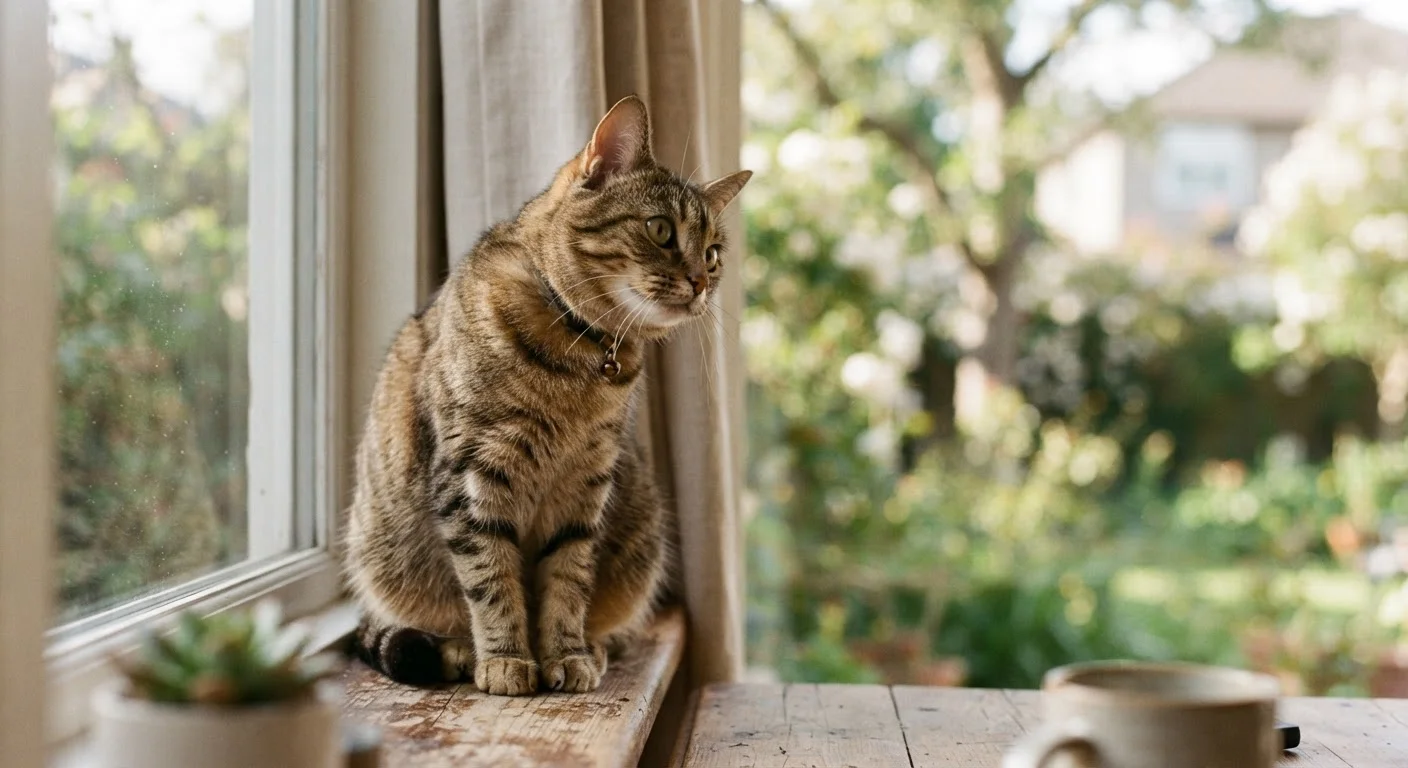
That rapid, stuttering jaw movement cats make when watching prey through a window — often accompanied by a staccato chirping sound — is one of the more visually striking feline behaviours. One hypothesis is that it mimics the killing bite cats use to sever the spinal cord of prey. Another is that it's a form of frustrated arousal: the cat can see prey but cannot reach it. Some field observations of wild cats suggest the sound may also serve as a lure or mimicry tactic. The honest answer is that researchers haven't fully settled the question, but it's entirely normal and harmless.
Chattering at prey may reflect frustrated predatory arousal — a normal, harmless response to unreachable targets.
Knocking things off surfaces
This one tends to generate the most owner exasperation. Cats use their paws to test the movement and safety of unfamiliar objects — a behaviour rooted in predatory investigation (poking prey to check whether it's still alive). When a glass slides to the edge of a counter, a cat gets immediate, satisfying sensory feedback: movement, sound, and sometimes an owner reaction. That reaction — even a frustrated "stop that!" — can function as social reinforcement. Providing dedicated puzzle feeders and interactive toys satisfies the same investigative drive more constructively. See indoor enrichment ideas for practical options.
Knocking objects off surfaces is investigative behaviour rooted in predatory curiosity, not spite.
Bringing "gifts" (dead prey)
It feels like affection; it looks like horror. When a cat deposits a dead mouse or bird at your feet, the most widely accepted explanation draws on maternal behaviour: mother cats bring prey to kittens to teach hunting. Cats may treat close human companions similarly, essentially attempting to provision or instruct someone they're bonded to. Some behaviourists also suggest it reflects the cat sharing a successful hunt with its social group. Either way, the behaviour is a sign of attachment rather than malice — though keeping cats indoors or using a well-fitted collar with a bell can significantly reduce wildlife impact.
Prey gifts reflect feline bonding behaviour — your cat is sharing a successful hunt with its social group.
Rubbing their face on everything (bunting)
Cats possess scent glands along their cheeks, chin, forehead, and the base of their tail. When a cat rubs its face against furniture, doorframes, or your hand, it's depositing pheromones — a process called bunting or head bunting. This serves both territorial marking ("this space is mine and it's safe") and social bonding when directed at people or other animals. It's a fundamentally positive behaviour. Cats tend to bunt objects and individuals they consider familiar and safe. Misread pet signals are more common than most owners realise — bunting is rarely one of them.
Face-rubbing deposits scent to mark safe spaces and reinforce social bonds — it's a compliment.
Sitting in boxes and small spaces
Cats are ambush predators that also need to hide from larger threats. Enclosed spaces satisfy both drives simultaneously: they offer a concealed vantage point from which to observe without being seen. Research conducted with shelter cats found that access to a hiding box measurably reduced stress indicators compared to cats without one. At home, a cardboard box offers the same functional benefit as an expensive cat cave — it's the enclosure geometry that matters, not the price tag. If your cat is frequently seeking confined hiding spots and seems withdrawn beyond its normal baseline, that shift in pattern may warrant a veterinary check.
Small enclosed spaces satisfy a cat's dual need for a safe hiding spot and a predatory observation point.
The sudden sideways run (zoomies)
Formally called Frenetic Random Activity Periods (FRAPs), the sudden sprint-and-skid across the floor — often at 2 a.m. — is a normal discharge of pent-up energy. Cats are crepuscular by nature, meaning they're most active at dawn and dusk. Indoor cats with limited hunting outlets may accumulate predatory energy that eventually releases in an explosive burst. FRAPs are typically short-lived and self-resolving. If they're disrupting your sleep regularly, structured interactive play sessions before bedtime can help your cat burn energy on a more convenient schedule.
Midnight zoomies are a normal energy discharge — structured evening play can shift the timing.
Staring without blinking
Prolonged, unblinking eye contact from a cat can read as unsettling — because in cat social language, it is. Direct, sustained staring is a dominance or threat signal between cats. When your cat stares at you without breaking gaze, it may be asserting confidence, monitoring a perceived competitor, or simply tracking a movement you're not aware you're making. Context matters enormously: a relaxed body posture alongside a stare reads very differently from a stiff, low posture. For a fuller picture of how body language cues combine, understanding cat aggression types explains how posture and gaze interact across different behavioural states.
Sustained direct staring is a dominance or alerting signal in cat language — always read body posture alongside it.
Using This Knowledge Every Day
Decoding these behaviours isn't just satisfying trivia — it changes how you interact with your cat. When you recognise a slow blink as an invitation rather than indifference, or understand that midnight zoomies are a normal predator energy release, you stop reacting with frustration and start responding with context. That shift builds a more trusting, lower-stress relationship for both of you.
Watch for behaviour pattern changes
Individual cats have baselines — their personal version of normal. A cat that suddenly stops kneading, hides more than usual, or loses interest in activities it previously enjoyed may be experiencing stress, pain, or illness. Tracking what's normal for your specific cat makes it much easier to notice meaningful departures. When in doubt, a veterinary check is always the right call.
If you want to go deeper into how cats communicate beyond these nine examples, Understanding Your Cat covers feline communication across every life stage. And if your cat's behaviour has taken a sudden, unexplained turn, it's always worth a conversation with your veterinarian — behaviour changes can sometimes reflect underlying health issues rather than pure personality.