

Key Takeaways
Leftover Instincts
Leftover instincts — sometimes called vestigial behaviors — are actions modern dogs perform that were once critical survival tools for their wild ancestors. Although today's dogs rarely face the same pressures as wolves or early canids, their nervous systems still carry the programming. These behaviors show up in everyday domestic life, often striking owners as bizarre or inexplicable.
Behaviorally, these are referred to as fixed action patterns (FAPs): genetically encoded, species-typical sequences that are triggered by specific stimuli and run to completion even when the original function no longer applies.
Your Dog Is Running Ancient Software
Domestic dogs (Canis lupus familiaris) diverged from wolves somewhere between 15,000 and 40,000 years ago, depending on the research you consult. That is an evolutionary eyeblink. Thousands of years of selective breeding have shaped dogs' appearance and trainability, but their core behavioral architecture remains largely intact — a set of instincts built for survival in environments that no longer exist.
Understanding this helps reframe almost every behavior that makes owners scratch their heads. For a broader foundation on why animals act the way they do, see Animal Behaviour 101, which covers the instinct-learning spectrum across species. This article focuses specifically on the canine habits most owners find baffling — and what evolutionary history tells us about their origins.
When Instinct Becomes Compulsion
There is an important distinction between a dog expressing a normal ancestral behavior and a dog locked in compulsive repetition that disrupts daily life. Excessive circling that prevents rest, obsessive licking, or relentless prey-sequence behaviors that the dog cannot be interrupted from may indicate an underlying anxiety or neurological issue. If a behavior intensifies, changes suddenly, or causes distress, consult your veterinarian.
The Roll: Scent Camouflage, Not Celebration
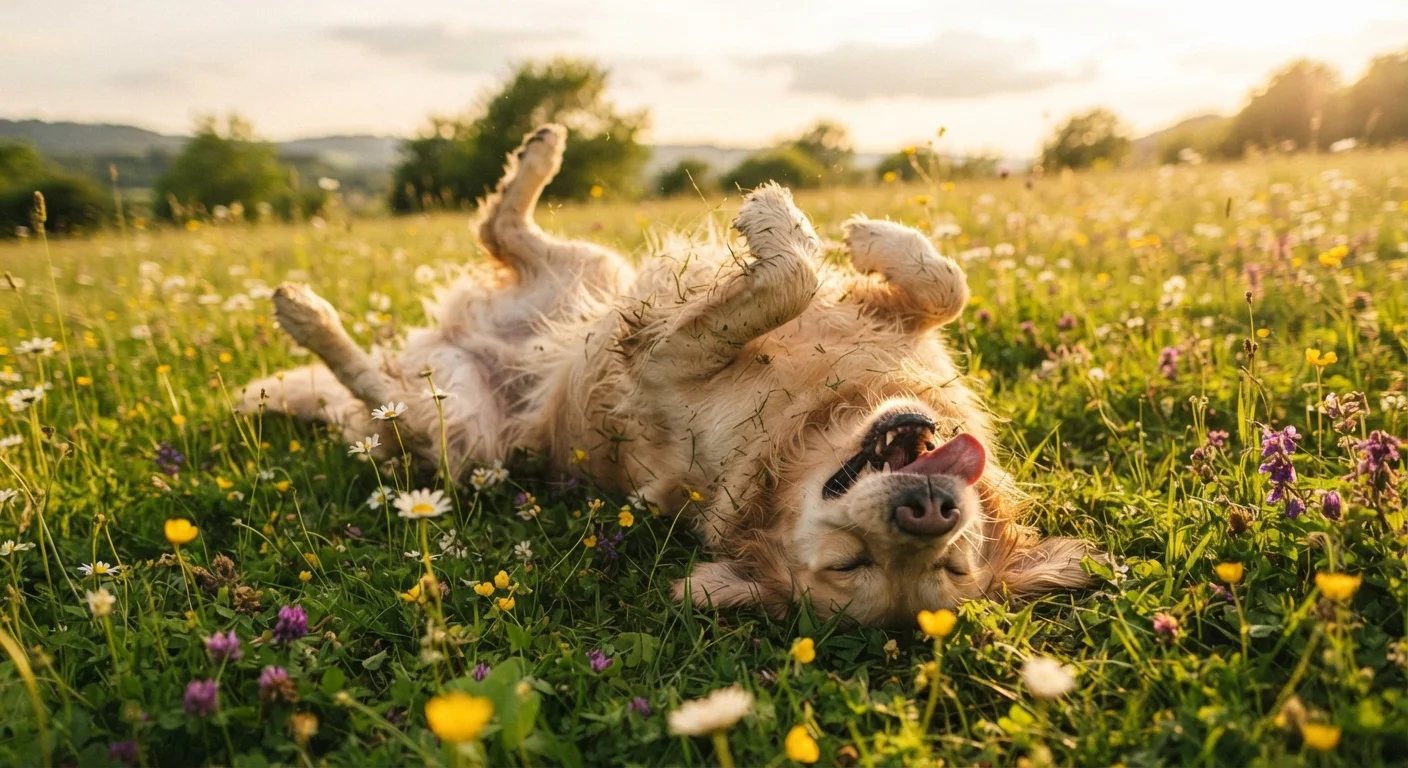
Few behaviors confuse owners more than watching a dog gleefully roll onto its back in something truly repellent — a dead bird, a pile of manure, a patch of mud reeking of decomposition. The dog looks ecstatic. The owner is horrified.
The leading behavioral explanation is scent camouflage. Wild canids hunting prey benefit from smelling like the landscape rather than like a predator. Rolling in a carcass or other strong environmental odor masks the dog's own scent signature. There is also a social communication angle: returning to the pack carrying a novel scent may have served as a form of information-sharing, alerting others to a resource nearby.
Your dog isn't broken or gross-minded. It's following a program that was adaptive for millions of years. The practical takeaway: you can interrupt and redirect this behavior before it completes, but punishing a dog after the fact is unlikely to have any effect — the impulse and the reward are too biologically ingrained.
300M
Scent receptors in a dog's nose
Compared to approximately 6 million in humans, according to veterinary anatomy research — explaining why smell drives so much canine behavior.
40×
Larger olfactory brain region than humans
The portion of a dog's brain devoted to analyzing scent is proportionally about 40 times greater than in humans, per veterinary neuroscience literature.
65,000 Hz
Upper hearing frequency for dogs
Humans top out around 20,000 Hz; this extended range explains why dogs freeze and alert to sounds their owners cannot perceive.
Circling, Digging, and Pre-Sleep Rituals
Before settling onto a perfectly comfortable dog bed, many dogs will circle it multiple times, paw at it, and possibly nose it into a completely different shape. To an owner who paid good money for that bed, it can look like ingratitude. It's actually deeply rooted nesting behavior.
Wild canids slept on the ground in varied terrain. Circling and pawing served practical functions: matting down tall grass or snow to create a surface, redistributing warmth, and performing a quick check for insects or small animals beneath the sleeping spot. Orienting into or across the wind while circling also provided early warning of approaching threats.
A study published in the journal Animal Cognition found that dogs preferred to align themselves along a north-south magnetic axis when undisturbed — suggesting that even the direction of lying down may carry ancient environmental logic. The behavior is harmless. If your dog's pre-sleep ritual becomes extremely prolonged or compulsive, mention it to your veterinarian.
The Freeze, the Stalk, and the Interrupted Prey Sequence
A dog walking calmly will sometimes stop mid-stride, lower its head, fix its gaze on something invisible to human eyes, and hold completely still. To the owner, it looks eerie. To the dog, it's a hunting posture encoded before domestication existed.
Wild canids use a prey sequence: orient → stalk → chase → grab-bite → kill-bite → consume. Selective breeding has amplified or suppressed different segments of this sequence across breeds. Herding dogs have been bred to orient, stalk, and chase — but not bite. Retrievers are optimized for the grab-bite and carry. Terriers retain a strong grab-kill impulse. When your dog freezes and stares, it is in the orient-stalk phase of that ancestral sequence.
Dog body language cues like ear position, tail carriage, and weight distribution all shift during this phase. Learning to read the full posture helps you understand whether your dog is alerting to a squirrel, processing a distant sound, or feeling genuinely uneasy.
Let Your Dog Sniff — It's Not Wasted Time
Animal behaviorists increasingly recognize that allowing dogs regular, unhurried sniffing opportunities during walks provides genuine cognitive enrichment. A 20-minute sniff-focused walk can be more mentally satisfying for a dog than a brisk mile-long march with no stops. Try designating specific areas where your dog leads the pace.
Scent Marking, Ground Kicking, and the Chemical Conversation
Dogs experience the world primarily through olfaction. Their noses contain roughly 300 million scent receptors compared to about 6 million in humans, and the part of their brain devoted to analyzing smell is proportionally about 40 times larger. Almost every behavior that puzzles owners has a scent-communication dimension.
Ground kicking after elimination isn't a cleanup attempt — dogs don't cover their waste the way cats do. The kicking deposits chemical signals from interdigital glands in the paw pads, creating a layered scent message: urine or feces plus a pheromone signature that persists for hours. The visual scratch marks also function as a territorial signal visible to other animals.
Prolonged sniffing at a single spot, apparently random stops mid-walk, and reluctance to leave certain locations all reflect a dog reading what researchers sometimes call the "pee-mail" — chemical information left by other animals that is completely invisible to human senses. Rushing a scent-engaged dog past these posts means interrupting a primary sensory experience. Allowing regular sniff time is now recognized by animal behaviorists as meaningful enrichment that supports cognitive health.
For a look at how well-intentioned owner behaviors can unintentionally work against a dog's wellbeing, this overview of common care mistakes is worth a read.