

Key Takeaways
Credit Card Minimum Payment
A minimum payment is the smallest amount a credit card issuer requires you to pay each billing cycle to keep your account in good standing. It is typically calculated as either a flat dollar amount (often $25–$35) or a small percentage of your outstanding balance — whichever is greater. Paying only this amount keeps you current on the account but leaves the vast majority of your balance accruing interest month after month.
Most issuers calculate the minimum as roughly 1–2% of the outstanding balance plus any accrued interest and fees. Because this percentage shrinks as the balance shrinks, payoff timelines extend dramatically — a mathematical phenomenon sometimes called the "minimum payment trap."
How the Minimum Payment Trap Actually Works
Most people understand, in theory, that carrying a credit card balance costs money. What far fewer people grasp is just how much money, and over how long a period, when they rely on minimum payments alone.
Here's the core mechanic: your card issuer charges interest on your outstanding balance each month. When you pay only the minimum, most of that payment covers interest — leaving your principal (the actual debt) barely reduced. Next month, interest is calculated on that still-large balance, and the cycle repeats. This is compound interest working against you rather than for you.
Consider a $3,000 balance at a 22% annual percentage rate (APR) — close to the national average as reported by the Federal Reserve. If your minimum payment is roughly 2% of the balance, your first payment is around $60. After that payment, perhaps $55 goes toward interest and only $5 toward principal. The balance barely moves. According to federal disclosure requirements, this scenario could result in over 15 years of payments and more than $3,000 paid in interest alone — meaning you'd effectively pay for the original purchase twice.
22%+
Average US credit card APR
The Federal Reserve tracks average credit card interest rates; rates above 20% have become common in recent years, amplifying the cost of minimum-only payments.
15+ years
Typical payoff timeline on minimums
Federal disclosure calculations show a $3,000 balance at ~22% APR can take over 15 years to clear when only minimum payments are made each month.
$3,000+
Interest paid on a $3,000 balance
General amortization modeling illustrates that interest-only minimum payments on a $3,000 balance at high APR can result in total interest exceeding the original balance.
This is why the debt cycle is so hard to escape: the math is structured to slow repayment to a crawl unless the borrower actively intervenes.
Why the Minimum Shrinks — and That Makes Things Worse
One underappreciated feature of minimum payments is that they decrease as your balance decreases. Because the minimum is a percentage of what you owe, a lower balance means a lower required payment. On the surface, this sounds like good news. In practice, it means less of each payment goes toward principal, and your payoff date keeps stretching into the future.
This gradual decline is sometimes called amortization drag. Your balance does fall — but agonizingly slowly, and the total interest paid accumulates steadily throughout. A borrower who starts with a $5,000 balance and dutifully pays every minimum on time will still be paying years later, often without realizing how much of their total payments have evaporated into interest charges.
Set a Fixed Payment, Not a Percentage
Rather than letting your minimum payment shrink as your balance falls, set a fixed monthly autopay amount — ideally what it would take to pay off the balance in 24–36 months. This single change prevents amortization drag and puts you firmly on a path to debt elimination. Check your card issuer's website or call their customer service line to set a custom autopay amount.
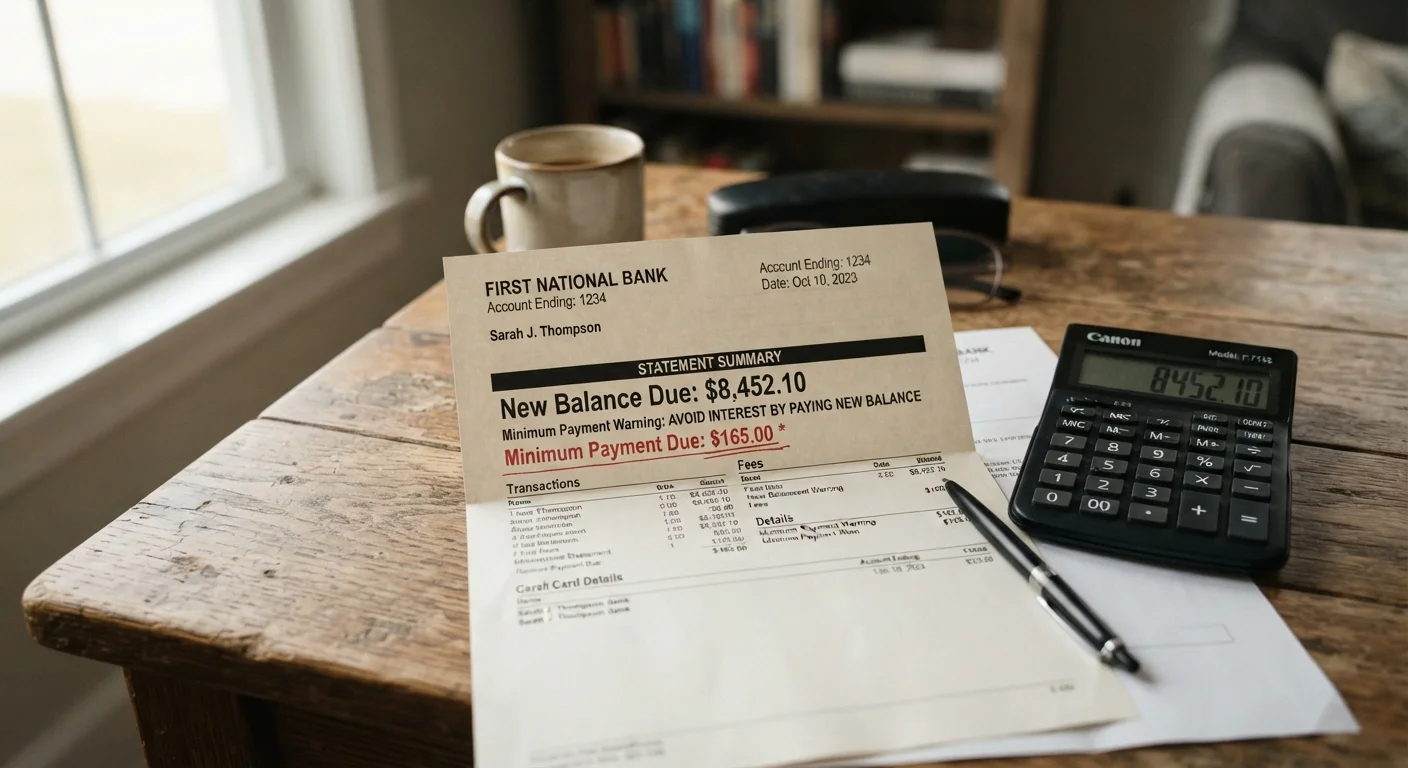
The Credit CARD Act of 2009 addressed this directly by requiring issuers to print a minimum payment warning on every statement. That warning shows two things: how long payoff takes at the minimum, and what it costs if you instead pay a fixed amount that clears the balance in three years. Reading those two numbers side by side is often the clearest illustration of how expensive the slow path really is.
The Real-World Impact: What the Numbers Look Like
Abstract percentages rarely motivate change. Concrete dollar figures often do. Here are some general illustrations based on widely used APR ranges — these are educational scenarios, not guarantees of any individual's outcome.
- $1,500 balance at 20% APR: Minimum-only payments could take roughly 8–10 years and cost over $1,000 in interest.
- $5,000 balance at 22% APR: Minimum-only payments could extend repayment beyond 20 years, with total interest potentially exceeding the original balance.
- $500 balance at 18% APR: Even a modest balance can take 3–4 years on minimums, costing well over $100 in interest on a relatively small sum.
Now consider what happens when you pay even $50 above the minimum each month. On that $3,000/22% APR example, adding $50 to the minimum payment could cut the repayment period from 15+ years to roughly 4 years — and save more than $2,000 in interest. The math rewards consistency far more than occasional lump-sum payments.
If you're working on a broader debt repayment strategy, it's worth reading about practical ways to free up money for debt repayment — small, realistic changes can generate the extra monthly dollars that make a real difference.
Practical Steps to Stop Paying the Minimum Forever
The good news is that escaping minimum-payment dependency doesn't require a dramatic financial overhaul. It requires a clear target and a small, consistent change in behavior.
- Read your statement's minimum payment warning. Federal law requires this disclosure. It's the single most motivating number on the page.
- Pick a fixed monthly payment above the minimum. Calculate what it takes to clear your balance in 24 or 36 months, and set that as your automated payment. Many card issuers allow you to set a custom autopay amount.
- Stop adding to the balance while you pay it down. Every new purchase resets the clock. If needed, set the card aside temporarily.
- Apply unexpected income directly to the balance. Tax refunds, bonuses, or side income applied to principal create an outsized reduction in interest costs.
- Track your progress monthly. Watching the principal fall reinforces the behavior and helps you catch any drift early — something covered in more depth in our article on where debt repayment plans quietly unravel.
It's also worth auditing recurring expenses — even small ones. Digital subscription creep is a common source of overlooked spending that, redirected to a credit card balance, can accelerate payoff meaningfully.
This article is for general informational and educational purposes only and does not constitute personalised financial advice. Consult a qualified financial professional for guidance specific to your circumstances.