

Key Takeaways
One monthly payment instead of many
Consolidating multiple balances eliminates the complexity of tracking several due dates, minimum payments, and creditors — reducing the cognitive load and risk of accidental missed payments.
Potentially lower overall interest rate
Borrowers with good credit may qualify for a personal loan rate well below their average credit card APR, which typically runs significantly higher. Less interest means more of each payment reduces the actual principal.
Predictable, fixed repayment schedule
Unlike revolving credit card debt, most consolidation loans have a set term and fixed payment, giving borrowers a clear end date and consistent monthly obligation to plan around.
May improve credit utilization ratio
Paying off revolving card balances with a consolidation loan can lower your credit utilization — the share of available revolving credit you're using — which is a meaningful factor in most credit scoring models.
Can reduce financial stress
Simplifying debt management and having a structured plan in place can lower financial anxiety, which research consistently links to broader decision-making and wellbeing outcomes.
Does not reduce the total amount owed
Consolidation is a restructuring, not a reduction. The underlying debt remains; only the form and terms change. Borrowers who expect the balance to shrink are often disappointed.
Longer terms can increase total interest paid
A lower monthly payment achieved by extending the loan term by several years can result in paying more total interest than the original debts would have cost — even at a lower rate.
Upfront fees may erode savings
Personal loan origination fees and balance transfer fees can add hundreds or thousands of dollars to the effective cost, particularly if the repayment period is short.
Qualifying requires adequate credit standing
Borrowers with poor or fair credit may only qualify for consolidation loans with high rates that offer no meaningful improvement over current debts, or may not qualify at all.
Risk of accumulating new debt
Once credit cards are paid off through consolidation, the accounts remain open. Without a deliberate change in spending behavior, new balances can accumulate, leaving the borrower managing both the consolidation loan and fresh card debt.
Secured options put assets at risk
Consolidating via a home equity loan converts unsecured consumer debt into debt backed by your home. Missing payments could risk foreclosure — a far more serious consequence than defaulting on a credit card.
Our Verdict
Debt consolidation can be a genuinely useful tool when it lowers your interest rate without dramatically extending your repayment timeline — and when it's paired with a real commitment to not accumulating new debt. For people juggling high-interest balances who have the credit standing to qualify for better terms, it can simplify finances and reduce total interest paid. However, it is not a solution in itself, and for those with spending patterns that drove the original debt, consolidation alone is unlikely to produce lasting change.
Best suited for adults with stable income and good-to-fair credit who carry multiple high-interest balances and are committed to changing the habits that created the debt.
What Debt Consolidation Actually Means
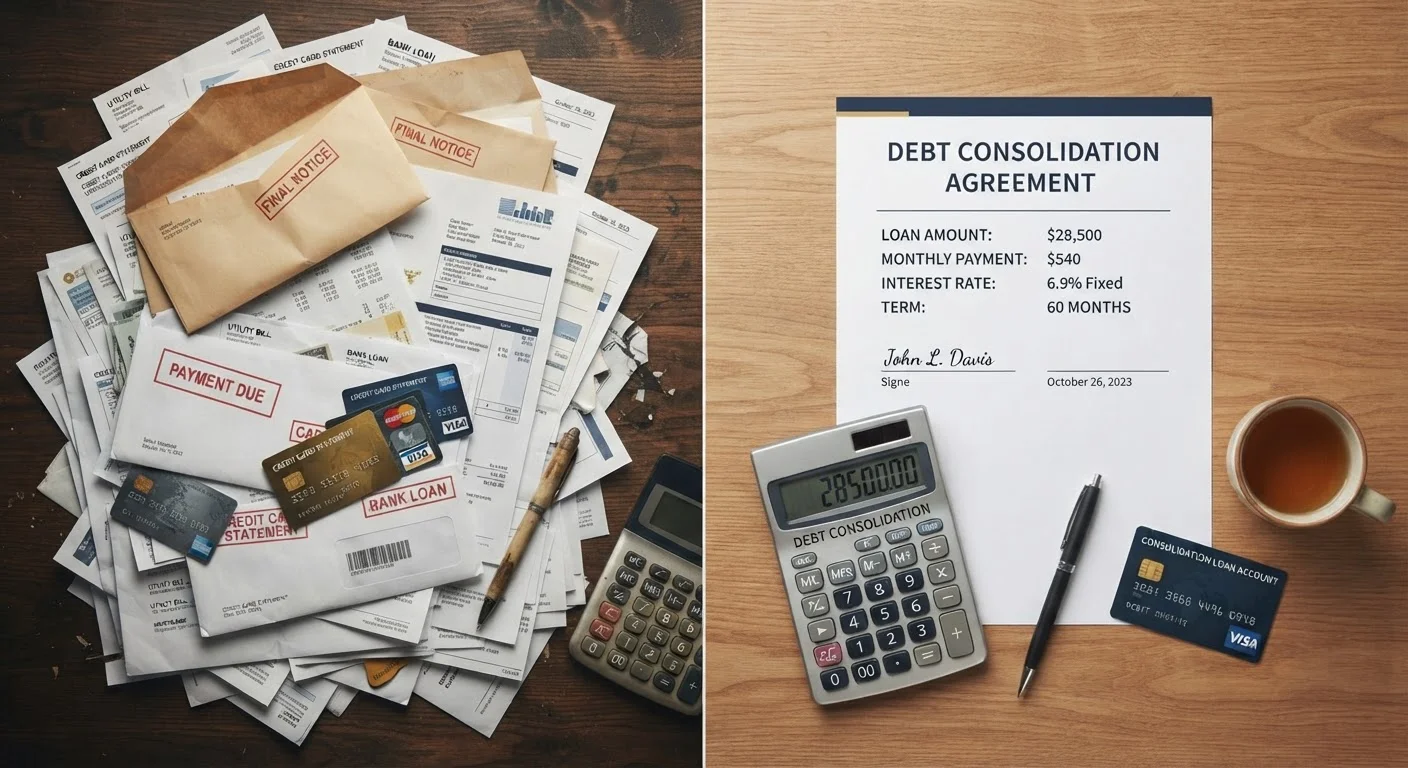
Debt consolidation is the process of combining multiple debts — often credit card balances, medical bills, or personal loans — into a single new loan or credit product. The goal is typically to secure a lower interest rate, reduce the number of monthly payments, or both.
The two most common methods are a personal consolidation loan (where a lender pays off your existing balances and you repay the new loan over a set term) and a balance transfer credit card (which moves existing card balances to a card with a low or zero introductory APR). Home equity loans and debt management plans through nonprofit credit counseling agencies are additional routes some people take.
If you're unfamiliar with terms like APR, principal, or debt-to-income ratio, our plain-language debt glossary is a useful starting point before evaluating any offer.
It's worth noting upfront: consolidation is a restructuring tool, not a debt-elimination strategy. The total amount owed doesn't shrink — only the arrangement changes.
The Genuine Advantages
One monthly payment instead of many
Consolidating multiple balances eliminates the complexity of tracking several due dates, minimum payments, and creditors — reducing the cognitive load and risk of accidental missed payments.
Potentially lower overall interest rate
Borrowers with good credit may qualify for a personal loan rate well below their average credit card APR, which typically runs significantly higher. Less interest means more of each payment reduces the actual principal.
Predictable, fixed repayment schedule
Unlike revolving credit card debt, most consolidation loans have a set term and fixed payment, giving borrowers a clear end date and consistent monthly obligation to plan around.
May improve credit utilization ratio
Paying off revolving card balances with a consolidation loan can lower your credit utilization — the share of available revolving credit you're using — which is a meaningful factor in most credit scoring models.
Can reduce financial stress
Simplifying debt management and having a structured plan in place can lower financial anxiety, which research consistently links to broader decision-making and wellbeing outcomes.
When the conditions are right, consolidation offers real benefits worth considering:
- Simplified repayment: Managing one due date instead of five or six reduces the chance of missed payments and the late fees that follow.
- Potential interest savings: If you qualify for a meaningfully lower rate than your current blended average, less of each payment goes toward interest and more reduces your actual balance.
- Fixed payoff timeline: Many personal consolidation loans have fixed terms, which means you can see exactly when you'll be debt-free — a motivating factor for many borrowers.
These benefits are real, but each depends on your specific rate, term, fees, and follow-through. A consolidation loan at only a marginally lower rate stretched over a much longer term may cost more in total interest than staying the course on your current debts. Compare structured repayment strategies like the avalanche and snowball methods as alternatives before committing.
The Risks and Trade-Offs
Does not reduce the total amount owed
Consolidation is a restructuring, not a reduction. The underlying debt remains; only the form and terms change. Borrowers who expect the balance to shrink are often disappointed.
Longer terms can increase total interest paid
A lower monthly payment achieved by extending the loan term by several years can result in paying more total interest than the original debts would have cost — even at a lower rate.
Upfront fees may erode savings
Personal loan origination fees and balance transfer fees can add hundreds or thousands of dollars to the effective cost, particularly if the repayment period is short.
Qualifying requires adequate credit standing
Borrowers with poor or fair credit may only qualify for consolidation loans with high rates that offer no meaningful improvement over current debts, or may not qualify at all.
Risk of accumulating new debt
Once credit cards are paid off through consolidation, the accounts remain open. Without a deliberate change in spending behavior, new balances can accumulate, leaving the borrower managing both the consolidation loan and fresh card debt.
Secured options put assets at risk
Consolidating via a home equity loan converts unsecured consumer debt into debt backed by your home. Missing payments could risk foreclosure — a far more serious consequence than defaulting on a credit card.
Financial professionals consistently raise several cautions that borrowers should weigh carefully:
Nonprofit Credit Counseling: A Free Starting Point
Before applying for a consolidation loan, consider speaking with a nonprofit credit counseling agency. Counselors accredited through organizations like the National Foundation for Credit Counseling (NFCC) can review your full debt picture, explain a Debt Management Plan (DMP) as an alternative, and help you compare options without trying to sell you a product. This guidance is typically free or low-cost and can be especially valuable if your credit score limits your loan options.
One risk that often goes unacknowledged: after consolidating, some people feel a false sense of relief and begin using freed-up credit again — running balances back up on the cards they just paid off. This is sometimes called the debt reloading pattern, and it can leave someone worse off than before. Our piece on how everyday borrowing habits keep people stuck explores this dynamic in more depth.
Questions to Answer Before You Apply
Before approaching any lender, work through these practical questions:
- What is your current blended interest rate? Add up the total interest you pay monthly across all debts, then compare it against what a consolidation loan would cost. The math needs to work in your favor.
- What fees apply? Origination fees on personal loans (often 1–8% of the loan amount) and balance transfer fees (typically 3–5%) can offset rate savings, especially on shorter payoff timelines.
- How will the new term affect total cost? A lower monthly payment can feel like a win, but if it extends repayment by several years, you may pay significantly more in total.
- Is your credit strong enough to qualify for a competitive rate? Lenders use your credit score and debt-to-income ratio to set your rate — a fair or poor credit profile may mean the offered rate isn't actually better than what you're already paying.
If a personal loan is part of your consideration, our checklist for informed borrowing walks through the key questions before signing.
This article is for general informational and educational purposes only and does not constitute personalized financial, tax, or legal advice. Consult a qualified financial professional for guidance specific to your circumstances.