

Key Takeaways
Our Verdict
Neither mindset is a permanent personality trait — they are patterns of thinking that can shift with awareness and practice. A growth mindset consistently leads to more adaptive, resilient financial behavior, especially when facing setbacks, debt, or the need to learn new money skills. Identifying where a fixed mindset shows up in your own financial life is the most actionable place to start.
| Best for | Recommended |
|---|---|
| Those who have experienced debt or financial setbacks | Growth Mindset approach |
| Those new to budgeting or investing who feel overwhelmed | Growth Mindset approach |
| Those wanting to understand why past financial habits have been hard to break | Fixed Mindset self-assessment |
What the Fixed vs. Growth Mindset Framework Actually Means
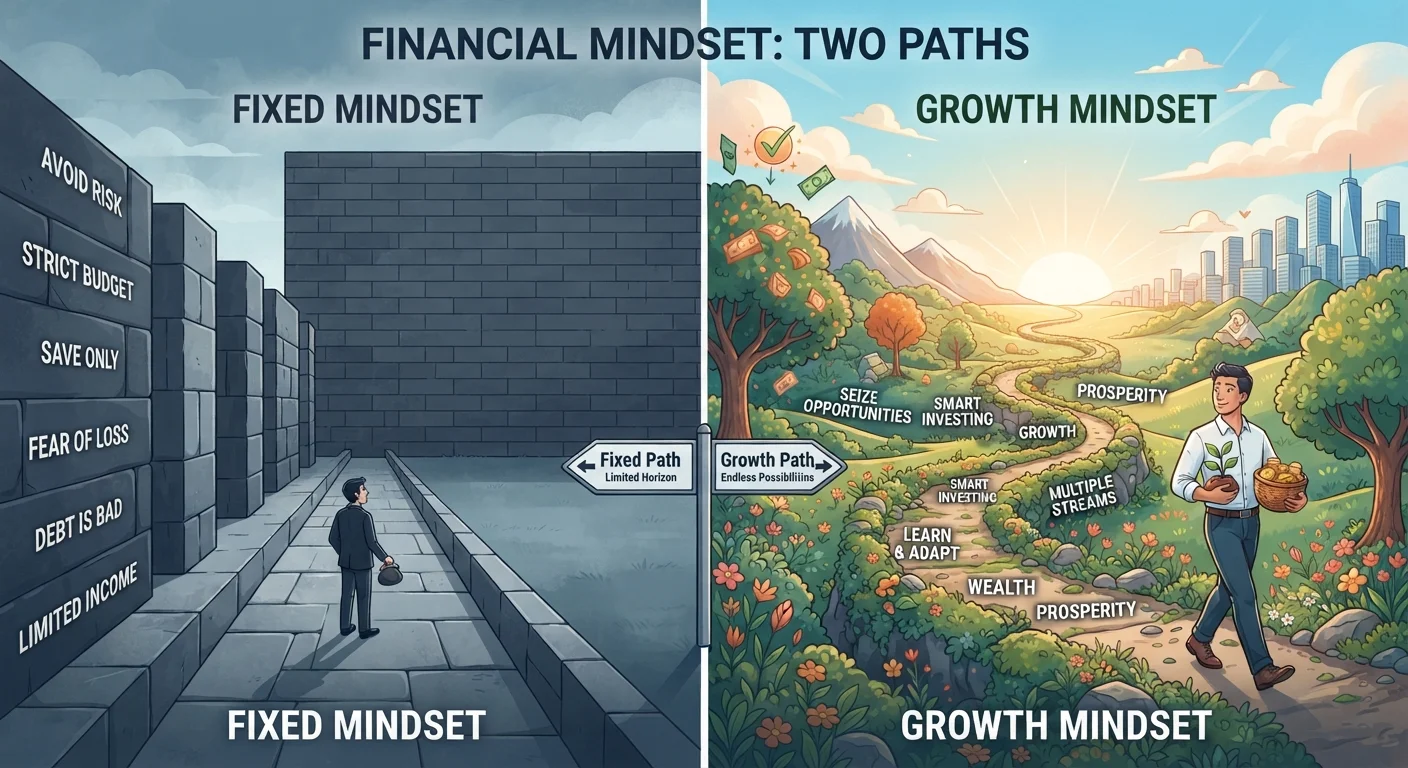
Psychologist Carol Dweck's research on mindset — developed primarily in educational contexts — draws a distinction between two core belief systems. A fixed mindset holds that abilities are essentially static: you either have a talent for something or you don't. A growth mindset holds that abilities develop through effort, learning, and persistence.
When applied to personal finance, the same divide appears clearly. Someone operating from a fixed money mindset may believe they are simply "not a math person," that wealth is reserved for people born into the right circumstances, or that their past financial failures are proof of permanent limitation. Someone with a growth money mindset tends to view the same setbacks as information — something to learn from and adjust to.
This matters because your money mindset shapes every financial choice you make, often without conscious awareness. Understanding the framework is the starting point for recognising which patterns might be driving your own decisions.
How Each Mindset Shows Up in Everyday Financial Decisions
The differences between these two mindsets aren't abstract — they show up in concrete, everyday behaviors.
| Fixed Mindset | Growth Mindset | |
|---|---|---|
| View of financial ability | Innate and largely unchangeable | Learnable through effort and practice |
| Response to debt or setbacks | Avoidance, shame, or resignation | Problem-solving, adjustment, and re-engagement |
| Approach to financial education | "I'm not a numbers person" — disengages | Seeks out new knowledge and skills actively |
| Risk and uncertainty | Avoids unfamiliar financial territory | Accepts manageable uncertainty as part of learning |
| Feedback and mistakes | Seen as evidence of inherent limitation | Seen as useful data to improve future decisions |
| Long-term financial resilience | Lower — rigid patterns hard to break | Higher — adapts as circumstances change |
Consider how each mindset responds to carrying credit card debt. A fixed mindset may produce avoidance: not opening statements, feeling deep shame, concluding that being in debt confirms something unchangeable about themselves. A growth mindset tends to produce a different response: acknowledging the situation, learning how interest compounds, and building a repayment plan — even an imperfect one.
The same pattern emerges around financial learning. People with a fixed money mindset often disengage from budgeting apps, financial literacy resources, or money conversations because engaging would risk confirming their belief that they "just aren't good at this." People with a growth mindset are more likely to treat confusion as a starting point rather than evidence of failure. This connects directly to how financial identity shapes behavior — seeing yourself as someone capable of learning money skills is itself a meaningful shift.
The Psychology Behind Why Mindsets Become Entrenched
Fixed money mindsets rarely appear out of nowhere. They typically form from repeated experiences: growing up in a household where money was a source of stress, shame, or secrecy; receiving messages that certain kinds of financial success weren't "for people like us"; or experiencing a significant financial failure — a job loss, bankruptcy, or debt spiral — without the tools or support to process it constructively.
These experiences create belief patterns that feel like facts. The danger is that they then become self-fulfilling: someone who believes budgeting is beyond them never attempts it seriously, which means they never build the skill, which confirms the original belief.
Reframe the Language You Use About Money
Notice when you catch yourself saying things like "I'll never be good at saving" or "money is just not my thing." These phrases reinforce a fixed mindset. Try replacing them with "I haven't learned this yet" or "I'm working on understanding this." Small language shifts can gradually change the underlying belief pattern.
It's also worth noting that mindsets are rarely all-or-nothing. Most people hold a growth mindset in some areas of their financial life and a fixed mindset in others. You might readily learn new workplace skills but feel completely stuck around investing. Recognising where the fixed patterns cluster is more useful than labelling yourself broadly. For a deeper look at your own patterns, a personal finance mindset audit can help surface assumptions you may not realise you're holding.
Practical Ways to Cultivate a Growth Mindset Around Money
Shifting mindset is not about positive thinking alone — it requires behavioral change that gradually builds new evidence about what you're capable of.
- Start with small, measurable wins. Set one concrete money goal that takes two to four weeks to achieve. Completing it creates genuine evidence — not just affirmation — that you can manage a financial task successfully.
- Separate identity from outcomes. A missed savings goal or an unexpected expense is an event, not a verdict on your worth or capability. Treating setbacks as data rather than judgments is a learnable habit.
- Build a foundation incrementally. Building a healthier relationship with money doesn't happen all at once — it comes from consistent small actions that compound over time, much like interest.
- Notice comparison traps. Fixed mindset thinking is often triggered by comparing your financial situation to others'. Redirecting focus to your own trajectory — where you were versus where you are — is more useful and more accurate.
Mindset Alone Won't Fix Structural Problems
A growth mindset is a valuable psychological tool, but it does not replace access to income, credit, or financial safety nets. Framing financial hardship purely as a mindset problem can unfairly shift responsibility away from real systemic barriers. Mindset work is most powerful alongside practical financial strategies and, where needed, professional guidance.
If you're also working through broader questions about how your thinking shapes your financial behavior, exploring the contrast between scarcity and abundance thinking adds another useful layer to the conversation.
This article is for general informational and educational purposes only and does not constitute personalised financial, psychological, or professional advice. For guidance tailored to your specific situation, consider speaking with a qualified financial adviser or a licensed mental health professional.