

Key Takeaways
Our Verdict
Each therapy format has genuine strengths. Individual sessions suit those needing deep, personalized focus; group therapy offers community and shared insight at lower cost; online formats remove access barriers for many adults. The most effective therapy is often the one a person can consistently attend and genuinely engage with.
| Best for | Recommended |
|---|---|
| Those seeking personalized, private exploration of specific issues | Individual therapy |
| Those who benefit from peer connection, shared experience, or lower cost | Group therapy |
| Those with scheduling constraints, geographic limitations, or mobility concerns | Online therapy |
| Those managing complex or co-occurring conditions requiring intensive support | Individual therapy with a licensed specialist |
How the Three Formats Are Structured
Therapy is not one-size-fits-all. The three most common formats — individual, group, and online — differ significantly in how sessions are organized, who is in the room, and what kinds of support they provide.
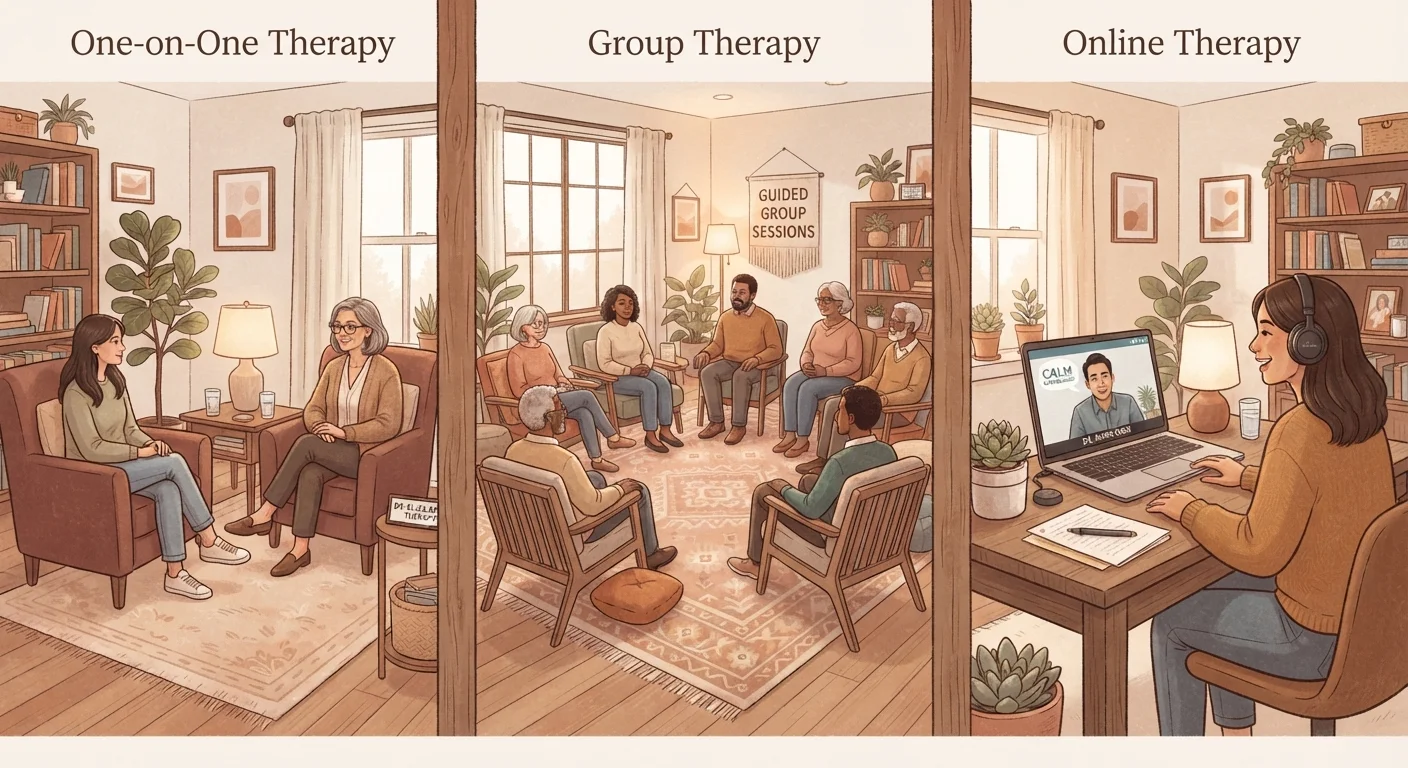
Individual therapy involves one client and one licensed therapist meeting in a private setting, typically for 45 to 60 minutes per session. The entire session is focused on a single person's concerns, allowing for deep exploration of personal history, thought patterns, and goals.
Group therapy brings together a small number of participants — commonly six to twelve — led by one or two therapists. Sessions are structured around shared themes such as anxiety, grief, or life transitions. Members share experiences and offer mutual support under professional guidance.
Online therapy mirrors either of the above formats but is delivered via video call, phone, or messaging platforms. The therapeutic relationship and techniques remain largely the same; what changes is the medium of delivery.
| Individual Therapy | Group Therapy | Online Therapy | |
|---|---|---|---|
| Session structure | One client, one therapist | 6–12 clients, 1–2 therapists | One-on-one or group via digital platform |
| Typical cost (per session) | $100–$250 out-of-pocket | $30–$80 per session | Varies; subscription or per-session |
| Personalization | Highest — fully tailored | Moderate — shared focus | Comparable to in-person format |
| Social connection | Limited to therapist | Strong peer interaction | Depends on format used |
| Accessibility | Requires local provider | Requires local provider | High — no travel needed |
| Insurance coverage | Commonly covered | Often covered | Increasingly covered |
| Best suited for | Complex or sensitive concerns | Shared-experience conditions | Scheduling or geographic barriers |
Cost, Access, and Practical Considerations
Cost is one of the most practical factors when choosing a therapy format. Individual sessions tend to be the most expensive, with out-of-pocket rates in the US commonly ranging from $100 to $250 per session, though costs vary widely by location and provider. Many insurance plans cover individual therapy with a co-pay.
Group therapy is generally more affordable — sessions often cost $30 to $80 each — because the therapist's time is shared among participants. This makes it a viable option for people working within tighter budgets. If you're navigating variable income, frameworks like those discussed in budgeting for irregular income can help you plan for consistent therapy costs.
Online therapy platforms have expanded access dramatically. Many offer subscription models or sliding-scale fees. For adults in rural areas, those with physical disabilities, or those managing demanding schedules, remote access can make the difference between receiving care and going without it.
Ask About Sliding-Scale Fees
Many licensed therapists and group practices offer sliding-scale pricing based on income. Community mental health centers, university training clinics, and nonprofit organizations are also worth exploring if standard session rates are a barrier. Don't assume cost rules out professional support — it's worth asking directly.
What Each Format Does — and Doesn't — Do Well
Understanding the strengths and limitations of each format helps set realistic expectations.
Individual therapy allows the therapist to tailor every intervention to one person. It is well-suited for processing trauma, managing complex mental health conditions, or working through concerns a person may not feel ready to share in a group. The confidential, one-on-one relationship also allows trust to build deeply over time.
However, individual therapy offers limited opportunity to practice interpersonal skills in real time. Some people also find that the absence of peers who share similar struggles can feel isolating during the process.
Group therapy directly addresses social connection. Research published in peer-reviewed psychiatric literature consistently supports its effectiveness for conditions including depression, substance use, and trauma, particularly because participants learn that others share their experiences. Group settings also provide a natural environment to practice communication and boundary-setting skills.
Group therapy may be less appropriate when a person needs focused attention on a highly specific or sensitive issue, or when they are not yet ready to share in a group setting.
Online therapy performs comparably to in-person therapy for many common concerns, including mild to moderate anxiety and depression, according to multiple systematic reviews. It is not always recommended as a substitute for in-person care in crisis situations, for certain severe conditions, or for therapies that rely on physical presence.
Choosing the Right Format for Your Situation
There is no objective hierarchy among the three formats. The right choice depends on your current needs, practical constraints, and personal comfort.
Consider starting with individual therapy if you are new to therapy, are managing a complex or sensitive concern, or prefer a private environment to build trust before engaging with others. Consider group therapy if peer connection and shared experience feel important to your healing, or if cost is a significant factor. Consider online therapy if logistical barriers have previously prevented you from accessing care.
It is also common to use more than one format simultaneously — for example, attending both individual and group sessions. A licensed therapist can help you assess which structure, or combination, aligns best with your therapeutic goals.
This article is for general informational and educational purposes only and does not constitute medical or mental health advice. If you are experiencing a mental health crisis or need support, please contact a qualified healthcare professional or a crisis helpline in your area.