

Key Takeaways
Car Loan Amortisation
Amortisation is the process of paying off a loan through fixed monthly payments over a set period. Each payment covers both interest and a portion of the original amount borrowed (called the principal). In the early months of a car loan, most of each payment goes toward interest; over time, a greater share reduces the principal.
Most US auto loans use a simple interest amortisation model, where daily interest accrues on the outstanding balance — meaning early payoff genuinely reduces total interest paid.
The Anatomy of a Car Loan Payment
Every monthly car loan payment is split into two parts: interest and principal. Interest is the lender's fee for advancing you the money. Principal is the actual loan balance you borrowed. Understanding how these two elements interact over time is the key to evaluating any loan offer clearly.
In the early months, the split is heavily skewed toward interest. On a $25,000 loan at 7% APR over 60 months, your first payment might direct roughly $146 to interest and only $349 toward reducing what you owe. By month 50, that same fixed payment might put just $19 toward interest and $476 toward principal. The total payment doesn't change — but what it accomplishes does.
This structure is called amortisation, and it's standard across virtually all US consumer auto loans. The lender front-loads interest because your outstanding balance — and therefore their exposure — is greatest at the start.
~$1,700+
Extra interest on 72-month vs 48-month loan
Illustrative calculation on a $25,000 loan at 6% APR, comparing a 48-month and 72-month repayment term.
1 extra payment/year
Bi-weekly payment equivalent
Paying half your monthly amount every two weeks produces 13 full payments annually instead of 12, reducing interest over the loan life.
~38%
New vehicle value lost in first 3 years
Industry estimates suggest many new vehicles lose roughly a third of their value within three years, compounding the risk of long loan terms.
How Interest Rate and Loan Term Interact
Two variables dominate the total cost of a car loan: the interest rate and the loan term. Borrowers often focus on the monthly payment, but that figure can be manipulated by stretching the loan term, which masks a much higher total outlay.
Consider two scenarios on a $25,000 loan:
- 48-month term at 6% APR: Monthly payment ≈ $587; total interest paid ≈ $1,176
- 72-month term at 6% APR: Monthly payment ≈ $415; total interest paid ≈ $2,880
The longer term saves $172 per month — but costs nearly $1,700 more in interest overall. Extend that further to 84 months and the total interest climbs higher still, while the vehicle itself depreciates continuously. For more on how that depreciation affects your financial position, see how vehicle depreciation works.
Compare Total Repayment, Not Just Monthly Payments
When evaluating any loan offer, ask the lender for the total amount repaid over the full term — principal plus all interest and fees. This single figure makes it straightforward to compare two offers regardless of their term lengths or rate structures. A lower monthly payment can easily hide a significantly higher overall cost.
APR vs. Interest Rate: What You're Actually Comparing
Lenders are required to disclose the Annual Percentage Rate (APR) on any loan offer. Unlike the nominal interest rate, APR incorporates fees and other financing charges, making it a more honest measure of total borrowing cost. Two loans with identical stated interest rates can carry meaningfully different APRs if one includes origination fees or other charges.
When comparing offers, always ask for the APR — not just the rate — and calculate the total amount repaid over the full term. For a plain-language breakdown of common loan terminology, this debt terms reference is a useful starting point.
It's also worth understanding that your credit score is a primary driver of the APR you're offered. A difference of even one percentage point in APR on a $25,000 loan can translate to hundreds of dollars over the life of the loan.
Loan Terms Are Often Negotiable
Many borrowers accept the first loan term presented by a dealership's finance office without exploring alternatives. Lenders — including credit unions and banks — may offer different APRs for the same loan amount. Shopping multiple lenders before visiting a dealership gives you a benchmark rate and negotiating leverage. Checking your own credit report for errors before applying can also improve the rate you're offered.
Strategies That Can Reduce What You Pay
Because most US auto loans use simple interest — meaning interest accrues daily on the remaining balance — paying extra directly reduces future interest charges. Practical approaches include:
- Making bi-weekly payments: Splitting your monthly payment in half and paying every two weeks results in 26 half-payments, equivalent to 13 full payments per year instead of 12.
- Applying lump sums to principal: Tax refunds or bonuses directed at the loan balance can accelerate paydown significantly.
- Refinancing if your credit improves: If your credit profile strengthens after origination, a lower APR through refinancing may reduce total interest — though always account for any fees involved.
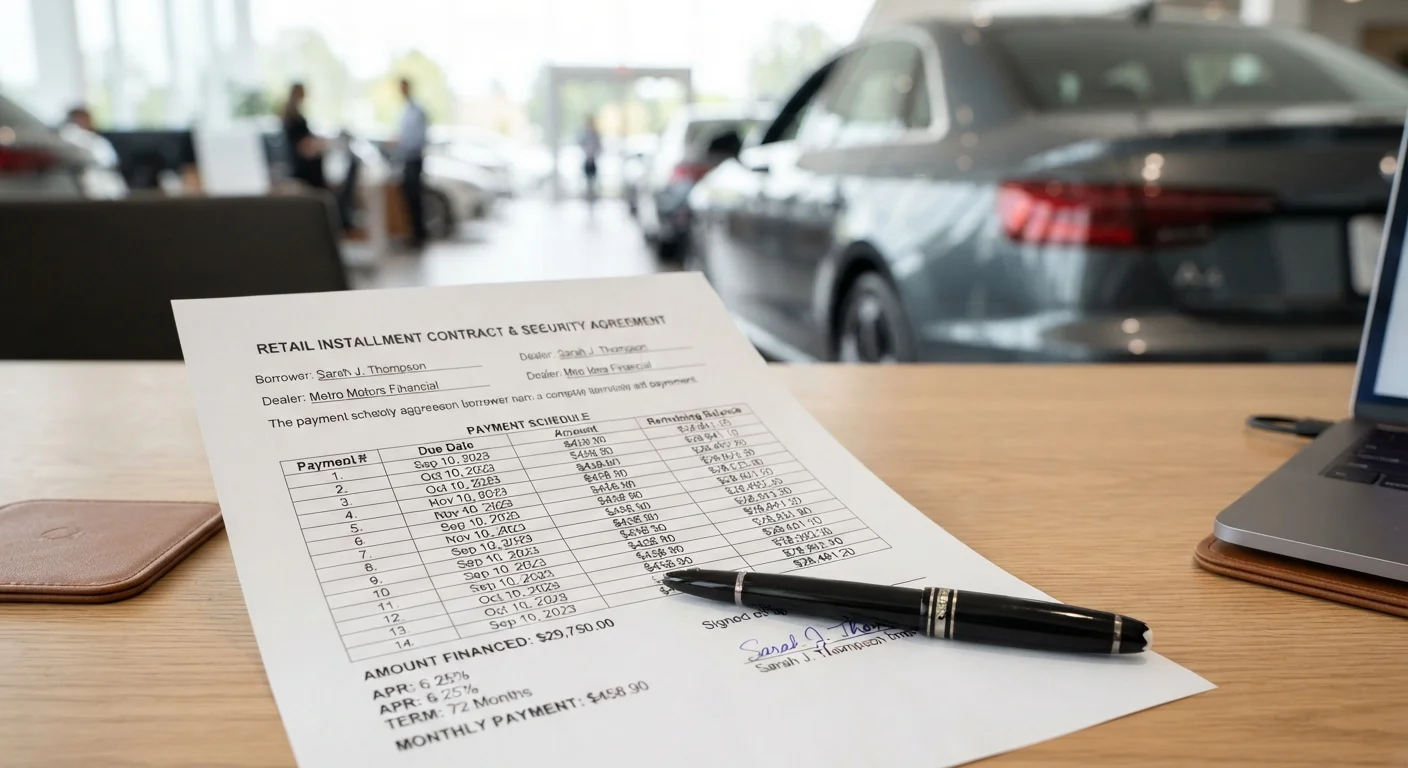
Before signing any loan, reviewing a full amortisation schedule — which most lenders will provide — shows you exactly how each payment is allocated across the full term. See key questions to ask before borrowing for a broader pre-loan checklist.
Auto loan interest is just one component of total car ownership cost. For the complete financial picture — including insurance, fuel, and maintenance — see the true cost of owning a car.
This article is for general informational purposes only and does not constitute financial or legal advice. Consult a qualified financial professional before making borrowing decisions.